Tuesday, November 30, 2021

November 2021 Best Books Round-Up

November stats: 41 books; and 26 of them were outstanding. I get fussier as I age so I will only read those books I think I will love. As a result, I read so many great books in November that I decided to break up my monthly round-up into three parts. The first part was yesterday, all audiobooks. Tomorrow will be all LGBTQ. And today is for the rest!

Everything Affects Everyone by Shawna Lemay

Be kind to yourself. Read this compassionate novel by multitalented Edmonton poet and photographer Shawna Lemay. Read it slowly. Within it, six women have conversations and contemplations about art, and about how best to live. Before the first page, its philosophical and experimental bent is revealed by the epigraphs, which are by the likes of Clarice Lispector, Hélène Cixous, and Rainer Maria Rilke. Later, Alan Watts is quoted on the distinction between belief and faith. I learned that the word angel comes from the word for messenger. I learned that angels eat Fruit Loops and whipped cream. I also learned it was impossible to rush through this book, because I kept stopping to savour the language and the ideas.

Everything will be okay. This is what I tell myself, and I think about what a good, sweet word is “okay.”

I want to know what characters are thinking and how they attempt to speak what‘s in their soul, honestly and simply. Or, alternatively, how they circle around things, how they attempt to conceal, or how they fail to express what they mean to convey.

The way we come to a conversation matters. The openness, the trust. Is every conversation a type of annunciation? Each person is an angel giving the other person, who is also an angel, a message. In that moment we are each responsible for the other. If one of the people in the conversation were to faint or to cry, for example, it would be up to the other person to act.

The angel bows to Mary and announces her fate. And some of what‘s happening in the image continues to speak to me. The deep bow of respect. The acknowledgment of beauty of another human being, the strength and endurance. The potential. Acknowledging the light in another being. Bowing to that light.

All of those artists painted angels, or found angels, and who‘s to say they didn‘t see or feel them? For me, it wasn‘t a question of belief in angels, but it was about a willingness to see what is there, and to witness the world with a deeper awareness. But also, to be open to the unseen world.

It is the questioning around the story that gives the story its dimension. But the story is there only as a kind of basic pretext.

There is an ongoingness that I wish to convey. The traditional narrative arc is wonderful, but it is not the only mode in which to talk about how things occur, how life rolls out, how life comes at us and is so boring and delightful at once, so unpredictable and so obvious, so weird and so lovely and hidden and open.

The air and the atmosphere are a miracle. We don‘t have to look around for examples of the miraculous; we need merely to breathe in and out, or move our hands through the air, the wind.

I like reading diaries better than novels, and better than watching movies. Diaries are life, you see. And life can be rather dull. Rather ordinary. If I have learned one thing, it is that the ordinary is more closely aligned with bliss and to splendour than to what might be deemed spectacular.

I know how to make myself appear completely ordinary so that I might observe others. What I observe is that not a single person on this earth is ordinary.

I was thinking about something so beautiful that I entered the silence of flowers.

The Years by Annie Ernaux
Translated by Alison L Strayer

I felt like I was swimming through time in company with French author Annie Ernaux, who intertwines personal and societal experiences in this memoir/cultural history spanning seven decades. The voice shifts between “she” for the author and “we” for the collective, managing to be both intimate and expansive. Not every detail (ie French politics) resonated, but I identified strongly with the changing landscape of women‘s lives and the rise of consumerism.

By their clothing, we could distinguish little girls from young girls, young girls from young ladies, young women from women, mothers from grandmothers, labourers from tradesmen and bureaucrats. Wealthy people said of shopgirls and typists who were too well dressed, “They wear their entire fortune on their backs.”

With the Walkman, for the first time music entered the body. We could live inside music, walled off from the world.

The USSR disappeared and became the Russian Federation with Boris Yeltsin as president. Leningrad was St Petersburg again, much more convenient for finding one‘s way around the novels of Dostoevsky.

Only teachers were allowed to ask questions. If we did not understand a word or explanation, the fault was ours.

But for the first time, we envisioned our lives as a march toward freedom, which changed a great many things. A feeling common to women was on its way out, that of natural inferiority.

Of all the information we received daily, the most interesting, the kind that mattered most, concerned the next day‘s weather. The rain-or-shine monitors in the RER stations displayed predictive, almanac-style knowledge that provided us with a daily reason to rejoice or lament, thanks to the surprising and yet invariable factor of weather, whose modification by human activity profoundly shocked us. 

Under the spell of media simplifications, people believed in the technological delicacy of bombs, “clean war,” “smart weapons,” and “surgical strikes”: “a civilized war,” wrote Libération.

Under Giscard d‘Etaing we would live in an “advanced liberal society.” Nothing was political or social anymore. It was simply modern or not. Everything had to do with modernity. People confused “liberal” with “free” and believed that a society so named would be the one to grant them the greatest possible number of rights and objects.

Television sets were turned in for newer models. The world looked more appealing on the colour display, interiors more enviable. Gone was the chilly distance of black-and-white, that severe, almost tragic negative of daily life.

The word “struggle” was discredited as a throwback to Marxism, become an object of ridicule. As for “defending rights,” the first that came to mind were those of the consumer.

Invisible North: The Search for Answers on a Troubled Reserve by Alexandra Shimo
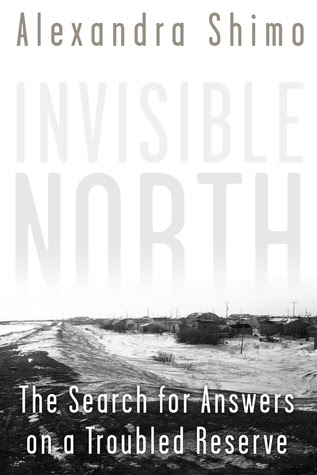
Lesbian journalist Alex Shimo had permission from the band chief to live on the reserve and document the story of unsafe water at Kashechewan in northern Ontario. But too much didn‘t make sense. Was it a hoax? Yet the shocking living conditions, the dire poverty—Shimo could see there was an important story to share with non-indigenous Canadians, but she struggled to maintain her mental equilibrium there. Words can hardly express how profoundly moved I was by this book.

This is where Canadian history differs from that of other developed countries, such as the United States and New Zealand, which also committed mass displacement of their Indigenous populations, but mostly stopped after the 19th century. As a result, Canadian First Nations have less land compared to those in other developed countries. For example, in the United States, Native Americans account for 2 percent of the population and reserves account for 2.3 percent of the total land. In New Zealand, Maoris account for 14.6 percent of the population and own 5.5 percent of the country. By contrast, Canadian Aboriginals make up 4.3 percent of Canada's total population, while reserves account for 0.2 percent of the nation. This, although Canada is an underpopulated, sprawling country near the size of a continent, with a land mass larger than the size of the United States and a population one-tenth the size.

Manikanetish by Naomi Fontaine
Translated by Luise von Flotow

Yammie left her Innu reserve, Uashat, on Quebec‘s North Shore, when she was a child. She returns 15 years later as a high school teacher. This quiet yet powerful novel documents a year of her experiences, connecting with her troubled but remarkable students, who face nearly insurmountable challenges. Meanwhile, she sorts out her own feelings of belonging to the place. This book pairs well with Shimo's Invisible North, because of the teenagers and the school situation in both.

An old, very wrinkled woman wearing the traditional Innu red-and-black felt bonnet. Not bothering to look directly at the camera. I was told later on that the missionaries were the ones who made Innu women wear the bonnets and keep their hair in braids rolled up on the sides of their heads and pinned at their temples. Because, with their long hair caressing their backs au naturel, they were beautiful. Attractive. Savage. Too beautiful for men of God and their oath of celibacy. They made them ugly.

Journal of a Travelling Girl by Nadine Neema

This remarkable chapter book for children (Grades 4-6) honours the traditional ways and stories of the Tłįcho people as well as a landmark historical moment in Canada: the signing of the Tłįcho land and self-government agreement in 2005. The action—external and internal—takes place through the eyes of 11-yr-old Julia while on an important canoe trip. Simple line drawings by Archie Beaverho accompany and enrich the text.

At the start of one of the portages, we saw a bird‘s nest that was so perfect it looked like a precious piece of art that someone had made for Easter. Inside, there were eight or nine eggs. It was just sitting there by itself in the long swampy grass. Grandma told us they were duck eggs. I couldn‘t believe that was made by a duck.

The Night Walk by Marie Dorleans
Translated by Polly Lawson

Many families turned to the solace of time spent in nature during the pandemic. Whether or not this activity was actually possible for readers of this endearing picture book, its portrayal of a quiet nighttime adventure is very inviting. There‘s also a natural propulsion: an unknown but important destination. A perfect laptime book: enjoy it slowly, studying the detailed pencil illustrations and seeking out the various nocturnal creatures. The art is understated, yet magical. Which is a feat, considering that the whole of the action takes place in the dark, and the story remains realistic, not drawing on any fantasy elements.


We threaded through the whispering forest. The earth was damp, the bark smelled comforting. Dead branches snapped under our feet, and ferns swayed quietly as we passed.

Mel Fell by Corey R Tabor


One of the many great things about this children‘s picture book about an intrepid young kingfisher is the orientation: the pages are designed to be viewed vertically instead of horizontally, and at one point in the story, the reader is instructed to flip it around with the opposite end up. Great manipulation! And it's also an inspiring story about bravery and community spirit. The appealing art, created with pencil and acrylic, is bright yet simple. 

Love from A to Z by SK Ali

I was not thrilled that my YA bookclub chose this title, since I am not a fan of romance. I‘d read Toronto author SK Ali‘s Saints and Misfits previously and it was okay, but I have little patience these days for books that I am not passionate about. I confess that I was pre-hating this book. I decided to just read enough of it to be able to join in the discussion. Then, I got sucked into the story. Wow, was I ever wrong about this book!

Believable characters. That's why I loved this YA romance even though I normally despise romance. Zayneb takes action in the face of bullshit and injustice. Adam is quiet and considerate. Islamic faith is satisfyingly woven into the narrative in an ownvoices way. I wept at a stranger‘s kindness, then at the description of MS symptoms, but didn‘t feel like the author was toying with my emotions. I guess “believable” is the key word here. I cared.

Everyone has a different definition of what “doing your best” means. For Mom and Dad, it means not rocking any boats.
For me it means fixing things that are wrong.

The Look of the Book: Jackets, Covers and Art at the Edges of Literature by Peter Mendelsund and David J Alworth

I have always been interested in book covers—I use them to judge contents like most readers do—but after reading this, I‘m hyperaware. Graphic designer Peter Mendelsund and scholar David Alworth collaborated on this heavily-illustrated investigation into the cover art on literary fiction. The way cover design first grabs our attention; how it frames and even shapes our reading experience; and the tricks or techniques used to translate verbal art into visual form. Love!

Like a bag of potato chips or a television commercial, book covers have an obvious mandate, which is to sell a commodity, except in the case of literature the commodity is also art.

Announcing the text and creating a conduit between imaginary and real space are two key tasks of the book cover. They are what the book cover does, first and foremost, but they are not all that it does. The cover‘s job is not over when you begin reading the pages. A good book cover has that time-release quality: it changes with you as you read.

If a book contains a map, it is likely either military history or fantasy—or Faulkner, which is both. Certain paratextual details, in other words, are indicators of genre: they tell you what kind of book you hold in your hands.

“A great book cover is, for me, like a great Spanish edition. The designer takes the manuscript and deftly translates it into a language I understand but am unable to speak with any clarity. ‘How on earth did you do that?‘ I think when I‘m given the finished product. To take 70,000 words and turn them into a single image. How is that not a miracle?”
—David Sedaris

Author Teju Cole insists that we push back against the “epidemic of relatability” that has besieged book culture. “It‘s like everybody wants to be ‘fun,‘ but not all books are ‘fun.‘”


Monday, November 29, 2021

Best Audiobooks in November

These are the audiobooks that I enjoyed most during the month of November 2021, while quilting, baking, walking, and doing household chores:

The Day the World Stops Shopping: How Ending Consumerism Saves the Environment and Ourselves by J B MacKinnon
Audiobook [12 hr] read by Kaleo Griffith

Consumption is the greatest driver of environmental problems. Framed as a thought experiment, journalist and environmental activist James MacKinnon writes about powerful external forces urging us to consume and how we rely on a consumer-driven economy, which is destroying our world. I appreciate the optimism in this book, which looks at what a difference can be made by only a small shift in habits, as demonstrated at the start of Covid lockdowns. This book was a finalist for the GG award for nonfiction.

We have to stop shopping. We can‘t stop shopping.

Unreconciled: Family, Truth and Indigenous Resistance by Jesse Wente
Audiobook [7 hr] read by the author

CBC arts columnist Jesse Wente is of mixed Anishinaabe and white heritage. In this memoir he shows what anti-Indigenous racism in Canada feels like. From war-whoop taunting when he was a kid, to racial profiling by police, to anonymous death threats when he has spoken up about Indigenous issues on air. I remember Hal Niedzviecki's Appropriation Prize editorial in the May 2017 issue of Write magazine, an issue that showcased Indigenous authors. Wente was a weekly columnist for the CBC at that time and he recounts the heated conversations and strong emotions that were a fallout from that piece. He also writes poignantly about how his grandmother‘s experience at residential school has shaped the lives of her descendants. 

Storytelling is one of the key methods used by colonizers to explain and obscure their lawless treatment of the lands and peoples over which they claim dominion. But storytelling is also one of our best weapons in the fight to reclaim our rightful place.

I‘ve met people whose view of the world was so shaped by [Hollywood] misinformation that they believed all Indians were dead, that we‘d gone extinct. I‘ve met others who refused to believe I was Indigenous because I didn‘t have long hair.

Tokenism is a byproduct of dehumanization. It‘s hard to tokenize someone you see as fully human, someone whose ideas and work you respect.
In my experience, no matter how well disguised the tokenization, that realization always comes eventually, and it‘s never been fun when it arrives. At Toronto International Film Festival it took years, and it ultimately ruined the job of my dreams.

The Na‘vis‘ only chance at defending themselves and their way of life comes in the form of a white man who uses technology to remotely operate a lab-grown Na‘vi body. He is literally wearing Indigeneity as a costume. This revolting form of “going native” climaxes in the usual way, with the white saviour out-Na‘vi-ing the Na‘vi. He taps into their ancient spirituality in a way none of the Na‘vi seemingly can and uses the planet‘s energy to save the day. [regarding James Cameron's film Avatar]

Unsettling Canada: A National Wake-Up Call by Arthur Manuel and Chief Ronald Errickson
Audiobook [10 hr] read by Darrell Dennis

Arthur Manuel, son of influential Indigenous political leader George Manuel, combines memoir with an excellent overview of continuing Indigenous political and economic struggles over land rights. Sometimes while listening to this audiobook I would feel so frustrated about the way successive Canadian governments continue to ignore treaty agreements, Supreme Court judgements and our own constitution that I would either pace the floor or have to take a break entirely. Audiobook narrator Darrell Dennis is Secwepemc, as is author Arthur Manuel; I appreciate hearing the correct pronunciation of the many different Indigenous nations in British Columbia. 

Another thing I appreciate is the multifaceted knowledge I am acquiring by seeking out works by Indigenous authors. In Unsettling Canada, for example, Manuel has a completely different reaction to the film Avatar than film critic Jesse Wente (see previous entry); Manuel's experience with BC treaty negotiations is very different from Darrel McLeod's (in Peyakow); and Manuel's approach to self-government is different from Jody Wilson Raybauld's (see Indian in the Cabinet). 

The first obstacle in defining our new one-to-one relationship with Canada will be the very heavy debt from the seizure and economic exploitation of our lands for 150 years since Confederation. This debt is enormous. I suspect that one of the main reasons that the Canadian government refuses to acknowledge our Section 35 rights is that it would leave it open to paying a percentage of the astronomical wealth that has been taken out of our lands.

[On the 10 years spent drafting the UN Declaration on the Rights of Indigenous Peoples]: Even referring to us as Indigenous "peoples” was a battle with the [United Nations member] states‘ representatives, who wanted us referred to as Indigenous "populations." That term would have kept us outside of the UN‘s basic rights covenants, which offers protections to all of the world‘s “peoples.”

There is no downside to justice.

A Most Remarkable Creature: The Hidden Life and Epic Journey of the World's Smartest Birds of Prey by Jonathan Meiburg
Audiobook [10 hr] read by the author

Before listening to this audiobook, I knew nothing about caracaras, which are falcons found mostly in South America. They are remarkable creatures, as the title claims: highly intelligent, sociable and inquisitive. The author does a deep dive into everything about them and the entire book is riveting. A must for natural science nerds.

Peregrines have the fastest visual processing speed measured in any animal and their eyes are so sharp that they could read the headline of a newspaper from a mile away. A human with eyes in the same proportion to its skull as a peregrine would have eyes that measure three inches across and weigh four pounds each.

The trouble with the past is that it keeps changing. The [dinosaur extinction] asteroid‘s effects on the history of life were so sudden and pervasive that it‘s easy to forget we didn‘t even know about it until very recently.

Social wasps share a skill that exceeds the ability of nearly every mammal on earth: they‘re master builders. Most social wasps fashion their homes from a papier-mâché of chewed-up wood fibres mixed with their own saliva, and each species builds in their own style.

Immune: A Journey Into the Mysterious System that Keeps You Alive by Philipp Dettmer
Audiobook [10 hr] read by Steve Taylor

The human immune system is amazing and indispensable. It is also incredibly complex, so I was happy to have its multiple layers explained with humour and many analogies in this entertaining science book. The audiobook has frequent information summaries and is read by Steve Taylor, who also voices the Kurzgesagt science channel on YouTube. After listening, I went out and bought a print copy from Audreys bookstore so that I can refer back to this book in the future. The print copy has lavish colourful illustrations.

To most living things, you are not a person, but a landscape covered with forests, swamps and oceans, filled with rich resources and plenty of space to start a family and settle down.

The Apollo Murders by Chris Hadfield
Audiobook [15 hr] read by Ray Porter

Unlike the way I kept stopping to wonder about the science in Andy Weir‘s The Martian, I trusted all the space technology stuff in Hadfield‘s writing and just immersed myself in the setting, enjoying the psychological thrill of a suspenseful mystery set during the Cold War between the USA and the Soviets. I especially loved the woman cosmonaut and all the character dynamics. I was incidentally reminded of the cool facts in Mary Roach‘s Packing for Mars. 

Despite the tv ads, astronauts haven‘t drunk Tang in space since Gemini in the 1960s. One of the early astronauts had vomited Tang during space motion sickness and reported that it tasted even worse coming back up.

The Chosen and the Beautiful by Nghi Vo
Audiobook [9 hr] read by Natalie Naudus

Demonic deals, small acts of magic, queer characters and a Vietnamese Jordan Baker as story narrator (stolen from her homeland when she was a baby) are exactly the ingredients I didn‘t know I wanted in this delicious reinvention of The Great Gatsby. Nghi Vo obviously loves the original classic, paying homage while adding her own imaginative spin. Jazz age excess with social justice undercurrents.

—And her man? Is he behaving himself?
—Of course not, Aunt Justine. But you know the type: a new girl every time he looks about & finds his arm free.
—Well, that‘s a shame for Daisy then. She ought to keep him in better line.
I thought sometimes that my aunt forgot about how big men were, how much space & air they could take up.
[transcribed from the audio edition]

So Many Beginnings: A Little Women Remix by Bethany C Morrow
Audiobook [8 hr] read by Adenrele Ojo

Like the previous audiobook, this is a retelling of classic literature. I loved Alcott's Little Women when I was in Grade 5, but it‘s not the kind of book I enjoy now (because too much fussing about physical appearance and boyfriends). This remix, on the other hand, is a treat. The setting, a Civil War-era freedpeople colony in North Carolina, is as vivid as the formerly-enslaved characters. Also, it has subtle queer content. Nods to the original are nicely folded in, while portraying a little-known side of American history.

Jo spoke gently now, so that [Amy] wasn‘t confused into thinking she‘d done anything wrong. “No one was ever a Master, dearheart. They were only enslavers, and they aren‘t now, not anymore, and never again.” [transcribed from the audio edition]

Tuesday, November 23, 2021

Short Books: Sweet and Sharp

Short books, those "which pretend to little, but abound in much" as Herman Melville says, can pack a literary wallop. I made a video talking about some of my favourite little book gems and you can find it on Shawn the Book Maniac's booktube channel: Lindy Does the Short and Sweet Book Tag.

(link to the video is above)

Here's my short list of the short books:

The Summer Book by Tove Jansson, translated by Thomas Teal

The Little Girl Who Was Too Fond of Matches by Gaetan Soucy, translated by Sheila Fischman

The Driver’s Seat by Muriel Spark

The Frozen Thames by Helen Humphreys

Home by Toni Morrison

Bear by Marian Engel

We the Animals by Justin Torres

Girl Meets Boy by Ali Smith

Weight by Jeanette Winterson

God Loves Hair by Vivek Shraya


I also talked about:


The 2021 Short Story Advent Calendar, edited by Alberto Manguel (which you can find in Edmonton at either Audreys Books or Glass Bookshop, or from anywhere via this link:

https://www.hingstonandolsen.com/store/the-2021-short-story-advent-calendar

And Also Sharks by Jessica Westhead

Manikanetish by Naomi Fontaine, translated by Luise Von Flotow

Sunday, October 31, 2021

October 2021 Reading Roundup


Here are some highlights from my reading in October. If you want books by Indigenous authors, check out yesterday's Indigenous Books Bonanza.

The Barnabus Project by the Fan Brothers

Barnabus, a genetically engineered half mouse, half elephant, makes a dramatic escape from the failed experiments shelf, and saves a bunch of others too. All three of Toronto's Fan brothers (Eric, Terry and Devin) collaborated to create the digitally coloured graphite illustrations that reward lingering over details in this magical picture book. Best of all is the beautiful message of inclusivity. Winner of the GG (Juvenile Illustration) and the TD Canadian Children‘s Literature Award.

The Wind and the Trees by Todd Stewart


Framed as a conversation between two trees across the years, this Canadian picture book is a quiet masterpiece about the cycle of life. Todd Stewart‘s silkscreen art is simple and striking. The background colours shift with each page turn, capturing many moods. Birds and animals add drama, also changing with each page turn: a treasure hunt for young readers. The interconnectedness of all is a comfort for readers of any age.

A Dream of a Woman: Stories by Casey Plett

Quiet, acute and bittersweet. I highly recommend this Giller longlisted collection featuring trans women who are as real as real can be. They deal with ordinary adult concerns—jobs, longtime addictions, looking for love that will last—complicated by their unique experiences of being trans. One of the stories is a novella split into 5 chapters, interleaved with the other stories, a style decision which is somehow more effective than reading it of a piece.

Truth was, you could be trans and not pass, and this might suck, but it didn‘t make you any less trans or less of a woman. You could be trans if it made you a homo, be trans without taking hormones, be trans and keep your old friends if they weren‘t dicks, be trans and keep your dick, be trans if you wanted to be out about it, for God‘s sake. You know what being stealth does to your soul?

Her inner conception of her appearance is amorphous and difficult to describe, but if she had to try, she might say it is of something masculine without a face, a muscular crush of feathers travelling through a room.

Some people say it was Menno shit, or small-town shit, but Gemma knows better. None of it‘s special. There‘s a line in a book by Miriam Toews herself: “It‘s just something that happens sometimes, a story as old as time, and this time it happened to me.”

“That‘s the thing,” Robyn had said softly. “After a certain age, bio family is chosen family, too. You choose to keep it up—or you don‘t. Both kinds can be unhealthy. Both kinds can be good. And you‘re never obligated to do a thing to someone who isn‘t good to you. Ever.”

We were sold that what‘s written on the internet was forever, but the fact is, so much of it was impermanent daydreams and abysses, gone the second you forgot how to look it up or the owner deleted it or unfriended you, or it lived on a remote subdivision that the Wayback Machine just wasn‘t meant to capture.

Was David gonna transition? Who fucking knew? Not him. It was a scary thought. For years, he‘d spent nights on the internet, discovering how one went about this. And every night, he‘d gone to bed blocking out more fears than he‘d started with. The spectre of poverty and rejection and violence alone were enough to instill an understanding in his body: You only do this if you‘re 300 percent sure.

Glorious Frazzled Beings by Angelique Lalonde

How do I tell you about the cumulative impact of these fierce yet whimsical stories? They are about home and motherhood and sisterhood and womanhood… alongside teeny tiny ghosts, a fox shapeshifter, a supernatural gardener… The charming elements are mixed with profound statements like: “I am good at pretending I know how to be where I am on this land I own that does not belong to me.” I absolutely love this Giller-shortlisted book.

The little fly on my nightstand puked all over my journal. I was so upset I messaged its mother, but its mother was dead because she had already lived out her long 15 days on earth by the time I was able to track down her number.

She frazzled in the bowels of her grief for a good long while, coming out somewhat composted on the inside. No longer so lithe, no longer so young, Carmen had more layers to her. A soil test would have told her she‘d become a more balanced ecosystem, ground in which greater diversity could thrive.

We learn such confidence from books, feeling like if we just look in the right place, the thing that brought us happiness will be there again, waiting, every time we turn the page back to where it was the last time!

You understand motherly sacrifice and motherly overwhelm. Motherly exasperation and motherly joy. You understand the big fat food duty and pending outbursts of the improperly fed, the overly tired, the wired-up or disconnected, the greedy little wanting-everything-for-yourself hatefulness of family. The untidiness of calling all of this love.

Maybe I am like others like me—an accident or designed outcome of the generations that came before. Left here with garbled stories because each generation tries to efface or correct the stories of the last in our attempts to settle ourselves.

Finances make her want to hide in her little shell and do turtle things until all the talking is over.

So cold in the desert night, her inner fire just a bare ember, spirit body needing spirit fire to ignite, keep herself going through this world. Knowing water alone would just freeze, that‘s how cold her insides were. Dump a good dose of whisky in the first glass, hot wetness to drown out dry nerves.

If you asked she would tell you that she loves him like a sheep loves clover: wrapped into its tongue and pushed sideways, mashed into sweet liquid green and fibre in the crush of its grinding teeth.

em by Kim Thuy
Translation by Sheila Fischman

The forward movement from character to character, chapter to chapter, would be dizzying if not for Kim Thúy‘s pure, spare prose that clearly shows the links, establishing order amidst the chaos of the war in Vietnam. True events, especially the My Lai massacre and Operation Babylift—are central to the story. I wept. Love is the antidote to trauma and this Giller-longlisted novel is full to the brim with love. A balm for the heart. Impeccable translation by Sheila Fischman.

If I knew how to end a conversation, if I could distinguish true truths, personal truths from instinctive truths, I would have disentangled the threads for you before tying them up or arranging them so that the story of this book would be clear between us.

During her visit to a camp in 1975, Tippi Hedren, actress in the Alfred Hitchcock film The Birds, received compliments from the Vietnamese refugees for her impeccable fingernails, which gave her the idea of organizing a manicure class for 20 or so women. Her first students, new Californians, passed their knowledge on to 60 more, who themselves trained other manicurists and so they multiplied, becoming 360, 3060 and more.

Upon arrival at their destination, the coolies worked as hard as beasts on sugar cane plantations, down in mines, building railroads, often dying before the end of their 5-year contract without having received their promised and longed-for salary. Companies involved in the trade assumed beforehand that 20, 30, or 40 percent of the “lots” would perish in the course of the voyage at sea.

During the Franco-Prussian War in 1870 and the following year, the rate of infections contracted sexually by the troops grew from less than four percent to more than seventy-five percent, which later led, during the First World War, to the German government‘s giving high priority to the production of condoms to protect its soldiers, even though there was a serious shortage of rubber.
Certainly, bullets kill, but so, perhaps, does desire.

The Octopus Has Three Hearts by Rachel Rose

Do you love stories about odd people? Do you love stories about animals? Then this Giller longlisted collection is for you! Animals and people and some weird situations with very real emotions. And so much heart! 

“Do you have a title yet?' asked Mandy. “How about The Goat Whisperer?“
“Not bad, Mandy, not bad. But I think I'll call it G is for Goat.“
“Well, isn't that a little obvious?“
“Exactly. Keep it simple. This English lady wrote a bestseller, H is for Hawk. I read it. Nothing happens except she is alone and depressed and lives with this hawk that she feeds bits of torn-up rabbit and trains to hunt. My book will be way, way better.“

Binge: 60 Stories to Make Your Head Feel Different by Douglas Coupland
Audiobook [6 hr] read by the author and about 18 other narrators, many of them well-known

Apparently, this collection of flash fiction is called 'Binge' because you can‘t read just one. Apparently, I found them addictive because I listened to the entire audiobook twice! The darkly funny tales are tangentially interconnected—through characters; Rubbermaid bins; classic muscle cars; noravirus, SARS and covid; murder… Also, I‘ll never look at cargo carriers on cars the same way, so the subtitle about changing my brain is true. The stories are intimate, and as if told by many different people; the audio production with multiple narrators works really well.

I realize this isn‘t even an actual story, with a beginning and end, I‘m telling you here. It‘s bits of autobiography. But if our lives aren‘t stories, what are they? Glorified microbes on a Petri dish?

For six months or so after my recovery, the people where I worked were greatly relieved when I telecommuted. Telecommuted. Boy, what an old-fashioned word that is. I worked from home.

I didn‘t dread sex, but pleasure-wise, it rated somewhere around having to vigorously use a coal tar shampoo to get rid of lice. Just something you have to do.

In the 1950s they were dropping bombs like firecrackers all over Nevada. In the casinos, they‘d announce the blasts so the gamblers could go outside to view the mushroom cloud. It was fun! But if you dropped one small nuke now people would freak out like little babies and run around suing whoever they could and, I don‘t know, getting hysterical thyroid cancer

Paul at Home by Michel Rabagliati
Translation by Helge Dascher and Rob Aspinall

Multi-award-winning Quebec cartoonist Michel Rabagliati captures the humour of daily life in his series of graphic novels about Paul. I believe this is the sixth one, and it‘s definitely his most poignant. Paul, who hates change, must come to terms with aging and loneliness. I especially love the portrayal of Paul‘s little dog companion, Cookie. Paul at Home is currently a finalist for the 2021 GG Translation award.

The Book of Form and Emptiness by Ruth Ozeki

“What makes a person want so much? What gives things the power to enchant, and is there a limit to the desire for more?” This fable-like novel draws on Zen wisdom, speaks through a talking book, and balances seriousness with whimsy in a story about psychic diversity, social justice, and our emotional attachment to objects. If you believe the public library is “a shrine of dreams” you may be as enchanted by this book as I was.

This historic image, dubbed the Blue Marble, became a symbol of the environmental movement and caused a profound shift in the way people conceived of the planet, shrinking it from something incomprehensibly immense and awesome into a fragile, lonely orb that you could cradle in the palm of your hand or crush beneath a careless heel.

She wanted to tell them, Your life is not a self-improvement project! You are perfect, just as you are!

Immersed in the minuscule details of daily living, we believe our lives to be separate & our selves to be separate too. But this is a grave delusion. The truth is that everything depends on everything else.

Of course the solution was quite simple: people just had to stop buying so much stuff, but when she mentioned this on a recent call with the American producers […] asking her not to talk about: consumerism, capitalism, materialism, commodity fetishism, online shopping and credit card debt. Speaking critically of such topics was un-American, they explained. American consumers wanted proactive solutions. Not buying was not proactive.

"Let me tell you something about poetry, young schoolboy. Poetry is a problem of form and emptiness. Ze moment I put one word onto an empty page, I hef created a problem for myself. Ze poem that emerges is form, trying to find a solution to my problem."

“Hasn‘t a book ever made you cry?”
He thought about ‘Medieval Shields‘ and ‘Byzantine Garden Design.‘ “No.”
“Okay, wow. Well, maybe you should try reading different books.”

Over the summer, he‘d become familiar with the patrons and staff, and learned how the rhythms of the Library fluctuated during the day. Early mornings belonged to the seniors: the elderly men in threadbare jackets, hovering over the newspaper pages like patient old herons; the gray-haired ladies in tracksuits and sun visors, perched like pigeons on the edges of their chairs.

Disorientation: Being Black in the World by Ian Williams
Audiobook [6 hr] read by the author

Ian Williams reads his own audiobook with warmth and humour. It's a collection of essays about his experiences of anti-Black racism in Canada. They‘re examples of systemic barriers as well as person-to-person interactions, often nonverbal. From childhood onward, all the negative ways that Williams has been made aware that he is different have shaped his sense of self and continue to take a toll on his state of mind. He quotes from writers like James Baldwin, Audre Lorde and Claudia Rankine. He says encouraging things like: “Hope lies in caring for something beyond the self.” It‘s a thoughtful conversation-opener for non-Black Canadians.

The cost of choosing a path that leads you through elite schools and respected jobs is lifelong alienation. You become a kind of Black person who is kind of Black.

Its kindergarten report card would say: Whiteness is encouraged to regulate its emotions and behaviour. Whiteness is encouraged to share. Whiteness is encouraged to play nicely with the other children.

The Air Year by Caroline Bird

I was enthralled by the slightly mysterious meanings and the sheer energy of imagination in the poems in this award-winning collection. They are full of dark humour and are about desire, intimate lesbian relationships, and going through hard times. It's invigorating! Winner of the Forward Prize (Best Collection) and shortlisted for the Costa Poetry Award.

I haunt my own home, silent but for the buzzing / of the fridge with the wine in it, with the secret / light no one can see until they open the door.

You were so beautiful I felt a commotion in the pit of my throat / like my words were fighting over you.

Full Spectrum: How the Science of Color Made Us Modern by Adam Rogers

A fascinating book of popular science that begins 400 million years ago with the geological forces that made titanium and ends with futuristic colours that exist only in our heads. (Pixar mind manipulation!) And remember all the fuss about The Dress? Was it blue-and-black, white-and-gold, or some other colours? Rogers wrote about The Dress in Wired in 2015 and says that over 38 million people read it. (Me included.) Across the centuries, people have worked hard to widen our art palette and solve the puzzle of colour vision—Newton even stuck a giant needle in his eye for the sake of knowledge—and Adam Rogers has an engaging way of writing about all of it.

We learn to see, and then we learn to create, and then we learn more about how we see from what we‘ve created. It‘s a grand oscillation between seeing and understanding.

Carbon‘s ability to stick to all kinds of other atoms in all kinds of ways is what makes “organic chemistry” organic. Be grateful for carbon‘s profligacy; that‘s life, as the saying goes.

Nobody makes colours alone. Nobody sees them without a context, without a contrast or a constant, without geology and biology and history and chemistry and physics. We all make colours together.

[…] we just have to tacitly agree that when I say “blue” you know what I mean […]. Colours may be less about cognition and more about communication.

The single most important thing that determined how you saw The Dress was how your brain identified, unconsciously, the colour of the light illuminating the image—maybe even what time of day you thought the picture was taken. The Dress undermined or outright broke almost every assumption scientists had about colour constancy and the daylight bias of human vision.

The cargo of the Belitung wreck [c 826 CE] redefined the history of colours as commodities, their materiality & technology as valuable as gold, silk, or spices. The way people made & used those colours was the era‘s highest of high tech. And the delivery mechanism was literally hardware, the killer app of the day: porcelain.

You‘ve probably heard of other Chinese inventions—gunpowder, movable type, the needle compass, paper money. Porcelain predated all of that, and was every bit as important, technologically and culturally as significant, as silk and ink. Northern white and southern celadon were two of China‘s greatest exports, the products of an almost magical technology.

In 1859, the novelist Charles Dickens decided to use his fortune to make explicit the radical political and economic subtext of his stories. He started a magazine, All the Year Round, and made himself a columnist. As a journalist myself, let me say that this is a good scam.