Showing posts with label YA. Show all posts

Tuesday, November 30, 2021

November 2021 Best Books Round-Up

November stats: 41 books; and 26 of them were outstanding. I get fussier as I age so I will only read those books I think I will love. As a result, I read so many great books in November that I decided to break up my monthly round-up into three parts. The first part was yesterday, all audiobooks. Tomorrow will be all LGBTQ. And today is for the rest!

Everything Affects Everyone by Shawna Lemay

Be kind to yourself. Read this compassionate novel by multitalented Edmonton poet and photographer Shawna Lemay. Read it slowly. Within it, six women have conversations and contemplations about art, and about how best to live. Before the first page, its philosophical and experimental bent is revealed by the epigraphs, which are by the likes of Clarice Lispector, Hélène Cixous, and Rainer Maria Rilke. Later, Alan Watts is quoted on the distinction between belief and faith. I learned that the word angel comes from the word for messenger. I learned that angels eat Fruit Loops and whipped cream. I also learned it was impossible to rush through this book, because I kept stopping to savour the language and the ideas.

Everything will be okay. This is what I tell myself, and I think about what a good, sweet word is “okay.”

I want to know what characters are thinking and how they attempt to speak what‘s in their soul, honestly and simply. Or, alternatively, how they circle around things, how they attempt to conceal, or how they fail to express what they mean to convey.

The way we come to a conversation matters. The openness, the trust. Is every conversation a type of annunciation? Each person is an angel giving the other person, who is also an angel, a message. In that moment we are each responsible for the other. If one of the people in the conversation were to faint or to cry, for example, it would be up to the other person to act.

The angel bows to Mary and announces her fate. And some of what‘s happening in the image continues to speak to me. The deep bow of respect. The acknowledgment of beauty of another human being, the strength and endurance. The potential. Acknowledging the light in another being. Bowing to that light.

All of those artists painted angels, or found angels, and who‘s to say they didn‘t see or feel them? For me, it wasn‘t a question of belief in angels, but it was about a willingness to see what is there, and to witness the world with a deeper awareness. But also, to be open to the unseen world.

It is the questioning around the story that gives the story its dimension. But the story is there only as a kind of basic pretext.

There is an ongoingness that I wish to convey. The traditional narrative arc is wonderful, but it is not the only mode in which to talk about how things occur, how life rolls out, how life comes at us and is so boring and delightful at once, so unpredictable and so obvious, so weird and so lovely and hidden and open.

The air and the atmosphere are a miracle. We don‘t have to look around for examples of the miraculous; we need merely to breathe in and out, or move our hands through the air, the wind.

I like reading diaries better than novels, and better than watching movies. Diaries are life, you see. And life can be rather dull. Rather ordinary. If I have learned one thing, it is that the ordinary is more closely aligned with bliss and to splendour than to what might be deemed spectacular.

I know how to make myself appear completely ordinary so that I might observe others. What I observe is that not a single person on this earth is ordinary.

I was thinking about something so beautiful that I entered the silence of flowers.

The Years by Annie Ernaux
Translated by Alison L Strayer

I felt like I was swimming through time in company with French author Annie Ernaux, who intertwines personal and societal experiences in this memoir/cultural history spanning seven decades. The voice shifts between “she” for the author and “we” for the collective, managing to be both intimate and expansive. Not every detail (ie French politics) resonated, but I identified strongly with the changing landscape of women‘s lives and the rise of consumerism.

By their clothing, we could distinguish little girls from young girls, young girls from young ladies, young women from women, mothers from grandmothers, labourers from tradesmen and bureaucrats. Wealthy people said of shopgirls and typists who were too well dressed, “They wear their entire fortune on their backs.”

With the Walkman, for the first time music entered the body. We could live inside music, walled off from the world.

The USSR disappeared and became the Russian Federation with Boris Yeltsin as president. Leningrad was St Petersburg again, much more convenient for finding one‘s way around the novels of Dostoevsky.

Only teachers were allowed to ask questions. If we did not understand a word or explanation, the fault was ours.

But for the first time, we envisioned our lives as a march toward freedom, which changed a great many things. A feeling common to women was on its way out, that of natural inferiority.

Of all the information we received daily, the most interesting, the kind that mattered most, concerned the next day‘s weather. The rain-or-shine monitors in the RER stations displayed predictive, almanac-style knowledge that provided us with a daily reason to rejoice or lament, thanks to the surprising and yet invariable factor of weather, whose modification by human activity profoundly shocked us. 

Under the spell of media simplifications, people believed in the technological delicacy of bombs, “clean war,” “smart weapons,” and “surgical strikes”: “a civilized war,” wrote Libération.

Under Giscard d‘Etaing we would live in an “advanced liberal society.” Nothing was political or social anymore. It was simply modern or not. Everything had to do with modernity. People confused “liberal” with “free” and believed that a society so named would be the one to grant them the greatest possible number of rights and objects.

Television sets were turned in for newer models. The world looked more appealing on the colour display, interiors more enviable. Gone was the chilly distance of black-and-white, that severe, almost tragic negative of daily life.

The word “struggle” was discredited as a throwback to Marxism, become an object of ridicule. As for “defending rights,” the first that came to mind were those of the consumer.

Invisible North: The Search for Answers on a Troubled Reserve by Alexandra Shimo
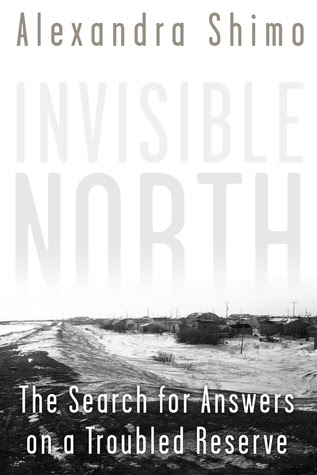
Lesbian journalist Alex Shimo had permission from the band chief to live on the reserve and document the story of unsafe water at Kashechewan in northern Ontario. But too much didn‘t make sense. Was it a hoax? Yet the shocking living conditions, the dire poverty—Shimo could see there was an important story to share with non-indigenous Canadians, but she struggled to maintain her mental equilibrium there. Words can hardly express how profoundly moved I was by this book.

This is where Canadian history differs from that of other developed countries, such as the United States and New Zealand, which also committed mass displacement of their Indigenous populations, but mostly stopped after the 19th century. As a result, Canadian First Nations have less land compared to those in other developed countries. For example, in the United States, Native Americans account for 2 percent of the population and reserves account for 2.3 percent of the total land. In New Zealand, Maoris account for 14.6 percent of the population and own 5.5 percent of the country. By contrast, Canadian Aboriginals make up 4.3 percent of Canada's total population, while reserves account for 0.2 percent of the nation. This, although Canada is an underpopulated, sprawling country near the size of a continent, with a land mass larger than the size of the United States and a population one-tenth the size.

Manikanetish by Naomi Fontaine
Translated by Luise von Flotow

Yammie left her Innu reserve, Uashat, on Quebec‘s North Shore, when she was a child. She returns 15 years later as a high school teacher. This quiet yet powerful novel documents a year of her experiences, connecting with her troubled but remarkable students, who face nearly insurmountable challenges. Meanwhile, she sorts out her own feelings of belonging to the place. This book pairs well with Shimo's Invisible North, because of the teenagers and the school situation in both.

An old, very wrinkled woman wearing the traditional Innu red-and-black felt bonnet. Not bothering to look directly at the camera. I was told later on that the missionaries were the ones who made Innu women wear the bonnets and keep their hair in braids rolled up on the sides of their heads and pinned at their temples. Because, with their long hair caressing their backs au naturel, they were beautiful. Attractive. Savage. Too beautiful for men of God and their oath of celibacy. They made them ugly.

Journal of a Travelling Girl by Nadine Neema

This remarkable chapter book for children (Grades 4-6) honours the traditional ways and stories of the Tłįcho people as well as a landmark historical moment in Canada: the signing of the Tłįcho land and self-government agreement in 2005. The action—external and internal—takes place through the eyes of 11-yr-old Julia while on an important canoe trip. Simple line drawings by Archie Beaverho accompany and enrich the text.

At the start of one of the portages, we saw a bird‘s nest that was so perfect it looked like a precious piece of art that someone had made for Easter. Inside, there were eight or nine eggs. It was just sitting there by itself in the long swampy grass. Grandma told us they were duck eggs. I couldn‘t believe that was made by a duck.

The Night Walk by Marie Dorleans
Translated by Polly Lawson

Many families turned to the solace of time spent in nature during the pandemic. Whether or not this activity was actually possible for readers of this endearing picture book, its portrayal of a quiet nighttime adventure is very inviting. There‘s also a natural propulsion: an unknown but important destination. A perfect laptime book: enjoy it slowly, studying the detailed pencil illustrations and seeking out the various nocturnal creatures. The art is understated, yet magical. Which is a feat, considering that the whole of the action takes place in the dark, and the story remains realistic, not drawing on any fantasy elements.


We threaded through the whispering forest. The earth was damp, the bark smelled comforting. Dead branches snapped under our feet, and ferns swayed quietly as we passed.

Mel Fell by Corey R Tabor


One of the many great things about this children‘s picture book about an intrepid young kingfisher is the orientation: the pages are designed to be viewed vertically instead of horizontally, and at one point in the story, the reader is instructed to flip it around with the opposite end up. Great manipulation! And it's also an inspiring story about bravery and community spirit. The appealing art, created with pencil and acrylic, is bright yet simple. 

Love from A to Z by SK Ali

I was not thrilled that my YA bookclub chose this title, since I am not a fan of romance. I‘d read Toronto author SK Ali‘s Saints and Misfits previously and it was okay, but I have little patience these days for books that I am not passionate about. I confess that I was pre-hating this book. I decided to just read enough of it to be able to join in the discussion. Then, I got sucked into the story. Wow, was I ever wrong about this book!

Believable characters. That's why I loved this YA romance even though I normally despise romance. Zayneb takes action in the face of bullshit and injustice. Adam is quiet and considerate. Islamic faith is satisfyingly woven into the narrative in an ownvoices way. I wept at a stranger‘s kindness, then at the description of MS symptoms, but didn‘t feel like the author was toying with my emotions. I guess “believable” is the key word here. I cared.

Everyone has a different definition of what “doing your best” means. For Mom and Dad, it means not rocking any boats.
For me it means fixing things that are wrong.

The Look of the Book: Jackets, Covers and Art at the Edges of Literature by Peter Mendelsund and David J Alworth

I have always been interested in book covers—I use them to judge contents like most readers do—but after reading this, I‘m hyperaware. Graphic designer Peter Mendelsund and scholar David Alworth collaborated on this heavily-illustrated investigation into the cover art on literary fiction. The way cover design first grabs our attention; how it frames and even shapes our reading experience; and the tricks or techniques used to translate verbal art into visual form. Love!

Like a bag of potato chips or a television commercial, book covers have an obvious mandate, which is to sell a commodity, except in the case of literature the commodity is also art.

Announcing the text and creating a conduit between imaginary and real space are two key tasks of the book cover. They are what the book cover does, first and foremost, but they are not all that it does. The cover‘s job is not over when you begin reading the pages. A good book cover has that time-release quality: it changes with you as you read.

If a book contains a map, it is likely either military history or fantasy—or Faulkner, which is both. Certain paratextual details, in other words, are indicators of genre: they tell you what kind of book you hold in your hands.

“A great book cover is, for me, like a great Spanish edition. The designer takes the manuscript and deftly translates it into a language I understand but am unable to speak with any clarity. ‘How on earth did you do that?‘ I think when I‘m given the finished product. To take 70,000 words and turn them into a single image. How is that not a miracle?”
—David Sedaris

Author Teju Cole insists that we push back against the “epidemic of relatability” that has besieged book culture. “It‘s like everybody wants to be ‘fun,‘ but not all books are ‘fun.‘”


Sunday, February 28, 2021

February 2021 Reading Round-Up

I've read so many great books this month that I'm going to split my highlights into several parts. Watch for an upcoming spotlight on Black authors, and a special St. Patrick's Day post featuring Irish authors. 

Today's mix includes: three stories that centre on an adult with a disability; three by or about Indigenous women; three in comics format; three audiobooks; three in translation; and four by Canadians.

We Are Not Free by Traci Chee

I started reading this book on February 19, 2021. On that same date in 1942, President Roosevelt signed the order that allowed the forced removal of over 100,000 Japanese Americans to concentration camps. (Japanese Canadians were similarly interned as "enemy aliens.") 
We Are Not Free is a poignant, lively, eye-opening novel in the voices of 14 teens from San Francisco, who are living in prison camps during World War II. It's an outstanding and heartbreaking portrayal of injustice and resilience. The rise, during 2020, in hate crimes against Asian Americans and Asian Canadians is a sad indication that the message of this novel remains relevant. It's YA for everybody.

“Wait,” I say. “You met Eleanor Roosevelt?”
“Yeah. She was saying we had to be in camps because we hadn‘t been integrated into the rest of American society like the Germans and the Italians, and I told her we hadn‘t integrated because we weren‘t allowed to buy or move anywhere except into neighborhoods that were already Japanese, so whose fault was it that we couldn‘t integrate?”
"In PM Magazine, Dr Seuss, the kids‘ book author, has been drawing us
with pig noses and wiry moustaches, queuing up for boxes of TNT.
There are all sorts of cartoons like that. Sometimes we look like pigs,
sometimes monkeys, sometimes rats. 
We never look like us."

It Began with a Page: How Gyo Fujikawa Drew the Way 
by Kyo Maclear and Julie Morstad

A stunning picture book biography of Japanese American artist Gyo Fujikawa (1908-1998), who was an iconoclast with a passion for social justice. 
Fujikawa‘s first author-illustrated book, Babies, portrayed children of all skin colours. It took several years for her to convince her publisher to take it on, but she was adamant. It was published in 1963 and sold nearly 2,000,000 copies. 
Canadians Kyo Maclear and Julie Morstad read Fujikawa‘s books when they were children and both say she inspired their own work in creating children‘s books that portray diversity.  


The Centaur's Wife by Amanda Leduc

Amanda Leduc is a Canadian writer and disability activist. In her second novel, a woman with cerebral palsy falls in love with a centaur. There‘s magic in the soil of a planet fed up with human greed; a heroic lesbian couple helping the survivors of an apocalyptic meteor shower; a young woman who had been waiting for a lung transplant; and a fox who wants to be a mother. It‘s a surprising, carefully crafted, poignant and fabulist story of love and grief, seeded with brief original fairy tales. 

“Stories are never just stories,” her father had said. “There‘s always a kernel of truth hidden deep within the words.”

She drew herself, a wide-eyed 12-year-old, one leg shorter than the other, her feet twisted and bent. Her mouth open in a silent scream.
She drew herself now. Her father‘s eyes, her father‘s smile. The uneven legs and lopsided shoulders that were entirely her own.

The mountain told him that humans lived the way that comets shot across the night sky—bright and burning, falling, gone. If you blinked, they disappeared.

Alone by Chabouté
Translated by Ivanka Hahnenberger

A graphic novel masterpiece about isolation, imagination, and letting go of fear. A disfigured hermit lives alone in a lighthouse with a dictionary and a goldfish as company. More alone than any covid lockdown. The cinematic style of French cartoonist Chabouté evokes the sounds of waves and gulls as well as the sense of remoteness. There are few words: this story is all about emotions. 

Buffy Sainte-Marie: The Authorized Biography by Andrea Warner
Audiobook read by the author and Buffy Sainte-Marie

Buffy's life story is amazing. Born on the Piapot reserve in Saskatchewan, she was adopted by an American family. Buffy faced many obstacles but she was determined to create and perform. Much of this biography is about her music, giving us a peek into the alchemy that underpins her artistry. Her lyrics come from her heart and they address social injustices with such power that her music was blacklisted by the US government (Lyndon Johnson and Nixon eras). The audiobook
 is narrated with obvious admiration and respect by Andrea Warner, with short interludes read by Buffy herself. Introduction by Joni Mitchell.

I have two main prayers: one is “thanks!” and the other is “wow!”

At one point in this biography I began a sentence with the words “Tearing down,” and in the editing process Buffy crossed them out and provided this alternative: “Creating, in spite of and beyond.” That simple reframing blew my mind. I actually felt a seismic shift in my brain. My own language has a tendency to be rooted in destruction. […] while her language is rooted in possibility, a desire to grow, explore and persuade.
-from the Afterword

The Yield by Tara June Winch

Indigenous peoples in Australia have had similar traumatic experiences with colonialism as in Canada, including stolen generations, racist violence and suppression of cultures. Using three perspectives—bisexual August‘s contemporary storyline; her grandfather‘s dictionary of Wiradjuri language and ancestral memory; and the account of a 19th-century Lutheran missionary—healing and cultural reclamation subtly unfolds in the “space between things.”

Marks or tracks, impressions of passing objects—MURRU
This is the tracks the snakes, the goanna, the birds, and us make as we crisscross the world. We all leave murru behind, so leave a gentle one.

What's a tin mine look like?
Big hole.
Is it bad?
‘Member Wizard of Oz?
Yeah.
‘Member Tin Man?
Yeah.
Well there's a reason he doesn't have a heart, darl.
What's that mean?
That tin don't love anyone or anything back.

The Night Watchman by Louise Erdrich

When I finished this layered historical novel set in the 1950s, I felt suffused by a warm emotional afterglow. Multiple characters and interlocking storylines give a sense of community and the many intractable problems faced by people of the Turtle Mountain Chippewa reserve. The most pressing issue is that they face termination in the eyes of the US government. My heart opened and welcomed in a whole bunch of wonderful characters.

Every so often the government remembered about Indians. And when they did, they always tried to ‘solve‘ Indians, thought Thomas. They solve us by getting rid of us.

The cold sap was a spring tonic. When you drank it, you shared the genius of the woods.

Sometimes now, a word failed to come to him when he was speaking, and in those times he substituted a descriptive phrase for the word, comically, and got a laugh. Just the other day he'd forgotten the word for car trunk, and said, “automobile cave with a hinge,” which was taken for wit.

Red Rosa: A Graphic Biography of Rosa Luxemburg 
by Kate Evans

“I want to affect people like a clap of thunder.” In this highly researched and visually appealing graphic biography, we get to know the remarkable Rosa Luxemburg. A Polish Jew with a crippled leg, she was a dynamo who received her PhD in 1897 in Zurich. She devoted her brilliant mind to social activism on behalf of workers. Her revolutionary theory addressed unemployment, lethal working conditions, starvation wages, evictions and more.

The distinctive feature of capitalism is the precariousness of the worker.

Clara: I know all mothers fret, but I do wish Kostya would do something with his life.
Rosa: Give him time. I‘m sure he‘ll find his feet. He‘s doing better than our glorious Party leaders. Far better to be a dreamer than to aim to shoot down the dreams of others.
Don‘t forget, as busy as you may be, to quickly raise your head
and cast a glance at those great silver clouds and
that silent blue ocean in which they are swimming.

The Adventures of China Iron by Gabriela Cabezon Camara
Translated by Fiona Mackintosh and Iona Macintyre

China Iron, mother of two by the time she's 14, embarks on a joyous Pippi Longstocking-ish picaresque journey through 19th-century Argentina, discovering the nature of Spanish colonialism, British imperialism, and her own pansexual self along the way. At journey's end is a way of harmonious connection with her beloved land: the ways and knowledge of the Indigenous peoples.

I took off my dress and the petticoats and put on the Englishman‘s breeches and shirt. I put on his neckerchief and asked Liz to take the scissors and cut my hair short. My plait fell to the ground and there I was, a young lad. Good boy, she said to me, then pulled my face towards her and kissed me on the mouth.

She was my North and I was the quivering needle on a compass: my whole body was pulled towards her, dwarfed by the strength of my desires. It was under the sway of that force that I began to feel, and now I think perhaps it‘s always that way, that you feel the world through others, through your bond with others.

It doesn‘t seem right, there are hardly any birds in the pampas and the few we have are low-flying or can‘t fly at all. You get flamingos like clouds of shrill pink on the horizon. You get ñandús that run faster than horses, their strong elastic legs scything the ground and raising the dust. The ñandús connect pampa and sky.

I, having lived wholly inside the dust, having been little more than one of the many forms that dust took there, having been contained in that atmosphere—the earth of the pampa is also the sky—started to feel it, to notice it, to hate it when it made my teeth gritty, when it stuck to my sweat, when it weighed down my hat. We declared war on the dust, all the while knowing that we were fighting a losing battle: we come from dust.

The smell of near-black tea leaves torn from the green mountains of India that would travel to Britain without losing their moisture, and without losing the sharp perfume born of the tears Buddha shed for the world‘s suffering, suffering that also travels in tea: we drink green mountains and rain, and we also drink what the Queen drinks. We drink the Queen, we drink work, we drink the broken back of the man bent double as he cuts the leaves […]


The Godmother by Hannelore Cayre
Translated by Stephanie Smee

A struggling single mother in her 50s is caught between the university expenses for her daughters and the care home costs for her mother in this darkly tongue-in-cheek tale of criminals in contemporary France.

She had asked to be cremated with her ashes scattered in a department store. The girls and I carried out her final wishes, selecting the Galeries Lafayette. I chose to scatter my share through the boutiques of her favourite designers. If you happened to find a bit of grey dust or some strange little bits of matter at the bottom of your Dior, Nina Ricci or Balenciaga suit pockets from the Spring-Summer 2017 collection—that was my mother.

And while I had plenty of faults, he had one big one: he believed in God. Philippe, this man who was integrity personified, intelligent, cultured and witty… believed in God! It just seems so unlikely that anybody could give any credibility to such a load of rubbish. He could have confided in me a belief that our fate as humans was predetermined by a dish of celestial noodles and I wouldn‘t have found it less ridiculous.

My father, good colonial that he was, had taught me at the same age he himself had learned, that‘s to say, at the age of 10. I still remembered the recoil ripping into my shoulder as he made me shoot, over and over, until I could absorb the shock with my body. So when my parents went out to a restaurant, they could leave me alone between the motorway and the forest with the revolver on the bedside table and not waste a moment worrying about whether I might be scared—after all, what babysitter could be as good as a .357 Magnum?

Burnt Sugar by Avni Doshi
Audiobook read by Vineeta Rishi

A prickly, unsettling story about love and hatred between a mother and daughter in contemporary India. The making of art, the unmaking of mental illness. Buried secrets. Riveting.


I told her that staying doesn‘t have the appeal, the mystery, of escape. To stay is to be staid, to be resigned, to believe this is all there will ever be. Aren‘t we creatures made for searching, investigation, dominion? Aren‘t we built to believe there can always be something better?

Everything Sad Is Untrue (A True Story) by Daniel Nayeri
Audiobook read by the author


A warm, touching and very funny autobiographical novel about the author‘s experiences as an Iranian refugee in middle school in Oklahoma. He tells this as a class project in the style of 1001 Nights, incorporating ancient lore with family history and stories about poop. The audiobook would be a great choice for family listening.

All Persians are liars and lying is a sin.
That's what the kids in Mrs. Miller's class think, but I'm the only Persian they've ever met, so I don't know where they got that idea.
My mom says it's true, but only because everyone has sinned and needs God to save them. My dad says it isn't. Persians aren't liars. They're poets, which is worse.

Here is a list of the foods from Iran that they have never heard of here: all of it. All the food. Jared Rhodes didn‘t even know what a date was.

The shame of refugees is that we always have to explain ourselves. It makes our stories patchworks, not beautiful rugs.


Slaughterhouse Five by Kurt Vonnegut, adapted into graphic novel format by Ryan North and Albert Monteys

A powerful graphic novel
adaptation of Kurt Vonnegut‘s anti-war classic. Billy Pilgrim‘s mind came unstuck during his time as a soldier in WWII. He was a POW in Dresden when Allied forces killed over 25,000 civilians in one night, flattening the city. Being abducted by aliens who explain the nature of time… slipping forwards and backwards to important scenes from Pilgrim‘s life: it works so well in images!
When I saw those freshly-shaved faces, it was a shock. “My God, my God,”
I said to myself — it's the Children‘s Crusade.”