Sunday, October 24, 2021

Encounters with Tim Hortons While Shadowing the Giller


This entry is part of my continuing collection of Tim Hortons references as I come across them in my reading. I hope these excerpts will prompt you to pick up and read the books in their entirety. All of the titles in this post were published between October 2020 and September 2021, making them eligible for Canada's Giller prize in 2021.

___________________________________


    The road is an intermittent companion. It was made to wrap around natural features, whereas I am compelled to push straight through. I'm heading more or less west from home. If I walk long enough, I'll fall into the ocean. Wouldn't that be poetical?
    My ambition is too blunted to contemplate such a lofty goal. I'll come across a derelict Tim Hortons before too long--maybe that's good enough.

Emily Brewes, The Doomsday Book of Fairy Tales, p 272

___________________________________


    But—and there is a but, and not a minor one—the two women's children couldn't stand each other. As soon as they were in the same room, they would turn their backs on one another. "As if they were like poles of two magnets," Suzan sighed when the conversation got to that point. (Desmond, whom I met at a Tim Hortons in Sudbury, had another explanation: "I couldn't stand the way she looked at me. There was something in her that struck a nerve. I couldn't tell you what it was. A huge void, or a vortex. It would take me days and a lot of work to extract myself from it.")

Jocelyne Saucier, And Miles to Go Before I Sleep (translated by Rhonda Mullins), p 56 

____________________________________


    Up ahead, someone has taken three of the brownies. Now there are only five left.
    "I'm going to make you an offer," says Loomis, trying to channel Vito Corleone, "that you can't refuse."
    "Make sure he doesn't cheat you," says Paula.
    I check the display case. Now there are only three.
    The mayor puts his arm around his wife. "Don't know why you insist we come here," he whispers. "Timmy's has a better selection and better prices."
    In addition to the real estate company, Mayor Bob also owns the two Tim Hortons in town.
    "Sure," says Paula. "If you want frozen lumps of lard."
    "Canadian company," says Bob. "Buy local."
    "Company hasn't been Canadian since 1995," says Paula.

Thomas King, Sufferance, p 47

_____________________________________


    The hardware store sat at the centre of Main Street in a town of three thousand and thirty-nine people. There was one Tim Hortons (facing impending closure), two pizzerias, a hospital, one public school, one Catholic school, a liquor store, a cafe, a pharmacy, a bookstore, the corner store, five churches, and Lou's hardware store. Indigo Higgins owned the local bookstore. She stocked poetry from Western Canada, Bart Hastings' murder mysteries, and books about birds. It was a well-known fact that Indigo could name collective nouns for birds in any situation, and she often created opportunities to mention an asylum of cuckoos, a museum of waxwings, a charm of goldfinches, or a pretense of bitterns. Each Christmas since Lou had married Edward, she had bought him a book from Indigo's store -- usually one of the select few that wasn't about birds and wasn't authored by Bart Hastings. Lou never knew what else to get him. This year, they hadn't exchanged gifts at all.

Amy LeBlanc, Unlocking, p 11

______________________________________


    "What's for breakfast?" I ask Amina, watching her fold my quilt into a perfect rectangle. Particles of dust fly up as she beats my mattress with a coconut broom and smooths out the creases in the bedsheet.
    Aunty, my mother's sister, says Amina is a couple of years younger than me, which means she is about seventeen. Yet a solemn maturity lurks behind her youthful olive skin, beneath the surface of the innocent wonder in her large chocolate-coloured eyes.
    "Porota, omelette, potato fry, tea," she says with a smile, exposing her rust-coloured, betel-stained teeth.
    Instantly, my mouth moistens. Over the past year in Toronto, I've only come to know cereal and Tim Hortons muffins for breakfast. The few times I tried the store-bought porota from No Frills supermarket, it felt as though I was eating rubber.

Silmy Abdullah, Home of the Floating Lily: Stories, 'Across the Ocean,' pp 50-51
Note: Two other stories in Abdullah's collection also have Tim Hortons references. I will let you discover them for yourself.

_______________________________________


    We reject the crumbling donuts and thin coffee offered in the hotel lobby, the elegant sounding "Continental Breakfast." We stop at a Tim Hortons on the outskirts of town. Next stop, the mountains and the new monument that is the reason for our visit.
    We avoid the drive-through, several cars making a figure eight in the parking lot, and join the line on the inside. I tell Dad he can find us seats while I wait to get our English muffins, but he doesn't. He's perturbed by the long line, so needs to exercise his annoyance, to take it for a walk like a small dog. He's mostly perturbed, I soon see, by the sight of the only person taking orders, an older South Asian lady. She's clearly distressed and requires help, but her colleagues are all occupied: two giraffe-like blonde teenage boys bobbing and weaving behind the soup/sandwich counter, and a gaggle of girls administering to the drive-through traffic, radio headsets fastened to their ears. I suggest to Dad that we'd be better off going through the drive-through, but he gives me a look as if I've asked hime to cut off his right hand.
    We wait. [...] Once or twice, the poor woman, confused by the onslaught of requests, Double-cream no sugar, one cream three sugar, double-double, double-milk one sugar, one decaf black, a maple dip not maple cream donut, an old-fashioned plain donut, not a glazed old-fashioned plain donut with vanilla sprinkles, sets both her hands on the counter and closes her eyes. The lineup of customers grows and surges.
    Dad makes a nocturnal sound and steps, figuratively and literally, out of line. I shrink. He shouts, "Can't anyone help this poor woman? What kind of place you running here?" The whole place pauses. Heads pivot, patrons at tables in mid-sentence mid-bite and mid-sip, coffee cups or iPhones at the ends of their arms. Things resume. The coffee machine begins again. I see a commotion through the door behind the counter, and a young woman, not in the standard Tim Hortons uniform, but in a black halter top, with a bracelet-of-thorns tattoo circling her right arm--she looks vaguely Goth, wholly angry--comes out and punches open a second cash register, narrows her crow eyes as if daring anyone to approach.
    [...]
    Once we're sitting, he starts in.
    "Disgraceful. Immigrants forced to take these jobs. Part-time, you can bet, then they don't have to pay benefits. We shouldn't patronize these people."
    "She seems to be handling it all right."
    "It's in the job description. You can't frown at Timmy Hortons."
    [...]
    Before we leave, a middle-aged man, around my age, in crisp new jeans and scuffed silver cowboy boots, long greying hair in a ponytail, stops by our table and says to my dad, "Thanks for saying something. Place makes money hand over fist. Canada's Goldman Sachs."
    Dad barely responds, just whispers, "You bet," without looking up. The man waits for a more meaningful interaction. I say, "Thanks," He nods and moves off. His cowboy boots snap along the sticky floor.

John O'Neill, Goth Girls of Banff, 'From Castle Mountain,' pp 124-127
Note: As with Abdullah's book (see previous entry) two other stories in O'Neill's collection have Tim Hortons references.

_______________________________________


    Surely there's a washroom in this building that I could use, said Grandma.
    I'm afraid not, he said, they're not designated for public use.
    She really has to go! I told him.
    You don't have to yell at me, miss, I can hear you. I told you they're not designated for public use.
    Her diuretic kicked in on the streetcar and she'll spring a leak if you don't let her use the fucking washroom, you fascist prick! I said.
    Swiv, said Grandma. She pretended to slice her throat with her finger. The guy finally looked at us and got up and came around to the front of the desk with his hand on his gun. Grandma asked him if it was all right with him if she peed in one of those giant planters by the window. He said no, he couldn't authorize her to do that. Do it! I told Grandma. I'm authorizing it! She said no, no, we'll find a place. She told the security guy she was very tempted to let 'er rip right there in the lobby on that shiny floor and he said ma'am, you do not have a constitutional right to use fighting words with me. Then grandma started talking about constitutional rights but she was huffing and puffing and also dizzy still, and sort of teetering around and it was hard for her to talk. You're gonna have a goddamn cardiac event, Grandma, I told her. I'm telling De Sica. De Sica! said Grandma. Did he call? Don't let this be the hill you die on! I said. Hoooooooooo, said Grandma. You're right. What a ridiculous last stand. I took Grandma's hand and we went to the Tim Hortons next door and bought two Boston cream doughnuts so they would give us the code to the washroom.

- - - - - - - - - - - 

    The cab driver fell in love with Grandma instantly and took her arm and helped her down the stairs and along the little path to the curb, like they were a bride and groom. Shotgun! yelled Grandma. She always had to sit in the front of cars. Normal people sit in the backs of cabs, but not Grandma. She wants to see everything and navigate everything and talk with the driver. The cab driver had to move all his stuff off the front seat. He wiped off the crumbs and chucked some garbage into the back seat next to me. A Tim Hortons cup landed on my leg. Sorry, sorry he said.

Miriam Toews, Fight Night, pp 32-33; 128-129

______________________________________


    A man passed them on the sidewalk, the late thirties overgrown-child type, baggy shorts and hockey-player hair, sandals. He was just walking along, eating a donut, sipping from a big Tim Hortons cup. Marthe wondered shat it felt like to live in the world like that guy did.

Aimee Wall, We, Jane: A Novel, p 65

______________________________________


    Aisla hasn't slept for more than forty-five minutes in a row for over a year. She looks at her list again sitting on the toilet, the baby sleeping in that bucket seat on the floor, one of her feet rocking as she tries to pee without splashing all over the toilet and her pants. Have to keep rocking or he'll wake up and getting him to sleep takes up so much of her life that any respite when he is actually sleeping is heavily and anxiously guarded. She has to look at her list again because she forgets something every time. She knows she's forgotten to write things on her list, but the most important things are probably on there. Probably. It's a fifty-two-minute drive into town, and if she's lucky he'll fall asleep halfway and stay asleep for twenty minutes after
—enough time for her to grab a coffee at the Tim Hortons drive-thru and take a pee in the mall bathroom before she starts her errands.

Angelique Lalonde, Glorious Frazzled Beings, 'The Pregnancy Test,' pp 157-158

______________________________________


    Sometimes I watch TV and I want to throw it against the wall. Sometimes I read a book and I want to rip out every page. Sometimes I am in a restaurant, patiently waiting for my takeout, and I see a straight couple my age laughing as they get their bags and go home and I want to block the entrance right in front of them and claw my eyes out and say, "Tell me—how did it happen? Did you meet at a fucking art opening? After a whole dramatic year on Tinder? DID YOU MEET AT FUCKING TIM HORTONS?! Are you going home to your fucking cat or your fish or your ADORABLE CHILD?!
    I have never been an aggressive person, as you know. And I would like to say I don't know where this urge to rage comes from. Except. Of course. I know exactly where it comes from. It shouldn't be so simple.

Casey Plett, A Dream of a Woman: Stories, 'Rose City, City of Roses,' pp 171-172

_______________________________________


    "It's a nice day out today. Feels like spring. Never used to melt this much when I was a kid. When I was a kid we had snow up to our armpits and froze all the way through all winter. Not like you kids, always warm and inside. You guys got it easy."
    Phoenix scoffs at this, but only a bit.    
    "Oliver had a hockey tournament this weekend so we went up to Sagkeeng and was in that arena all weekend. Was colder in there than outside. Good thing they have a Tim's out there. I never asked you, are you a tea girl, Phoenix, or coffee? Which do you like better?"

Katherena Vermette, The Strangers, pp 142-143

Tuesday, October 12, 2021

September 2021 Reading Roundup


Here are a few of the best books that I read in September, starting with four that are longlisted for the 2021 Giller prize.
 

Fight Night by Miriam Toews

“What makes a tragedy bearable and unbearable is the same thing—which is that life goes on.” Grandma‘s wisdom and zest for life, together with 9-year-old narrator Swiv‘s voice, make this a perfect novel. It's written in the form of a letter to Swiv's absent father. The fight of the title is both internal and external: against sadness, self-doubt, lack of courage, the patriarchy and religious dogma. The kid is a master of hyperbole and the book is hilarious—sometimes to the point of slapstick—and it‘s heartbreakingly real.

We all have fires inside us, even you. Grandma says you pour so much alcohol on the fire inside you that it‘s guaranteed to never go out.

When she swallows her pills she pretends they‘re tiny soldiers sent off to fight the pain and sometimes holds them up and says to them, thank you for your service, lest we forget, and then she swallows them and says “play ball!”

"Do you know Shakespeare‘s tragedies? People like to separate his plays into tragedies and comedies. Well, jeepers creepers! Aren‘t they one and the same? So, King Lear fails to connect with what‘s important in life and loses his mind… who hasn‘t? There is comedy in that, don‘t kid yourself. That‘s life! And life doesn‘t necessarily make sense. We‘re human!"

Grandma sang let it be, let it be, let it be, lord let it be. I told her lord wasn‘t the right word. The right word was yeah, let it be, not lord, let it be. She‘s right, said Ken. It‘s yeah, not lord. Okaaaaaaay! said Grandma. From the top. She sang it again but used the wrong lyric. She did it on purpose. She just likes opportunities to say lord because it makes her feel like she‘s praying.

I took the magazine out of the pocket on the seat in front of me and opened it to an ad that said ‘Literally in Love with Jumpsuits.‘ I put it back into the pocket.

Then I woke up and it was still the same day which was the longest day ever because of the time change and almost dying 400 times in water, air and on land. We‘d probably almost die in a fire before bedtime.

Lou poured everyone a glass of white wine to toast family. He looked sad and happy at the same time. That‘s a popular adult look because adults are busy and have to do everything at once, even feel things.

Astra by Cedar Bowers

A bisexual woman‘s life from birth into her senior years, as seen through the eyes of others. Each chapter jumps ahead in time and is told from the perspective of a different person. I love kaleidoscopic character-based stories like this. An added hook is that it‘s about an intentional community. To top it off, the writing is top notch.

I‘ve found it much, much harder to lose the people who never gave you enough, than it is to lose the ones who gave you everything.

Men sit around discussing liberation and free love and what a glorious new world they are creating, because now everyone can truly be “free” if they have the balls for it. And it‘s such bullshit. Clodagh has met hundreds of free men over the years, but she can‘t say she‘s ever met a free woman.

There was another question that troubled him now. How could he be sure that when he went home, he wouldn‘t revert to the boy he used to be? How could he stay the person he‘d worked so hard to become?

We Jane by Aimee Wall

“The thing to remember was that they were out in the middle of the Atlantic on an island on an earth simmering with heat and rage and people would have to see that they were eventually, once again, going to have to fend for themselves.” Women taking control of reproduction is one aspect of this brilliant novel, written with convincing dialogue peppered with Newfoundland expressions. Above all else, it's about queer women‘s relationships with each other.

You look back on where you came from and think why live like that. The slush, the snow in May, the forever blanket of fog. There are people who eat dinner in their backyards all year long and there you are, barely able to go out in your shirtsleeves except for a few days a year.

Don‘t get all sepia-toned on me. She would say things like that but then tell a story about some show at the LSPU Hall that had devolved into a fistfight, a full-on racket, and how that was the summer they put the clocks ahead two hours so it was light light light till late every night and everyone went a bit squirrelly, all this in a voice dripping with that sepia honey and Marthe would thrill to it quietly, getting to go to that place.

But it can be another way, Jane would say. It‘s already been another way, Jane would say. And Marthe would agree.
And just as Marthe was settling into the conversation, just as she was about to ask for actual details—what other way, exactly, did Jane mean—Jane would change the subject, or end the conversation. It was dizzying, but effective. Marthe was consumed.

Jenny had arrived in New York just in time to watch all the radical feminist groups disintegrate into power struggles and infighting but, she shrugged, all that‘s kind of inevitable. People are loath to talk about it because they don‘t want to make us all sound like petty bitches and, like, hurt the cause, but some of them were petty bitches! But just because it came apart eventually doesn't mean it failed. None of these things were ever meant to stay on in the same form forever.

Oh Trish, she‘s a bit different, you know, but she‘s best kind really, and my cousin thinks the sun shines out of her ass ever since she had the baby at home. Yeah. In the living room. She‘s a bit different, but you know. It was one of Marthe‘s least favourite expressions, the way people said it here. Oh, I see, well that‘s a bit different. As in, I find that outrageous, or weird, or incomprehensible, but I'm making a show of reserving judgement while actually judging because, you know, it takes all kinds.

Jane liked big novels, Great Works. Mann and Stendhal and the Russians and Henry James. She liked novels of ideas with the ideas woven into the world of the book, novels where vaguely weak sick people sit around the sanatorium talking about time and philosophy and art. Jane wanted, always, the transcendent. The almost over the top. She liked opera. Most anything played by Glenn Gould. She was impatient with anything less.

Back in the car, on the highway, Jane settled another paper cup of coffee into the cup holder, pulled a rumpled copy of Buddenbrooks, fat with damp, from between the seats: Read to me?
[…]
Marthe took the book from Jane‘s hand and started reading. She loved reading aloud, it was so rare that anyone wanted it.

The Son of the House by Cheluchi Onyemelukwe-Onuobia

Nigerian Canadian lawyer and academic Cheluchi Onyemelukwe-Onuobia has already garnered awards for this, her debut novel, which was first published in 2019 in South Africa. It‘s a moving family saga told from the viewpoints of two women who, in the opening chapter, have been kidnapped in Enugu. While waiting for their loved ones to raise ransom money, they tell each other their life stories. Feminist, heartfelt and dramatic.

Putting one‘s hands in various businesses would tell poverty that we were really serious about not making friends.

“Julie, I wish I had died in battle like Chima,” Afam had once confided in me.
“No, don‘t say that,” I had protested immediately. Because that was what was required: when people wished for suicide, you told them no. When they had nightmares like he did every night, you waved their fears away and told them that all was well. I should have let Afam speak.

When I stepped out, the sun was still trying to make up its mind whether it had to work yet another day. The car sputtered a little, also trying to decide whether its ten years on earth—that is, if you believed Innocent, the mechanic who sold it to me—did not yet qualify it for retirement.

Life was hard, but if you took it in little chunks, you could find some chunks that were good.

We Want What We Want by Alix Ohlin

“Child. We are done for in the most remarkable ways.” —Brigit Pegeen Kelly, from the epigraph.
In this remarkable collection of short stories, one of the best that I‘ve read so far this year, people‘s desires are the source of difficulty and pain… but can be done about that? We want what we want. I want more by Alix Ohlin. 

“I think I‘m burning out,” she said to Sam, and he thought she meant on work, but she meant on everything. Sam was stable and good for her, absorbing whatever she threw at him, the tofu of husbands, but it didn‘t help. She considered an affair, but it seemed like too much work. Anyway, her days were full of meetings and carpools; there was no time for malfeasance.

I first read Mulvaney‘s book, The Woman I Knew, when I was thirteen years old, an impressionable age. Although I should say that I was impressionable at all ages, especially where books were concerned. I wanted books to press themselves upon my body and mind, to change me in every way a person could be changed.

Oszkar is disgusting, potbellied and scruffy bearded. To this party he has worn shorts that fall below his knees and a yellow t-shirt that reads Silence is golden. Duct tape is silver. Looking at him, she thinks about people interviewed on the news after their neighbour commits some terrible crime, saying, “He seemed like such a nice guy. You would never suspect.” Oszkar is not such a person. You would suspect him of anything.

They break for soda and chips, which his mother brings downstairs on a tray. The look she gives Aziza broadcasts sharp betrayal; she wanted Aziza to lure Tim outside, instead of joining him here in artificial reality. But Aziza can imagine nothing more artificial than the reality outside, the hum of vehicles disappearing into garages, the angry wheeze of leaf blowers operated by men in masks, like a gardening militia.

Beautiful World, Where Are You by Sally Rooney
Audiobook read by Aoife McMahon

I adored everything about this novel, including the way we get to know the four characters only through what they say and do, plus through their email correspondence and texts. It‘s written in third person with a point of view so limited that nothing is revealed beyond what can be observed from the outside. And yet I truly cared about these not-especially-likeable Irish thirty-somethings who manage to divulge so much to each other about their feelings.

For my part, the difference between lockdown and normal life is, depressingly, minimal. 80 to 90 percent of my days are the same as they would be anyway: working from home, reading, avoiding social gatherings. But then it turns out that even a tiny amount of socializing is different from none.

What if it‘s not only a small number of evil people who are out there, waiting for their bad deeds to be exposed, what if it‘s all of us?

Personally, I have to exercise a lot of agency when I read, and understanding what I read, and bearing it all in mind long enough to make sense of the book as I go along. In no sense does it feel like a passive process in which beauty is transmitted to me without my involvement. It feels like an active effort, of which an experience of beauty is the constructed result.

Great novels engage my sympathies and make me desire things. When I look at the Desmoiselles d‘Avignon I don‘t want anything from it; the pleasure is in seeing it as it is. But when I read books, I do experience desire. I want Isabel Archer to be happy. I want things to work out for Anna and Vronsky.

Maybe we‘re just born to love and worry about the people we know, and to go on loving and worrying, even when there are more important things we should be doing. And if that means the human species is going to die out, isn‘t it in a way a nice reason to die out?

Recollections of My Nonexistence: A Memoir by Rebecca Solnit
Audiobook read by the author

I highly recommend this brilliant, clear-eyed and compassionate look back at the author as a young woman becoming herself and a writer within the ever-present and harmful context of patriarchy.

I came to understand visual art as a kind of philosophical inquiry by other means.

I am fond of sentences less like superhighways and more like winding paths, with occasional scenic detours, or pause to take in the view, since a footpath can traverse steep & twisting terrain that a paved road cannot. I know that sometimes what gets called digression is pulling in a passenger who fell off the boat.

It is the reader who brings a book to life. I lived inside books and though it‘s often assumed that we choose books to travel through them to get to the end, there were books I took up residence in.

I was told to move someplace more affluent, although some of my most malevolent harassment occurred in such places. To get a car. To spend money I didn‘t have on taxis. To cut my hair, dress as a man, or attach myself to a man. To never go anywhere alone, get a gun, learn martial arts. To adapt to this reality, which was treated as natural or as inevitable as the weather. But it wasn‘t weather and it wasn‘t nature and it wasn‘t inevitable and immutable. It was culture. Changing that culture and those conditions seemed to be the only adequate response. It still does.

It could have been me who found myself in a moment in which my fate was not my own, my body was not my own, my life was not my own. And I hovered on that brink and was haunted by it for a few years that reshaped my psyche in ways that will never be over, which was perhaps the point: to remind me that I would never be entirely free. This violence mostly targets girls and young women, as an initiation rite, a reminder that even after you cease to be a frequent target, you are vulnerable.

All our struggles can be imagined as turf battles, to defend or annex territory, and we can understand the differences between us as being, among other things, about how much space we are allowed or denied.

I think that a lot of girls and young women have this yearning, that is part desire to have a man and part desire to be him, to merge with this force, to be where power is, to be powerful.

In Memory of Memory by Maria Stepanova
Translated by Sasha Dugdale

Maria Stepanova set out to record her Jewish family‘s history in Russia, but the more she uncovered, the more she doubted what she thought she knew. This remarkable work of literature is hard to classify: it‘s a blend of memoir, fiction, 20th century history, archival documents, and essays about art. These all come together gracefully in what turns out to be a rumination on memory and mortality. The translation by Sasha Dugdale is lively and poetic.

I always knew I would write a book about my family […] because it was simply the case that I was the first and only person in the family who had a reason to speak facing outward, peering out from intimate family conversations as if from under a fur cap, addressing the railway station concourse of collective experience.

This white-hot near-religious belief in higher education was handed down through the generations and I remember it in my own childhood. “We are Jews,” I heard this at the age of seven. You cannot allow yourself the luxury of not having an education.

My china boy seemed to embody the way no story reaches us without having its heels chipped off or its face scratched away.

The whole country was at war with “cosmopolitanism,” a code word for Jewishness.

[The poet Valentin Stenich, the first Russian translator of Ulysses] was executed in 1938. It‘s said he did not conduct himself with honour at his interrogations. God forbid anyone should find out how we conduct ourselves at ours.

In December 1936 in a New York gallery, Joseph Cornell showed his first film to a small audience. It was called Rose Hobart […]
The 32-year-old Salvador Dalí was in the audience. In the middle of the screening he jumped to his feet and shouted that Cornell had robbed him. He insisted that this idea had been in his subconscious, these had been his, Dalí‘s, dreams, and Cornell had no right to use them as he wished.

In place of a memory I did not have, an event I did not witness, my memory worked over someone else‘s story; it rehydrated the driest little note and made of it a pop-up cherry orchard.

I bailed on four Canadian novels this month, all of them Giller possibles.
If I hadn't felt such pressure to read as many eligible titles as time allowed,
I might have had more patience. I may return to them at some point.


Monday, October 4, 2021

Giller Shortlist Wishlist

All five books on my Giller shortlist wishlist were published between August 24 and September 28, 2021. There must have been some special magic in the air! The official shortlist will be announced tomorrow.

A Dream of a Woman by Casey Plett
em by Kim Thuy
Fight Night by Miriam Toews
Glorious Frazzled Beings by Angelique Lalonde
The Strangers by Katherena Vermette

Sunday, October 3, 2021

The Shadow Knows: Video of My Reactions to the Giller Longlist

Shawn the Book Maniac invited me to talk about the 2021 Giller longlist on his Booktube channel. 

You can watch our 30 minute conversation here: https://www.youtube.com/watch?v=tYCjcRuGFxw

Tuesday, September 21, 2021

My Indigenous Books TBR

One of the things my dear friend Shawn is doing to celebrate the fourth anniversary of his booktube channel is an invitation to submit a camera flip. In other words, he's posting videos other people have created. I made a 15-minute recording talking about some Indigenous literature that I plan to read soon. You can view the video here: Lindy on Shawn the Book Maniac's channel . And while you are over there, sample some of Shawn's offerings. My favourites are his Friday Reads episodes and also his playlist of Bite-Sized Book Chats. 

Shawn also is offering prizes to celebrate the happy occasion. Scroll through his recent episodes to find his Book Cover Fragment Contest and his Book Giveaways.

Keep on vlogging, Shawn!

-------------------------------

These are the TBR books I spoke about in the video:

Nishga by Jordan Abel

it was never going to be okay by jaye simpson

awacis: kinky and dishevelled by Louise B Halfe Sky Dancer

The Seed Keeper by Diane Wilson

The Swan Book by Alexis Wright

Wednesday, September 8, 2021

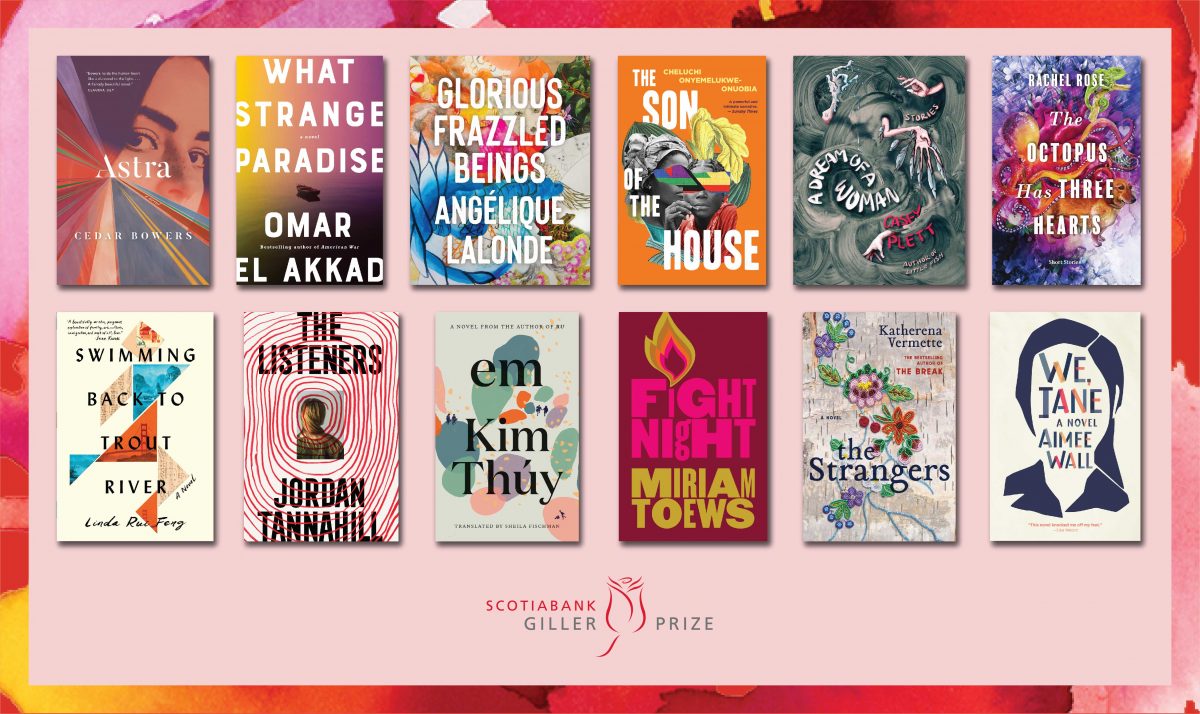
2021 Giller Longlist Reaction


Wow! My first reaction upon seeing the Scotiabank Giller Prize judges' longlist is surprise. Lots of surprises on this list, actually. 

It is a challenge to keep up with new Canadian fiction, so I'm happy that there's a Craving Canlit page on the Scotiabank Giller website. My fellow shadow jurors and I have relied on this list of eligible titles to prepare our own longlist predictions. One of the longlisted titles (Swimming Back to Trout River) wasn't on this site, so it escaped my notice entirely. 

Three of the titles won't be published until the end of September (A Dream of a Woman; Em; and The Strangers) and one was just released yesterday (Glorious Frazzled Beings). Another was first published in 2019 and then reissued in May 2021 (Son of the House), so I wasn't aware that it fell within the eligibility requirements.

I've only read four out of the twelve on the longlist, and my prediction yesterday included only five out of the twelve. Not a very accurate forecast. 

I'm overjoyed to see Fight Night on the list, because I consider it to be a perfect novel. 

What Strange Paradise speaks to our shameful times, of refugees treated like unworthy human beings. With the focus on individuals, and particularly on one child refugee, this novel is capable of opening hearts.

Astra highlights our connections to other people, and how perspectives shift depending on time, relationship, and viewpoint. Maria Mutch's Molly Falls to Earth does a similar thing -- and does it even better! -- using prose that sings, so I'm sorry that it isn't on the list as well.

The Listeners speaks to our times also: the splitting of society into two distinct groups, conspiracy theories, our search for community and for something more meaningful than the daily grind. I hadn't predicted that this would make the longlist because I perceived a few flaws, but it's a spellbinding novel and I'm not displeased to see it on the list. 

I'm surprised and sad that Sheung-King's You Are Eating and Orange. You Are Naked. didn't make the list. This one has an innovative fragmentary format, beautiful flowing prose, and captures the in-betweenness of having multiple nationalities so well.

I look forward to reading the rest of the longlist and plan to come up with my own shortlist before the official announcement on October 5, 2021.

Tuesday, September 7, 2021

2021 Giller Prize Prediction

Tomorrow, September 8, the Scotiabank Giller Prize longlist will be announced. This is my second year as a shadow juror, a role I take seriously even though it is just for fun. It is a huge pleasure to read so many great novels, short stories and graphic novels by Canadian writers. So far, I've read 46 eligible titles and bailed on an additional four. Some books that I think might be strong contenders have not yet been published, and so I will have to guess about them. Before revealing my longlist prediction (plus wish list) for the 2021 Giller, I want to talk about my judging criteria. 


This is what I'm looking for:

Life-affirming stories that acknowledge the complexities of existence and that make me think. I want lots of white space, by which I mean room to wonder and imagine, rather than having everything neatly laid out.

Style. Whether it's using a conventional structure or an innovative format, the writing is crafted with rigorous care. I want to experience freshness and surprise, through word choice and perspective. I'm especially drawn to a unique narrator's voice.

Believable characters. I slip into characters as I read, so I need to trust that the author is treating their characters with respect, no matter what kind of character I inhabit. Also, I immediately resist if I feel like my emotions are being manipulated.

Insight. Feeling a resonance with the issues our society is grappling with, such as colonialism, xenophobia, feminism, social isolation, conspiracy theories, and aging with dignity.

Setting. A sense of grounding in time and place that enriches the story experience.

Plot. The story must have intrinsic coherence and hang together. I want to sense the narrative arc over the course of a novel or short story, whether the action is internal or external.

Enlargement. An inner expansion that comes as a result of reading a particular piece of literature.

Okay, so here are my nine longlist picks in alphabetical order by title:


Everyone Knows Your Mother Is a Witch by Rivka Galchen

Fight Night by Miriam Toews

Molly Falls to Earth by Maria Mutch

Return of the Trickster by Eden Robinson

Shadow Life by Hiromi Goto and Ann Xu

Speak, Silence by Kim Echlin

We Want What We Want by Alix Ohlin

What Strange Paradise by Omar El Akkad

You Are Eating an Orange. You Are Naked. by Sheung-King

And, because there are so many fine possibilities, I also have a wish list composed of honourable mentions (which I've read) and books not yet published (which I haven't read, so they are marked with an asterisk):

Astra by Cedar Bowers

The Book of Form and Emptiness* by Ruth Ozeki

Em* by Kim Thuy

A Funny Kind of Paradise by Jo Owens

Ghost Lake by Nathan Niigan Noodin Adler

Manikanetish* by Naomi Fontaine, translated by Luise von Flotow

The Strangers* by Katherena Vermette

To Know You're Alive by Dakota McFadzean

What do you think? I look forward to seeing what the Giller judges have chosen this year.