Monday, November 30, 2020

November 2020 Reading Round-Up

November has been a fantastic reading month! Here are some highlights:

Beowulf: A New Translation by Maria Dahvana Headley
Audiobook [4 hr] read by JD Jackson and the author


“Holy hell, Beowulf, how‘d it go out there?” He “battled like a brawler” with monsters, that‘s how. This hero is “hashtag: blessed.” I find great pleasure in reading multiple interpretations of classic works, especially when the language play is as thrilling as in this new translation. Headley‘s nods to other versions, including this reference to Tolkien‘s Smaug: her dragon has “piles of preciouses.”

After reading the print edition, I listened to the audiobook. I couldn‘t get enough! JD Jackson‘s golden voice is absolutely perfect for the bar stool boasting in this new translation.

Meanwhile, Beowulf gave zero shits.
He dressed himself in glittering gear
his mail-shirt finely forged, links locked
and loaded. He‘d meet this murdering mother
under mere, and amend her existence.

Beowulf is a living text in a dead language, the kind of thing meant to be shouted over a crowd of drunk celebrants. Even though it was probably written down in the quiet confines of a scriptorium, Beowulf is not a quiet poem. It‘s a dazzling, furious, funny, vicious, desperate, hungry, beautiful, mutinous, maudlin, supernatural, rapturous shout.
—from the author‘s introduction

Maria Dahvana Headley‘s reason why we need to keep analyzing texts like Beowulf: “We might, if we analyzed our own long-standing stories, use them to translate ourselves into a society in which the hero doesn‘t require monster killing, border closing, and hoard clinging, but instead requires a more challenging task: taking responsibility for one another.”

Dearly: Poems by Margaret Atwood

It was serendipity that I experienced Dearly and the new translation of Beowulf at about the same time. They pair well, because Headley and Atwood incorporate a similar muscular flair and sly humour. So good!

Shine on, orange messengers!
Repel the darkness,
tell Death: No rush.
At least there‘s some kind of brightness.

(From: Carving the Jacks)

Through the night they nudged,
unfurling like moist fans, living sponges,
like radar dishes, listening.

(From: September Mushrooms)

A Little Called Pauline by Gertrude Stein and Bianca Stone


Gertrude Stein‘s puzzling poem, the title of this picture book, is from Tender Buttons. The words make more sense to me when I see them as a story told through Bianca Stone‘s whimsical illustrations. The single mother and daughter relationship is richly portrayed, and I also love the sense of queer community that we can see on the occasion of a party for little Pauline‘s birthday. Lots of white space gives the text emphasis. Delicious for all ages. 

Gertrude Stein was a really amazing, wild poet. She liked to use sentences in new ways that looked different than other people‘s. ‘Why not try saying something silly while saying something serious?‘ she must have thought. ‘Let‘s get people to think about words differently because they have to when they read my poems!‘
-from the illustrator‘s afterword

A little lace makes boils. This is not true.

Truth Be Told: My Journey Through Life and the Law by Beverley McLachlin

The endpapers show Beverley McLachlin‘s path from growing up in a log cabin in the Alberta
foothills to being the longest serving Chief Justice on the Supreme Court of Canada. She proved her Grade 8 teacher wrong; the woman told her she had no useful abilities for the working world. An inspiring memoir that looks not only at a remarkable life, but the many important judicial decisions in the wake of the Canadian Charter of Rights and Freedoms.

The Pincher Creek Municipal Library saved my life. Or so it seems to me now. Would I have survived without it? Probably. Would I have grown up to be the person I am without it? Most certainly not. In the pages of those books, I learned new ways of writing and thinking and feeling and being. And I discovered new worlds far away from my provincial little town in the foothills of southern Alberta.

In my first year on the Supreme Court of BC, an elderly judge offered me a few tips on how to succeed. One of them related to judgement writing. “Fudge it up,” my mentor advised. “The Court of Appeal won‘t be able to overturn you because they won‘t be able to figure out what you said.”
I was too polite to contradict him, but I have never followed his advice. Litigants and the public were entitled to a judgment they could understand.

If I Knew Then by Jann Arden
Audiobook [3 hr] read by the author


A funny, inspiring memoir about how good it is to get older. I especially recommend listening to Jann Arden narrate the audio edition of her story because she has perfect comedic timing. She speaks of coming out, overcoming alcohol addiction, and the deaths of her parents, all with a positive attitude towards the future.

For such a long time, I didn‘t think getting older was going to be all that useful, to be honest. The glamour and the joy of youth is pounded into us at every turn, so that we end up dreading the one thing that holds a hell of a lot of power in real life: wisdom.

And yes, it IS possible to bloom extremely late in life. I am blooming as I sit here. I can feel myself blooming. You can never stop blooming, people. It‘s the best part of being a human being.

The Erratics: A Memoir by Vicki Laveau-Harvie
Audiobook [6 hr] read by the author


An amazing, darkly funny memoir about two sisters in their seventies who, after being estranged from their nonagenarian parents for decades, return home to deal with a dire situation. Their mother is more than difficult: she‘s mentally ill, a manipulative and charming liar who‘s been starving their father and waking him every half hour at night. When she‘s hospitalized with a broken hip, the daughters take action. Their efforts are complicated by a number of factors, including the fact that neither woman has any legal authority in regards to their parents, plus there's geographic distance. The parents have a rural home near Okotoks, one sister lives with her wife in Vancouver, and the author lives in Sydney, Australia.

When winter comes, summer is the memory that keeps people going. The remembrance of a long slanting dusk, peonies massed along the path, blossoms as big as balloons, crimson satin petals deepening to the black of dried blood in the waning light.

In winter the cold will kill you. Nothing personal. Your lungs will freeze as Christmas lights, tracing the outline of white frame houses, wink cheerfully through air so clear and hard it shatters.

The Best of Me by David Sedaris
Audiobook [13 hr] read by the author


An excellent selection of previously published pieces, some hilarious, some touching, all of them read with the author‘s perfect comedic timing. I especially enjoyed the stories about his family: he makes it clear how much he enjoys the company of his remaining siblings. His last interaction with his sister Tiffany is heartbreaking. Even though I had encountered most of the stories before, it‘s like listening to good songs again.

Their house had real hardcover books in it, and you often saw them lying open on the sofa, the words still warm from being read.

A Children's Bible by Lydia Millet
Audiobook [6 hr] read by Xe Sands

This starts out as a disaffected group of teenagers who are disdainful of their parents‘ bad behaviour. Then, it takes a turn towards biblical apocalypse when a hurricane hits the coastal mansion where they‘ve all been vacationing. Then, the Book of Revelation becomes even more evidently an inspiration. This is a wild ride! 

For our parents, religious education wasn‘t a priority. Driving out of the city for the summer, taking a break from Minecraft on his tablet, Jack had gazed out the car window, pointed at the top of Bethany Baptist church, and asked our mother what the long plus sign meant.

Is there a tick crawling on me? Right this minute, burrowing into my skin? And then I thought: Wait. Forget the tick. Why are we always complaining? We get to be alive.

Leave the World Behind by Rumaan Alam
Audiobook [7 hr] read by Marin Ireland
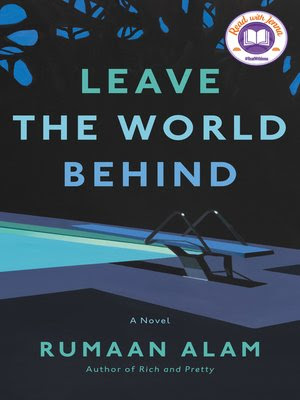

Blame it on the mood of this point in our history: there are eschatological similarities between this novel and the previous one, A Children's Bible. Happily, they enrich each other rather than detract. Leave the World Behind is suspenseful without being edge-of-your-seat. When it looks like the world is ending, what‘s most important to you? This character-based novel explores that question as well as issues of class and race. Brief glimpses into what is and will be happening elsewhere add just enough context for the listener, while following the people who end up sharing a house but are cut off from what‘s going on in the wider world.

“I remember thinking at first: oh this is so odd. People in spangled costumes; they dance for a few minutes and scurry off the stage and then they do it again. I thought it was a story, but a ballet is just a bunch of short things loosely organized around a theme that doesn‘t make much sense to begin with.”
Like life, Clay didn‘t say.

The End of Everything (Astrophysically Speaking) by Katie Mack
Audiobook [6 hr] read by Gabra Zackman and the author

Taking a long view (say, 7 billion years) is a comfort to me, a way to get beyond current anxieties about the state of the world. Bring on phantom dark energy, the multiverse landscape abd women scientists. I can‘t entirely grasp the theoretical concepts outlined by Katie Mack, but I‘m inspired by her creative thinking and her passion. And I really love her sense of humour.

But red shift is also connected to cosmic time. The expansion of the universe makes a lot of things weird in astronomy, and one of them is that we use what is essentially a colour, written as a number, to denote speed, distance, and the age the universe was at the time when the thing was shining. Physics is wild.

Human thermal radiation comes out at the low frequency of infrared light because we‘re much cooler than open flames, unless things are going very badly for us.

There‘s really no theory out there in which dark energy can destroy our planet before our own sun does the job. But vacuum decay is another matter.

Network Effect by Martha Wells
Audiobook [13 hr] read by Kevin R Free

And speaking of outer space, it was such a treat to be inside Murderbot‘s head again, that security unit creature who is part mechanical, part biological. Murderbot hates being touched but will do ANYTHING to protect those who‘ve earned its loyalty. Fifth in a series, it‘s a standalone, but why miss out on the earlier episodes? If you're looking for intelligent escape and entertainment, I highly recommend these. The first four are novellas and this one is longer. All five audiobooks are read by Kevin R Free. Space adventure with lots of action and social justice too. 

Crosshairs by Catherine Hernandez


The global rise in fascism in the real world makes this near-future dystopia particularly frightening and relevant. “Others”—people with black or brown skin, trans and disabled folk, etc—lose citizenship rights in Canada. Will the majority of the population just sit back and do nothing? A fast-paced climate change novel that reminds me of Cherie Dimaline‘s The Marrow Thieves.

When I do not act, I am complicit!
When I know wrong is happening, I act!
When the oppressed tell me I'm wrong, I open my heart and change!
When change is led by the oppressed, I move aside and uplift!

[The anthem of white allies]

The Beguiling by Zsuzsi Gartner


Dark, very funny and very weird. I was immediately swept up in this bizarre tale of a mother in Vancouver who can‘t cope with motherhood, and to whom strangers keep confessing their deepest secrets. All of their stories eventually link together—I found myself flipping back to previous pages to ascertain details—and I felt the weight of grief by the end. 

The Beguiling and Crosshairs were both eligible for the Giller prize, so I'm considering these to be part of my Shadow Giller project, even though the Giller has already been awarded. The Beguiling was a finalist for the Writers' Trust Fiction Prize this year.

“Give me my epidural!” I hollered. “I want my fucking epidural!” But it was a rapid-fire labour & too late for even a pathetic little extra-strength Tylenol.
“I‘m going to roar like a lion,” I announced in an oddly calm & determined voice to the sweaty & excited faces around me. And I did. So ferociously the women in the fertility clinic in the next wing of the hospital fled en masse. All the impala of the Serengeti ran for cover. The MGM lion would have shit himself. The baby did shit herself in the womb, have I mentioned that? An advance deposit, I guess.

There were things that had flown out of my mouth on the trip home that don‘t bear repeating. The flight attendant actually asked Julian, as he sat placating the baby on his lap, “Is this woman bothering you?” He replied, “This woman is my wife.” Were sadder words ever spoken by a man?

“Not everything is Julian‘s fault. Actually”—this was drawn out to its full four syllables, each one punctuated by a bullet with my initials scored on its casing—“nothing is Julian‘s fault.”
62 pounds of porcelain-skinned, coruscating disdain, sparking like a Catherine wheel and who could really blame her? People say adolescent girls tend to turn on their mothers. But could I really be considered her mother? (I am the eggmom, they are the eggmoms, I am the walrus, goo goo g'joob.)

[…] may have been the best thing that ever happened to me. It triggered the confessions that added a dimension to my life otherwise undreamt of in philosophy. And it freed me, in the sense of freedom meaning nothing left to lose, although I would not have traded all my tomorrows for even a single yesterday or all the la-las and da-das in the world.

He barked at anything that moved, including dust motes, targeting them with his quivering eyes as if each one were a personal enemy. Poor little creature had all the signs of PTSD. He had seen the enemy and the enemy was us.

Sharks in the Time of Saviors by Kawai Strong Washburn


This novel about a poverty-stricken Hawaiian and Filipino family looks at interpersonal dynamics and responses to tragedy, via the rotating distinctive voices of all five members. It is grounded in an understanding of the colonial economic forces underlying poverty. There‘s also a fantastical element connected to traditional Hawaiian spiritual beliefs; it gives this novel a feeling of expansion and triumph over hardship.

If someone were to ask me what money means this would be what I would say: The world feels like it will stay under you no matter what you do.

“So life‘s still good at home?” I said. “You and Mom still doing your thing?”
“What, you mean like sex?” he asked. “Yeah, we still oofing. In fact, just last night we was —“
“Dad—“
“No, serious, just last night we went for happy hour at Osmani Bar and I was like, ‘Babe, no one gonna see nothing in the parking lot and—‘“
“Dad! I‘ll hang up the phone. I swear to God.”
He laughed and laughed. “Only joke! Sheesh, everyone‘s all uptight over there.”

I‘ve learned that laughter is the first wall he puts up against the hurt of the world. The walking he‘s doing now is what comes after that wall is smashed apart.

On Lighthouses by Jazmina Barrera, translated by Christina MacSweeney


A microhistory of lighthouses, mixed with memoir, travel, science and literature: this little book is a gem. Mexican author Jazmina Barrera‘s introspection on why she is so passionate about lighthouses adds to the appeal.

The Fresnel lens brought about the greatest revolution in lighthouse history. The stepped surface allows for a large aperture and short focal length; the lens occupies less space and uses fewer raw materials. It is, in addition, beautiful, like those monstrous animals that glow in the depths of the ocean.

Bruce Chatwin stopped collecting art because the pieces anchored him to one place and he wanted to travel, but he discovered that travel was another form of tyranny since “as you go along, you literally collect places.”

84, Charing Cross Road by Helene Hanff
Audiobook [2 hr] read by a full cast: Barbara Rosenblat; John Franklyn-Robbins; Jill Tanner; Shristina Moore; Simon Prebble; Barbara Caruso; and Davina Porter


This collection of correspondence between a New York writer and a London bookseller in the mid-twentieth century is delightfully presented as a multicast audiobook
 production.

We are all hoping for better times after the election. If Churchill and company get in, as I think and hope they will, it will cheer everyone up immensely.

Over the Rooftops, Under the Moon by JonArno Lawson and Nahid Kazemi


Ethereal mixed media illustrations by Iranian illustrator Nahid Kazemi match the philosophical tone of Canadian JonArno Lawson's poetic text about solitude, community and interconnectivity. It‘s truly a picture book for all ages because adults and children alike are apt to absorb new insights into life‘s big questions. Enigmatic, exuberant, and somewhat unsettling.
Color arrives, sometimes when you least expect it.

Small in the City by Sydney Smith


Ink and watercolour artwork matches the somber mood in this story about a child looking for a lost cat. Sydney Smith has previously won awards for picture books he‘s worked on with other people. This is his first where he‘s gone solo. The results are spectacular, with perfect pacing and moody art. This gorgeous picture book is on several noteworthy best-of lists and has garnered a Governor General award, a TD Canadian Children‘s Book award and the inaugural Sheila Barry Best Canadian Picture Book award.

“Even the term “children‘s book” can be limiting. We all have limited ideas surrounding what it is to be a child and it‘s hard to dive deep when you are jumping from such a low height. Instead, we should be asking what is to be human, including children. And then just write for yourself.”
—Sydney Smith, from an interview here: Art of the Picture Book


Being Frog by April Pulley Sayre


Natural science and poetry in picture book format. Simple rhyming text and gorgeous photography add up to a perfect introduction for young children to Rana clamitans, the green frog. The author‘s note at the end contains more information and points to further resources.

In many children‘s books, a frog is a character. It has human thoughts and habits. It is basically a human in a frog suit. I love these imaginary frogs, but I also like real ones. Real frogs are not humans. But they are not toys, either. They are animals. They are alive. They are beings.
—from the Author‘s Note

Killer Style: How Fashion Has Injured, Maimed and Murdered Through History by Alison Matthews David and Serah-Marie McMahon


Scary—and highly entertaining—examples of the dangers inherent in fashions: mercury used to make 18th-century hats; exploding celluloid hair combs; lethal makeup and hair dye; women strangled by scarves caught in machinery; flammable pjs and ballet costumes; poisonous fabric coloured green with arsenic; radium wrinkle cures; skirts and shoes that hobble movement; the dangerous working conditions in the garment industry... it‘s horrifying and fascinating. All ages.

Archaeologists discovered that early humans used rust to redden their hair in the Stone Age. Thousands of years later, ancient Romans made black hair dye by soaking leeches in red wine for 40 days. And to cover up grays? They prepared a mixture of boiled walnut shells and charred earthworms.


Sunday, November 8, 2020

Shadow Giller Jury Selects a Winner for 2020

No discussion was necessary because our Shadow Giller jury was unanimous in our choice of a winner this year:

How to Pronounce Knife by Souvankham Thammavongsa


My thoughts: These quiet stories, told with compassion and humour, feature Laotian refugees and immigrants. They are bus drivers, beauticians, farm labourers and factory workers—hard-working, self confident people. People who carry a sense of home within themselves. People who know the power of laughter. There’s a lovely porous quality to Thammavongsa’s writing: it holds the sense of possibility in all that is unsaid and unnamed. 

More from the other jurors at Shadowing the Best of CanLitAnd the winner is

The official Scotiabank Giller prize judges will announce their choice tomorrow evening, November 9, 2020. The ceremony will be online.

Saturday, October 31, 2020

October 2020 Reading Round-Up


While healing from broken toes on both feet (too much exuberance; don't ask me more) and repetitive strain in both arms (too much blogging of reviews as a Giller shadow juror), I've had plenty of time to read in October. I've been fussy, too, abandoning a couple of books that weren't holding my interest. Yaa Gyasi's Transcendent Kingdom was one; no doubt it was just the wrong book for me at the time, since I loved her first, Homegoing.

What follows are a dozen brief reviews and selected quotes from some reading (and audiobook listening) highlights this month:

Breasts and Eggs by Mieko Kawakami
Translated by Sam Bett and David Boyd


A story of two sisters in today‘s Japan. One is asexual. They grew up in poverty & don‘t have much money as adults. Not much happens, yet I found the characters fascinating; getting to know them from the inside is the treat of this immersive novel. Serious issues are tackled, including parenthood, gender roles in society, cosmetic surgery, and choosing to live one‘s life against the grain. 

        Beauty meant you were good. And being good meant being happy. Happiness can be defined in all kinds of ways, but human beings, consciously or unconsciously, are always pulling for their own version of happiness. Happiness is the base unit of consciousness, our single greatest motivator. Saying “I just want to be happy” trumps any other explanation.

        I unlocked the door and entered the familiar assortment of shadows. It was uncomfortably cool, almost like winter. The carpeting felt damp. It actually smelled like winter. Which was funny, since I hadn‘t noticed it outside. Does that mean the smell was inside my apartment? When the temperature and intensity of the sunlight and the quality of night all met certain criteria, did that smell issue from the books and clothes and curtains and the other nooks and crannies all at once? Remembering something.

        Once I was reclined there in the darkness with my eyes closed, I felt like my brain was being broken down and packed away. I couldn‘t fall asleep.

Just Us: An American Conversation by Claudia Rankine


Claudia Rankine is amazing, not only for her intellectual rigour in these essays about the racist structure of American society, but also for her open-minded engagement in conversation with white people—friends and strangers—on this topic. Her desire to understand racist viewpoints strikes me as a useful step in dismantling them, and then moving on to the next step: creating a better future.

        My own interracial marriage exists inside a racist America whose ways make life more difficult. Many times driving in NYC and NJ, we were pulled over by police and asked how we knew each other; there are all the places my husband walks into while I‘m stopped at the door; and there are the white women who understand our relationship to be anything but a marriage as they step between us to flirt.

        A friend insists that attaching blondness to whiteness and white supremacy is ridiculous. It just looks better on most women, she claims. I am not white, so I try to inhabit her form of certainty. My friend‘s unwillingness to interrogate why “better” and “blond” are married interests me.

        The idea that one can stand apart is a nice fantasy but we can‘t afford fantasies.

        A white friend tells me she has to defend me all the time to her white friends who think I‘m a radical. Why? For calling white people white? For not wanting black people to be gunned down in our streets or black girls to be flung across classrooms & thrown to the ground by officers? What does that even mean? I ask her. Don‘t defend me. Not for being human. Not for wanting us to simply be able to live.

Projections edited by Rebecca Romney


Speculative fiction from the past -- published between 1836-1998 -- have been selected by Rebecca Romney for the way these stories reflect on contemporary reality. It's a literal box of delights: the dozen attractive, individually-bound booklets in this anthology come packaged in a gorgeous container. It's published by Hingston and Olsen, the same talented duo that has been creating Short Story Advent Calendars.

The New Wilderness by Diane Cook
Audiobook [13 hr] read by Stacey Glemboski


It‘s fitting that Emily St John is the author chosen for the cover blurb on this compelling and unsettling near-future survivalist tale, since both authors explore group dynamics under extenuating conditions. The mother-daughter relationship at the core of Cook‘s novel is practically visceral in its depiction. I was completely swept up.

        There used to be a cultural belief, in an era before she was born, that having close ties to nature made one a better person. And when they first arrived in the Wilderness, they imagined that living there might make them more sympathetic, better, more attuned people. But they came to understand there'd been a great misunderstanding about what better meant. It's possible it simply meant better at being human, and left the definition of the word human up for interpretation.

        What made it one of the most popular magazines in circulation were the vintage spreads it printed every month. Scenes from the archives of the old days: old estates, sprawling penthouses, rustic sheep farms, front porches, lawns, and even sky blue pools. Views of landscapes that were nice to look at, of attics, of homes in all sorts of weather. These were astonishing to look at now.

Hamnet and Judith by Maggie O'Farrell
Audiobook [11 hr] read by Daisy Donovan


Another audiobook that totally swept me away. The impact of a child‘s death is exquisitely portrayed, with all of the deeper resonances that accrue from choosing to place the family in the path of a (bubonic) plague and for the male head of that family to be a 16th-century English playwright whose name is recognized worldwide today, even though it is never mentioned in the novel. But why did the Canadian publisher change the title? (In the UK it's simply Hamnet.)

        She grows up feeling wrong, out of place, too dark, too tall, too unruly, too opinionated, too silent, too strange. She grows up with the awareness that she is merely tolerated, an irritant, useless, that she does not deserve love, that she will need to change herself substantially, crush herself down if she is to be married.

Interior Chinatown by Charles Yu
Audiobook [4 hr] read by Joel de la Fuente


This novel about anti-Asian racism in the USA is playfully inventive... and also heartbreaking. 

        “I have to talk with an accent because no one can process what the hell to do with me. I‘ve got the consciousness of a contemporary American and the face of a Chinese farmer of 5,000 years ago. Asian man. It‘s a fact. Look it up. No one likes us.”        

        “Falling in love is a story.” She says that telling a love story is something that one person does. Being in love takes both of them. Putting her on a pedestal is just a different way of being alone. 

          She brings incense and a shrine to her ancestors and a smaller one for a particular minor deity, the god of immigration and prosperity and real estate transactions, which started out a long time ago as the greater spirit of irrigation and good fortune and agriculture. This is the deity who understands, above all, location, location, location.       

        You hold your daughter in your arms. She looks at you and you know that she came from somewhere else. Somewhere beyond your comprehension, the little tiny interior space you‘ve been living in, inside your own dumb head. You know that she is an alien from another planet here to save you, a being from some far away land. She takes one look at you, and you know that she knows things about you, and you know things about yourself you didn‘t before. You‘ve been a father for approximately 10 seconds and you know for certain that you will never be the same.

Azadi: Freedom. Facism. Fiction by Arundhati Roy


The crystalline essays in this collection are mostly adapted from lectures given between June 2018 and April 2020. Azadi—Freedom—is a rallying cry for social justice in the Indian subcontinent. May the humane, intelligent voice of Arundhati Roy challenge the murk of fascism and shine a light towards a better future.

        As India embraces majoritarian Hindu nationalism, which is a polite term for fascism, many liberals and even communists continue to be squeamish about using that term. This, notwithstanding the fact that RSS ideologues are openly worshipful of Hitler and Mussolini, and that Hitler has found his way onto the cover of an Indian school textbook about great world leaders, alongside Ghandi and Modi.

        Is fascism a kind of feeling—in the way anger, fear and love are feelings—that manifests itself in recognizable ways across cultures? Does a country fall into fascism the way a person falls in love? Or, more accurately, in hate? Has India fallen in hate?

        The principles of equality are anathema to the caste system. It‘s not hard to see how the idea that some human beings are inherently superior or inferior to others by divine mandate slides easily into the fascist idea of a “master race.” To escape the tyranny of Brahminism over the centuries, millions of Dalits and people from other subjugated castes converted to Islam, Sikhism or Christianity. So, the politics of Hindu nationalism and its persecution of minorities is also intricately intertwined with the question of caste.

        Today, 13 February 2020, marks the 193rd day of the Indian government‘s shutdown of the internet in Kashmir. After months of having no access to mobile data or broadband, now 7 million Kashmiris, who live under the densest military occupation in the world, have been allowed to view what is known as a white list—a handful of government-approved websites. […] It‘s the equivalent of giving a thirsty person water from an eyedropper.

        Reporters Without Borders say that India is the fifth most dangerous place for journalists in the world, ranked just above Afghanistan, Syria, Yemen and Mexico.

A Burning by Megha Majumdar

There‘s no art besides fiction that lets you live inside the consciousness of other people. In this novel set in Mumbai, India, rotating viewpoints of three main characters bring to heart the prejudice, injustice & inequality that's embedded in Indian society. My heart broke for Jivan, wrongfully accused of being a terrorist. Lovely, a hijra, is appealing in her irrepressible ambition. Even PT Sir‘s ignoble actions are understandable.


A History of My Brief Body by Billy Ray Belcourt
Audiobook [4 hr] read by author


In emotionally intense vignettes, Belcourt documents his first 25 years as a gay Nêhiyaw man, reaching for the poetic possibilities in life. These erudite essays focus on his self-reinvention after leaving his northern Alberta reserve to attend university and subsequently earn a PhD in English. Belcourt writes about finding joy, connections and purpose, despite the racism in Canadian society. 

The creative drive, the artistic impulse, is above all a thunderous yes to life.

How Not to Spill by Jessica Johns


Like Billy Ray Belcourt, Jessica Johns is queer and Nêhiyaw from northern Alberta. Her first poetry collection is only 40 pages, so it didn‘t take long for me to read through it twice. And I will read through it again, because I can't get enough. “My ceremony is facetiming my nieces & nephew every sunday.” From badass grandmothers to dreams about MySpace, love letters, warnings and doorways: these are poems about holding on to beauty no matter what.

        if i were
        a tornado i‘d make sure to drop
        something nice off at your house:
        a dairy cow, a bouquet of wheat
        from alberta, a time machine.

----------

        I FELL IN LOVE ON TWITTER

        which if you didn‘t know
        is the worst place to fall
        in love or lust
        to be earnest
        & funny
        & cree
        & queer
        & every other
        beautiful thing

The World Is Round by Nikky Finney


I picked this collection up to revisit Nikky Finney‘s poetry while waiting for her newest work. Her fierce, joyous, loving celebration of ordinary people—especially black women—lifts my heart. From an unborn child, to a beloved grandmother, to an adult lesbian daughter, to the “sun‘s womb,” these poems encompass the personal, the political, and more. The World Is Round, first published in 2003, stands up firmly against the test of time.

        I cast out among the learned and teach
        to alter sleeping states. I stand before the
        university pond and fish for the living who
        send air bubbles up to the learned who know
        real life bestows no terminal degrees.

----------

        “Ain‘t Too Proud to Beg”
            —The Temptations, 1966

        Ho Chi Minh
        and my father
        chain-smoked
        Salem cigarettes
        all their lives.

        I am my father‘s
        manifesto.
        His little red book
        begging him to stop.

The Good German by Dennis Bock
Audiobook [7 hr] read by Adam Verner


What if Hitler had been assassinated, and then Germany signed a treaty with the US and won WWII after dropping an atomic bomb on London? From the 1940s — 60s, we follow the lives of several people of German ancestry in Canada, where they are persecuted simply for being German. Meanwhile, across the US border, antisemitism grows. 
A thoughtful alternate history. Is guilt a form of madness? Who is responsible for the suffering and tragedy in our lives? 

        “Don‘t ever think in absolutes, okay?” he said. “There‘s always something hopeful out there, something to strive for.”

Banned Book Club by Kim Hyun Sook, Ko Hyung-Ju, and Ryan Estrada


The author‘s true story of her political activism in South Korea, in 1983 when she was a first-year university student. The well-drawn cast of characters tugged at my heartstrings and their fervour in the face of oppression is inspiring. The final chapter, set in 2016, shows all of them gathered to protest another corrupt government but also aware of the gains that their efforts realized over the years. Black and white comics format.


Hyun Sook: Did they take you in for questioning?
Yuni: That‘s what THEY called it.
Hyun Sook: Was it as violent as what happened to Hoon and Jihoo?
Yuni: When it comes to women, they inflict a different KIND of violence. The kind that doesn‘t heal. The kind you can‘t wear like a badge of honour. The kind I hope you never have to experience.


Sunday, October 25, 2020

Always Brave, Sometimes Kind by Katie Bickell


Always Brave, Sometimes Kind by Katie Bickell
Brindle and Glass, September 2020

A jigsaw puzzle of a novel that appeals to my social justice warrior self.

Set in various parts of Alberta, we follow about 40 recurring characters as their lives intersect over the decades between 1994 and 2016. Painted in broad strokes, these people are nonetheless surprising: a saintly person who is closed-minded on one issue, or a mean person who does something selfless.

The two central families are multigenerational. One is headed by a medical doctor, a South Asian immigrant and widower, who lives in Edmonton. The other is headed by an Indigenous woman, widowed while her three children were still young, who lives on a First Nations reserve in northern Alberta.

The chapters are episodic pieces to a larger picture of interconnectivity. What I enjoyed most is the portrayal of Alberta's social fabric over time, and the way it has been affected by government policies and the vicissitudes of oil prices. It's a novel that touches on many social and economic issues such as missing and murdered Indigenous women, mental health, racism, protests at abortion clinics, gender inequality, online harassment, mad cow (BSE) disease, homelessness, the Temporary Foreign Workers program, the opioid addiction crisis, religious extremists, labour disputes (hospital support staff and teachers), minimum wage, and the rise of white supremacists in Alberta. 

The most crucial issue of this novel has to do with what has been called the "Sixties Scoop," the four-decades-long governmental policy and practice of removing massive numbers of Indigenous children from their homes and placing them up for adoption or in foster care. "Private adoption agencies made a killing," as one of the characters points out.

        Dolly thought of the first photograph she'd ever seen of her son. The child had been listed for adoption in a Keep Sweet magazine her visiting sister had brought up from Utah. There were three [siblings] pictured: wee little Jack with the sparkly eyes, a girl about the same age as Susan, and an older boy listed as Wilf. [...] The ad suggested Wilf as a good fit for rural families in need of free labour, but that the little ones were sweet and playful and all three were in excellent health. The children's mother had been recently widowed. In the section listing the reason why the Albertan government had apprehended the children it simply read: Impoverished.
        [...] A Child Is Waiting, Jack's caption read. The Quentin family could have him for as little as four thousand dollars. Dolly so wanted another, and the boy obviously needed a home.
        "It isn't right," Earl said at first, adopting a child like they were ordering a Chatty Cathy from Sears Roebuck. But Earl had always wanted a son, Dolly argued, and little Jack was from Alberta. That meant he was already one of their own -- they couldn't let him go to America or Europe or Timbuktu! So many little Indian children were being scooped up and scattered all around the world. Now that just wasn't right.

Righting historic wrongs is a theme that left me with a hopeful feeling after I finished reading Always Brave, Sometimes Kind.

------------------

Note: Thank you to the publisher for supplying a review copy.

This post is part of a series. I'm on the Shadow Giller jury this year, so I've been reading as many qualifying Canadian titles as possible. To see my other posts that are a part of this project, click on the Shadow Giller tag. Also, please visit our Shadowing the Best of CanLit website to see what the rest of the Shadow Giller jury are up to. Thanks for visiting my blog.

Wednesday, October 14, 2020

Tim Hortons References: The Cup Overflows!

Enjoy a little book tour via a collection of Tim Hortons references. 


I took this photo exactly one year ago, while in Toronto for Thanksgiving.
(Can you spot the Tim Hortons?)

   
    Our food stores can't be beat. It's true that the Bay closed down with its really neat Maxi, but in Chicoutimi we have at least two Metros, a couple of Intermarches, a big IGA, a big Loblaws, a Maxi, a Super C. The Corneau Cantin too, but they're expensive and are always on the verge of going bankrupt. Still, when you get your Publisac at the beginning of the week, you can find good bargains. There's also Tanguay, which isn't bad, a huge Gagnon Freres with an escalator, the Bureau en Gros, an Omer DeSerres, all the dealerships (except for luxury cars), three Tim Hortons, soon to be four, a super Pacini, where you can make your own toast, a Casa Grecque with a salad bar, a Scores with a nice salad bar too, a great new Jean Coutu across from the other Jean Coutu, but twice the size; in fact we're up there with just about anybody, even people in Quebec City. A great Winners, a Pennington, an H&M that's coming soon. (p 20-21)

        I view the whole scene from the roof of Tim Hortons, onto which I have climbed. The daring of my friend by default has inspired me. It will soon be my turn to play. I climb down to pedal to the end of the world. To watch the world burn, I put on my helmet. (p 181)

-from You Will Love What You Have Killed by Kevin Lambert, translated by Donald Winkler

--------------------

        She knew she was being vain, but she was excited for her old university friends to see her updated look. Seeing Sunil again, however, might make for a complicated reunion. The last time she had been alone with him was a few years ago, during a late-night study session at a Tim Hortons. 
[...]
        "Hello, Serena, don't you look well," Karen said. She was rosy cheeked and plump, and Serena couldn't help but notice the giant diamond she waved around on her left hand. An apple scent wafted from her. "Quite a small dress you have on."
        "She can rock it though, huh?" Kal grinned as he leaned over to kiss Serena's cheek. "If it isn't Miss 'One Hundred and One Questions' herself! God, I remember how much you bugged me when I asked you to join the University Indian Association years ago. Serena was all, 'What counts as an Indian?' By the time graduation came around in 2001, she was standing with all us Indians for pictures. I hope you know the answer to your question now, Serena. Good to see you."
        Serena blushed, remembering her younger self, immersed in women's studies, desperate to find a place to fit in. How could she even have questioned who counted as Indian? The answer met her in the mirror when she stared at herself every day. She smiled at the group. Sunil was the only one who didn't meet her gaze.
        "How are you, Sunil?" she found herself asking. For a brief moment, it was as if Kal and Karen had vanished. Only she and Sunil were sitting at a table covered with textbooks and Timbits. She wondered what would have happened if she had given Sunil a chance to be her boyfriend -- if she had looked past the fact that he was a man immobilized by his shyness and allowed him to take her on a proper date. Would she be married with children by now? Would she be living in a house somewhere in the suburbs? (p 135-137)

- from The Desirable Sister by Taslim Burkowicz

--------------------

        The next day he sent me Sup again and told me he was helping organize a show to buy the singer dental implants. We chatted for weeks: I told him about studying for my first midterms and he told me about working at Tim Hortons. When I found out I was going to be playing the part of the Cheshire Cat in the school production of Alice in Wonderland, he wrote, They should have made you Alice.
        I told him I wanted to be the Cheshire Cat, it was a more interesting role. I fantasized about inviting him to see me slinking around the stage in my black turtleneck and leggings with whiskers painted on my face.
        Sometimes he'd say, Too bad you're so young, and I'd say Why? and he'd say Never mind. (p 54)

        Eventually Holly got a text from a guy who said his ex-girlfriend had the dogs. She met him in a Tim Hortons and they drove together to the building where his ex-girlfriend lived.
        "Were you scared?"
        "No, that's why I met him at the Tim Hortons first, to make sure he wasn't," she paused, "scary, I guess."
        "What about when you got in the car?"
        "I trusted him, after talking at Tim Hortons," she said. "You just have to listen to your gut in those types of situations." (p 62)

-from All I Ask by Eva Crocker

--------------------------
  

      The average adult female should consume only 6 teaspoons (25 grams) of added sugars a day. The average adult male should consume only 9 teaspoons (38 grams) of added sugars a day. [...]
        North Americans eat 16 to 21 teaspoons of added sugar every day. If it's hard to wrap your head around that number [...] consider the iconic Iced Capp at Tim Hortons. A large Iced Capp contains 15 teaspoons of sugar. According to the new guidelines, that's a little more than twice the recommended daily amount for a woman.

-from Peace, Love and Fibre: Over 100 Fibre-Rich Recipes for the Whole Family by Mairlyn Smith

---------------------

        "You look like you could use a cup of coffee," he says. "Don't worry about your friend, okay? Sandra's going to take good care of her. Look, see the Timmy's right down the hall, by the elevator?" He points to a sign and digs in his pocket. "let me get you some cash."
        Shannon shrugs his hand off her elbow and he steps off. "Do I look like I need your money?"
        The girl behind the Tim Hortons counter wears an immaculate French braid and no makeup. Her uniform is boxy and nothing about her says sex, only work. Everything screams temporary foreign worker. Probably still fresh off the boat.
        "Black," Shannon snaps. "No sugar."
        "Yes, ma'am, one minute, one minute." The worker talks weird, her mispronounced words pitched in apology. She offers a quick smile but drops it when she sees Shannon's face. It's another two minutes before she figures out the till and takes the change Shannon's held out the whole time.
        Shannon taps her foot. She doesn't have time for this shit. She's got to get to the airport, pay the rent, the damage deposit. She could have been there and back twice by now.
        "Hello? I said black." The girl flinches, spilling the cream she's poured into Shannon's coffee. Shannon turns to the man in line behind her. "Think anyone here speaks English?" (p 89)

        The bush outside the Fort McMurray conference centre had acorns on the ends of its branches that grew straight up like it was giving the world a gazillion middle fingers. Eff you, idling semi truck! Eff you, Tim Hortons drive-thru next door! Eff you, minivan mom with oversized sunglasses! You look like a stupid bug!
        Mom keeps talking, but Zoe pretends she can't hear. (p 99)

        It doesn't seem right, doing all that work and letting someone else take the credit. Like when the twins won Most valuable Players at the World juniors last year and thanked Dave on camera for coaching the Timbits team they played on as little kids, but actually it was Lacey who had coached four of the six weeks because Dave was stuck in camp all season. (p 150)

        Glass in one hand and bottle in the other, Karen returns to the ladies. She walks the circle made around the psychic's wobbly little table, refilling glasses. The group's token non-executive wife (only invited because the executive husbands wanted her field-operator husband to bring their three National Hockey League sons to their annual golfing retreat) lifts a giant Tim Hortons paper cup and beams a smile just as warm and homey as the coffee.
        "I've got my double-double, but thanks, Karen." The woman tilts her head to the side, but her 1990s feathered bangs don't move an inch.
        What was that old joke? The bigger the hair, the closer to God?
        Karen pats her shoulder. She's always had a soft spot for women like Lacey, round and thick and a little boring. Sincere people make the nicest company, their happy-go-luckiness a salve for the jaded-but-glamourous. (p 170-171)

-from Always Brave, Sometimes Kind by Katie Bickell

--------------------

I'm pleased that other readers occasionally send me Tim Hortons sightings:

        Somewhere in rural Quebec we stop at a Tim Hortons for a bathroom break. There's a payphone out front and I have two prepaid phone cards in my pocket from Strane with instructions to call if I get lonely.

-from My Dark Vanessa by Kate Elizabeth Russell
with thanks to @la_rose_noire of Litsy

---------------------------

        I went for a run this morning in my old gym shorts, with a Tim Hortons gift card (a parting gift from the parents; they believe in well-caffeinated students) tucked inside my hoodie. I ran for half an hour, stopped for coffee, then took my time walking home. (p 43)

-from Nice Try, Jane Sinner by Lianne Oelke
with thanks to @LauraBeth of Litsy

For more Tim Hortons excerpts, click here.

Sunday, October 4, 2020

Giller Shortlist Prediction 2020

I hope these six titles will be on the official Giller prize shortlist:


The official shortlist announcement will be tomorrow, October 5, 2020;  watch it streamed live online at 8 a.m. MDT. 

-----------
This post is part of a series. I'm on the Shadow Giller jury this year, so I've been reading as many qualifying Canadian titles as possible in order to come up with my own predictions before the official announcements. To see my other reviews that are a part of this project, click on the Shadow Giller tag. Also, please visit our Shadowing the Best of CanLit website to see what the rest of the Shadow Giller jury are up to. Thanks for visiting my blog.