Showing posts with label biography/memoir. Show all posts

Sunday, April 30, 2023

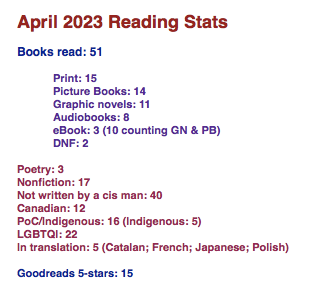
April 2023 Reading Stats and Booktube Activity

I went through a lot of books this month! Out of 51, these are the best (in alphabetical order):

A Is for Bee: An Alphabet Book in Translation by Ellen Heck

Birnam Wood by Eleanor Catton

Brown Girls by Daphne Palasi Andreades

Butts: A Backstory by Heather Radke; audiobook read by Emily Tremaine

Old Babes in the Woods: Stories by Margaret Atwood

Permafrost by Eva Baltasar; translated by Julia Sanches

Remember by Joy Harjo and Michaela Goade

The Tender Narrator by Olga Tokarczuk; translated by Jennifer Croft and Antonia Lloyd-Jones

Thick Skin: Field Notes From a Sister in the Brotherhood by Hilary Peach

The Third Person by Emma Grove

Thistlefoot by GennaRose Nethercott; audiobook read by January Lavoy

Unraveling: What I Learned About Life From Shearing Sheep, Dyeing Wool and Making the World's Ugliest Sweater by Peggy Ornstein; audiobook read by the author

Wash Day Diaries by Jamila Rowser and Robyn Smith

Welcome to St Hell: My Trans Teen Misadventure by Lewis Hancox

What Feelings Do When No One's Looking by Tina Oziewicz and Aleksandra Zajac; translated by Jennifer Croft

These are the two I didn't finish:
April readathons on booktube:

Trans Girl April - I read 13 books by trans and nonbinary authors
Picture This - I read 14 picture books (actually more, but I didn't count them all)
People April - I read 10 books of memoir or biography, including the group read, The Five
Read Across Canada - Manitoba - I haven't yet read the one I chose (Wild Geese)

My goal to read from my own shelves: I read 4 (all purchased in 2023)

Booktube uploads:


Friday, December 31, 2021

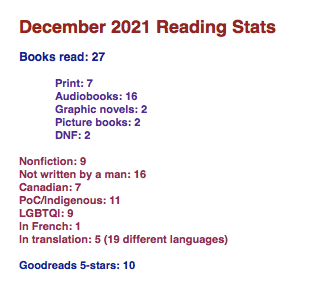
December 2021 Reading Round-Up


This will be more brief than my usual monthly wrap-up because I'm healing from a concussion and can't spend much time reading or looking at screens. It's day 23 and I am improving steadily. Audiobooks have been a blessing, and also loved ones who have read aloud to me. Here's a list of my highlights from December (in no particular order):

Talking to Canadians by Rick Mercer

The Lion's Den by Anthony Marra

This Is Your Brain on Stereotypes by Tanya Lloyd Kyi and Drew Shannon

The Sentence by Louise Erdrich

State of Terror by Hillary Rodham Clinton and Louise Penny

Starbird by Sharon King-Chai

1000 Years of Joys and Sorrows: A Memoir by Ai Weiwei, translated by Allan H Barr

The Beatryce Prophecy by Kate DiCamillo

Dorie's Cookies by Dorie Greenspan
(Note: I read most of this cookbook in November, and I tried out about 9 or 10 recipes. Yummy!)


Wednesday, December 1, 2021

Best LGBTQ Books in November

Here's part three of my picks from November's reads: all by queer authors. November's part one, audiobooks, can be found here. Part two, a lovely mixed bunch, can be found here.

Kimiko Does Cancer: A Graphic Memoir by Kimiko Tobimatsu and Keet Geniza


At 25, Kimiko Tobimatsu was diagnosed with mucinous breast cancer. This comic-format memoir documents her experience navigating the medical system in Canada as a queer woman of mixed ethnicity. Attitudes towards traditional markers of femininity, the emphasis on maintaining a positive outlook, flashy cancer fundraising campaigns, and work ethic while incapacitated by illness are just some of the issues thoughtfully explored. Appealing art by Keet Geniza is a perfect complement.

It probably doesn‘t help that I tie my masculinity—and, really, my value—to being able to provide for others. Whether it‘s running errands, baking or offering emotional support, I tend to focus on my output as the key way I affirm my butchness, dykeness, whatever you want to call it. This isn‘t sustainable post-cancer.

There‘s not a lot of writing out there on cancer and disability. Maybe because for those of us who are now cancer-free, the ongoing symptoms are after-effects (of surgery, radiation, meds), not the result of disease still being present. Or maybe it‘s because the mainstream cancer narrative is about overcoming adversity, not about experiencing ongoing disability.

Luckenbooth by Jenni Fagan

A bracing romp through the 20th century in Edinburgh, starting with arrival of the devil‘s daughter in 1910 and tying up the loose ends of her fate in 1999. There‘s a fascinating cast of mostly queer characters who, over the years, happen to live in the same building, folded into the history of the city and the larger world. A touch of horror, more than a few ghosts, and a large dollop of redemption. 

They say we are helpless, they say we are weak, they say we are nothing … they are liars!

— I didn‘t know poets were so well informed, Mr Burroughs.
— Don‘t trust poets unless they are scientists.

…films of novels make me uneasy. They‘re trying to steal words and put them into boxes. It‘s not where the worlds of novels are meant to be. My words exist in here you see, in my mind. Then they exist in your mind. Nobody else gets to see how they pass between us — it is a form of alchemy! Of all the art forms writing is the most intimate and strange.

His niece‘s set-up at Blossom‘s My Little Pony stables is highly elaborate. First off, Cupcake and Rosedust will bitch about Princess Sparkle. They‘ll talk about how disappointing she is. That she can‘t just be cheerful like them. They will cut her pony tail off. Write all over her stable in coloured pencil. They will steal her favourite things. Then they will trot off, very smug and happy with themselves.

I can verify now, thinking is the deepest act of transgression.

The Actual Star by Monica Byrne

Wow! Alternating between three timelines—Mayan civilization in 1012; Belize in 2012; and post environmental disaster 3012—this hefty, audacious novel tackles big ideas of how best to live on our planet. Monica Byrne‘s vision of a worldwide nomadic sex-positive society that evolves from climate refugees gives me hope. You may need patience for Kriol dialogue, Spanish, and invented future vocabulary that includes many terms for personal identity.

“What does entropy have to do with desire?”
“Well, as the universe comes apart, everything we desire will get farther and farther away. So we‘ll have to work harder to get it.”

18 December 3012
The human race has outgrown this way of life. Just like we outgrew monarchy and capitalism.

Birds are not birds; they are messengers.
This world is a world of deceptions.
This world is merely a representation of representations.
The star we see is not the actual star.

Field Study: Meditations on a Year at the Herbarium by Helen Humphreys

A balm for my soul. Helen Humphreys draws connections between plants and people in astute, quiet, poetic ways—seeking out the stories of collectors who contributed to the Fowler Herbarium in Kingston, Ontario, where she spent a year looking through over 140,000 specimens. This fascinating and contemplative literary work is the result. The book itself is beautifully designed and heavily illustrated: it would make a lovely gift.

This world is a world of disappearing species, but it is also still a world of wonder and beauty. And while we must all do more, and petition our governments to do more about the climate crisis, and not ignore the fact that humans are responsible for the destruction of species and habitat, we must also celebrate what is still here with a ferocious reverence.

A visit to the herbarium is an exquisite kind of time travel. And by learning more about the intersection of people and nature in the past, I hope to gain some understanding of where we can go from here.

The air was churning with coloured birds and the wheel of their songs.

Drawing is mostly looking, or an excuse to look long and hard at something. Francis HallĂ©, a botanist who also draws, says, “The extended time required for drawing amounts to a dialogue with the plant… Drawing represents the work of human thought.”

Just as I am drawn more to the character of some people, I also prefer the character of particular flowers, and in Queen Anne‘s lace, I prefer there to be space between the blooms and the umbrels, for the head of the flower to have an open appearance, the “lace” loose enough to see through to the field grasses below.

The observations that I have made of the natural world last in my mind because they were hard won. They were gained by hours and hours of watching or walking, hours and hours of looking but not entirely seeing, until the moment when some new piece of knowledge swam into consciousness. These moments of clarity are perhaps one of the greatest pleasures of being a sentient animal.

Raccoon by Daniel Heath Justice

Cherokee scholar Daniel Heath Justice‘s wonderful cultural history of raccoons joins 99 others in the growing Reaktion series, all of which focus on a single species. It‘s well-researched and lavishly illustrated. Rest assured that in the extensive chapter on etymology, the author has avoided including violent and degrading imagery that exemplifies the racist “coon” stereotype. Fun fact: gaze, nursery and mask are collective nouns for raccoons. My big takeaway, among the many things I learned, is the reason that raccoons are thriving: neophilia. They love new things, and so their curiosity makes them highly adaptable to our changing environment.

Even their physical characteristics seem designed to polarize: one observer sees adorable impishness in the black facial pelage, banded tail and hunched back, whereas a less generous viewer sees a masked cartoon criminal sneaking around in a striped prison uniform.

While Fes Parker‘s onscreen portrayals of Davy Crockett and Daniel Boone both featured coonskin caps, there is little evidence that the historical personalities themselves wore the now-iconic headwear.

Given that the English word raccoon comes to us directly from the Powhatan arakun, the inclusion of Meeko the raccoon as a sidekick is one of the few legitimate nods to historical accuracy in Disney‘s Pocahontas. […](Pocahontas was a child when she briefly met Smith, she was later kidnapped by the English and subjected to sexual abuse, the English killed her Powhatan husband and her ‘marriage‘ to Rolfe was anything but consensual.)

We so often expect an animal to behave like a docile little human in a fur coat, and such expectations are rife with dangers for both species, although raccoons obviously get the worst of it.

The heaviest raccoon on record was a domesticated northern raccoon named Bandit, who weighed an astonishing 34 kg (75 lb) when he died in Pennsylvania in 2004.

it‘s really, really important to me that Rocket Raccoon … is not a cartoon character, it‘s not Bugs Bunny in the middle of The Avengers, it‘s a real, little, somewhat mangled beast that‘s alone. There‘s no one else in the universe quite like him, he‘s been created by these guys to be a mean-ass fighting machine.
—Director James Gunn

Injun by Jordan Abel

Listening to Jordan Abel read his work is an ideal way to grasp what he is doing with language in this award-winning poetry book. I had been impressed when I heard him perform his work previously, but on the printed page I was initially baffled. Abel's brilliance was gradually revealed to me as I read the included supplementary material, the sentences with the word injun pulled from 91 public domain novels, and then through rereading the poems several times. Words in these collage poems become increasingly fractured as the book progresses. It took me awhile to realize that Jordan Abel‘s deconstruction is a way to decolonize literature. You can view Abel reading from his work on YouTube.

lets play      injun
and clean ourselves
off the       land

Fairest: A Memoir by Meredith Talusan

A thought-provoking memoir of a non-white trans woman with albinism who moved from the Philippines to the USA when she was in her teens. A member of my feminist book club chose this because she is half Filipino and had never read anything by someone from the Philippines. It sparked one of our best discussions ever, because of its nuanced portrayal of appearance, passing and identity. Also, it really shows the way queer culture has changed over a few short decades.

I felt a pang then, my conscience, but the collective voices of my photo professors drowned it out, with stories of how Diane Arbus woke subjects up at sunrise to get them at their most vulnerable, how Nan Goldin took out the door to her bathroom so she could take pictures of people having sex or doing drugs, and how the French artist Sophie Calle even worked as a maid at a hotel just to take pictures of guests‘ private belongings.

Gender transition provided me with much greater freedom of expression, the ability to determine the forms of femininity I wanted to embody, instead of feeling like I had to negotiate every feminine accessory or mannerism with a strict gay church that constantly threatened to reject me. I would have probably been bakla had I stayed in the Philippines, remained in that more indeterminate space in a culture where that was possible.

Cosmoknights (Book 1) by Hannah Templer

Lesbian gladiators (and a lesbian mechanic) rescue princesses … in space. The first volume of this speculative fiction graphic novel is so much fun that I immediately went to queer cartoonist Hannah Templer‘s website to read Book 2 in webcomic format. Print release of Book 2 is scheduled for Fall 2022. Templer's site is here.

--Rough day, huh?
--They put me in a dress.

Note Kate's 'Trans Teen Beauty Queen' tattoo.


Tuesday, November 30, 2021

November 2021 Best Books Round-Up

November stats: 41 books; and 26 of them were outstanding. I get fussier as I age so I will only read those books I think I will love. As a result, I read so many great books in November that I decided to break up my monthly round-up into three parts. The first part was yesterday, all audiobooks. Tomorrow will be all LGBTQ. And today is for the rest!

Everything Affects Everyone by Shawna Lemay

Be kind to yourself. Read this compassionate novel by multitalented Edmonton poet and photographer Shawna Lemay. Read it slowly. Within it, six women have conversations and contemplations about art, and about how best to live. Before the first page, its philosophical and experimental bent is revealed by the epigraphs, which are by the likes of Clarice Lispector, Hélène Cixous, and Rainer Maria Rilke. Later, Alan Watts is quoted on the distinction between belief and faith. I learned that the word angel comes from the word for messenger. I learned that angels eat Fruit Loops and whipped cream. I also learned it was impossible to rush through this book, because I kept stopping to savour the language and the ideas.

Everything will be okay. This is what I tell myself, and I think about what a good, sweet word is “okay.”

I want to know what characters are thinking and how they attempt to speak what‘s in their soul, honestly and simply. Or, alternatively, how they circle around things, how they attempt to conceal, or how they fail to express what they mean to convey.

The way we come to a conversation matters. The openness, the trust. Is every conversation a type of annunciation? Each person is an angel giving the other person, who is also an angel, a message. In that moment we are each responsible for the other. If one of the people in the conversation were to faint or to cry, for example, it would be up to the other person to act.

The angel bows to Mary and announces her fate. And some of what‘s happening in the image continues to speak to me. The deep bow of respect. The acknowledgment of beauty of another human being, the strength and endurance. The potential. Acknowledging the light in another being. Bowing to that light.

All of those artists painted angels, or found angels, and who‘s to say they didn‘t see or feel them? For me, it wasn‘t a question of belief in angels, but it was about a willingness to see what is there, and to witness the world with a deeper awareness. But also, to be open to the unseen world.

It is the questioning around the story that gives the story its dimension. But the story is there only as a kind of basic pretext.

There is an ongoingness that I wish to convey. The traditional narrative arc is wonderful, but it is not the only mode in which to talk about how things occur, how life rolls out, how life comes at us and is so boring and delightful at once, so unpredictable and so obvious, so weird and so lovely and hidden and open.

The air and the atmosphere are a miracle. We don‘t have to look around for examples of the miraculous; we need merely to breathe in and out, or move our hands through the air, the wind.

I like reading diaries better than novels, and better than watching movies. Diaries are life, you see. And life can be rather dull. Rather ordinary. If I have learned one thing, it is that the ordinary is more closely aligned with bliss and to splendour than to what might be deemed spectacular.

I know how to make myself appear completely ordinary so that I might observe others. What I observe is that not a single person on this earth is ordinary.

I was thinking about something so beautiful that I entered the silence of flowers.

The Years by Annie Ernaux
Translated by Alison L Strayer

I felt like I was swimming through time in company with French author Annie Ernaux, who intertwines personal and societal experiences in this memoir/cultural history spanning seven decades. The voice shifts between “she” for the author and “we” for the collective, managing to be both intimate and expansive. Not every detail (ie French politics) resonated, but I identified strongly with the changing landscape of women‘s lives and the rise of consumerism.

By their clothing, we could distinguish little girls from young girls, young girls from young ladies, young women from women, mothers from grandmothers, labourers from tradesmen and bureaucrats. Wealthy people said of shopgirls and typists who were too well dressed, “They wear their entire fortune on their backs.”

With the Walkman, for the first time music entered the body. We could live inside music, walled off from the world.

The USSR disappeared and became the Russian Federation with Boris Yeltsin as president. Leningrad was St Petersburg again, much more convenient for finding one‘s way around the novels of Dostoevsky.

Only teachers were allowed to ask questions. If we did not understand a word or explanation, the fault was ours.

But for the first time, we envisioned our lives as a march toward freedom, which changed a great many things. A feeling common to women was on its way out, that of natural inferiority.

Of all the information we received daily, the most interesting, the kind that mattered most, concerned the next day‘s weather. The rain-or-shine monitors in the RER stations displayed predictive, almanac-style knowledge that provided us with a daily reason to rejoice or lament, thanks to the surprising and yet invariable factor of weather, whose modification by human activity profoundly shocked us. 

Under the spell of media simplifications, people believed in the technological delicacy of bombs, “clean war,” “smart weapons,” and “surgical strikes”: “a civilized war,” wrote LibĂ©ration.

Under Giscard d‘Etaing we would live in an “advanced liberal society.” Nothing was political or social anymore. It was simply modern or not. Everything had to do with modernity. People confused “liberal” with “free” and believed that a society so named would be the one to grant them the greatest possible number of rights and objects.

Television sets were turned in for newer models. The world looked more appealing on the colour display, interiors more enviable. Gone was the chilly distance of black-and-white, that severe, almost tragic negative of daily life.

The word “struggle” was discredited as a throwback to Marxism, become an object of ridicule. As for “defending rights,” the first that came to mind were those of the consumer.

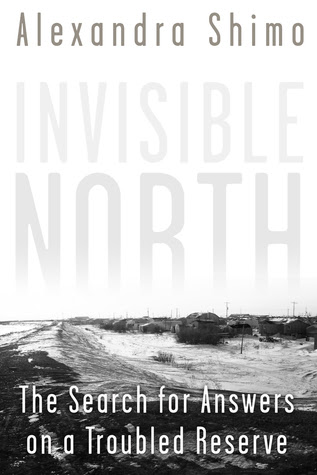
Invisible North: The Search for Answers on a Troubled Reserve by Alexandra Shimo

Lesbian journalist Alex Shimo had permission from the band chief to live on the reserve and document the story of unsafe water at Kashechewan in northern Ontario. But too much didn‘t make sense. Was it a hoax? Yet the shocking living conditions, the dire poverty—Shimo could see there was an important story to share with non-indigenous Canadians, but she struggled to maintain her mental equilibrium there. Words can hardly express how profoundly moved I was by this book.

This is where Canadian history differs from that of other developed countries, such as the United States and New Zealand, which also committed mass displacement of their Indigenous populations, but mostly stopped after the 19th century. As a result, Canadian First Nations have less land compared to those in other developed countries. For example, in the United States, Native Americans account for 2 percent of the population and reserves account for 2.3 percent of the total land. In New Zealand, Maoris account for 14.6 percent of the population and own 5.5 percent of the country. By contrast, Canadian Aboriginals make up 4.3 percent of Canada's total population, while reserves account for 0.2 percent of the nation. This, although Canada is an underpopulated, sprawling country near the size of a continent, with a land mass larger than the size of the United States and a population one-tenth the size.

Manikanetish by Naomi Fontaine
Translated by Luise von Flotow

Yammie left her Innu reserve, Uashat, on Quebec‘s North Shore, when she was a child. She returns 15 years later as a high school teacher. This quiet yet powerful novel documents a year of her experiences, connecting with her troubled but remarkable students, who face nearly insurmountable challenges. Meanwhile, she sorts out her own feelings of belonging to the place. This book pairs well with Shimo's Invisible North, because of the teenagers and the school situation in both.

An old, very wrinkled woman wearing the traditional Innu red-and-black felt bonnet. Not bothering to look directly at the camera. I was told later on that the missionaries were the ones who made Innu women wear the bonnets and keep their hair in braids rolled up on the sides of their heads and pinned at their temples. Because, with their long hair caressing their backs au naturel, they were beautiful. Attractive. Savage. Too beautiful for men of God and their oath of celibacy. They made them ugly.

Journal of a Travelling Girl by Nadine Neema

This remarkable chapter book for children (Grades 4-6) honours the traditional ways and stories of the Tłįcho people as well as a landmark historical moment in Canada: the signing of the Tłįcho land and self-government agreement in 2005. The action—external and internal—takes place through the eyes of 11-yr-old Julia while on an important canoe trip. Simple line drawings by Archie Beaverho accompany and enrich the text.

At the start of one of the portages, we saw a bird‘s nest that was so perfect it looked like a precious piece of art that someone had made for Easter. Inside, there were eight or nine eggs. It was just sitting there by itself in the long swampy grass. Grandma told us they were duck eggs. I couldn‘t believe that was made by a duck.

The Night Walk by Marie Dorleans
Translated by Polly Lawson

Many families turned to the solace of time spent in nature during the pandemic. Whether or not this activity was actually possible for readers of this endearing picture book, its portrayal of a quiet nighttime adventure is very inviting. There‘s also a natural propulsion: an unknown but important destination. A perfect laptime book: enjoy it slowly, studying the detailed pencil illustrations and seeking out the various nocturnal creatures. The art is understated, yet magical. Which is a feat, considering that the whole of the action takes place in the dark, and the story remains realistic, not drawing on any fantasy elements.


We threaded through the whispering forest. The earth was damp, the bark smelled comforting. Dead branches snapped under our feet, and ferns swayed quietly as we passed.

Mel Fell by Corey R Tabor


One of the many great things about this children‘s picture book about an intrepid young kingfisher is the orientation: the pages are designed to be viewed vertically instead of horizontally, and at one point in the story, the reader is instructed to flip it around with the opposite end up. Great manipulation! And it's also an inspiring story about bravery and community spirit. The appealing art, created with pencil and acrylic, is bright yet simple. 

Love from A to Z by SK Ali

I was not thrilled that my YA bookclub chose this title, since I am not a fan of romance. I‘d read Toronto author SK Ali‘s Saints and Misfits previously and it was okay, but I have little patience these days for books that I am not passionate about. I confess that I was pre-hating this book. I decided to just read enough of it to be able to join in the discussion. Then, I got sucked into the story. Wow, was I ever wrong about this book!

Believable characters. That's why I loved this YA romance even though I normally despise romance. Zayneb takes action in the face of bullshit and injustice. Adam is quiet and considerate. Islamic faith is satisfyingly woven into the narrative in an ownvoices way. I wept at a stranger‘s kindness, then at the description of MS symptoms, but didn‘t feel like the author was toying with my emotions. I guess “believable” is the key word here. I cared.

Everyone has a different definition of what “doing your best” means. For Mom and Dad, it means not rocking any boats.
For me it means fixing things that are wrong.

The Look of the Book: Jackets, Covers and Art at the Edges of Literature by Peter Mendelsund and David J Alworth

I have always been interested in book covers—I use them to judge contents like most readers do—but after reading this, I‘m hyperaware. Graphic designer Peter Mendelsund and scholar David Alworth collaborated on this heavily-illustrated investigation into the cover art on literary fiction. The way cover design first grabs our attention; how it frames and even shapes our reading experience; and the tricks or techniques used to translate verbal art into visual form. Love!

Like a bag of potato chips or a television commercial, book covers have an obvious mandate, which is to sell a commodity, except in the case of literature the commodity is also art.

Announcing the text and creating a conduit between imaginary and real space are two key tasks of the book cover. They are what the book cover does, first and foremost, but they are not all that it does. The cover‘s job is not over when you begin reading the pages. A good book cover has that time-release quality: it changes with you as you read.

If a book contains a map, it is likely either military history or fantasy—or Faulkner, which is both. Certain paratextual details, in other words, are indicators of genre: they tell you what kind of book you hold in your hands.

“A great book cover is, for me, like a great Spanish edition. The designer takes the manuscript and deftly translates it into a language I understand but am unable to speak with any clarity. ‘How on earth did you do that?‘ I think when I‘m given the finished product. To take 70,000 words and turn them into a single image. How is that not a miracle?”
—David Sedaris

Author Teju Cole insists that we push back against the “epidemic of relatability” that has besieged book culture. “It‘s like everybody wants to be ‘fun,‘ but not all books are ‘fun.‘”


Saturday, August 14, 2021

July 2021 Reading Roundup


My top reads in July 2021:

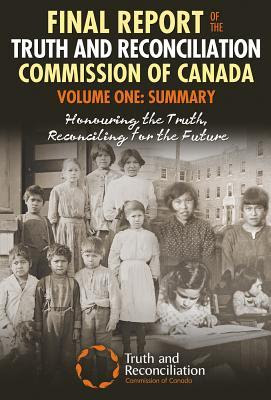
Final Report of the Truth and Reconciliation Commission of Canada, Volume One: Summary: Honouring the Truth, Reconciling for the Future by the Truth and Reconciliation Commission


I thought it would be a dry slog. I was wrong. The writing is engaging and the content is immensely enlightening. I'm so glad that my friend Kathy agreed to buddy read this with me, because I've intended to read it since it was released in 2015, but kept putting it off due to fear of feeling sad and angry while grappling with the content. And it did make me sad and angry, but I'm very glad to have read it. This summary volume gives a good grounding in the complex ways residential schools have continued to affect Canada‘s Indigenous peoples. I now have a better understanding of what reconciliation means and feel more equipped to speak up when I encounter racism in my daily life.

Kathy adds: "the Report also places the Canadian Government's decision to create the residential schools in context. The report does a very good job of outlining the political, legal and religious views that made the Canadian Government's decision possible."

Essential reading for all Canadians. It's available free in pdf format on the TRC website.

Molly Falls to Earth by Maria Mutch

Bystanders surround a dance choreographer having an epileptic seizure on a sidewalk. This brilliant, kaleidoscopic novel takes place over seven minutes: her vivid memories, special people and long-held secrets are interwoven with scenes from a documentary about missing people. We are all interconnected: even strangers touch our lives, though our perceptions may differ. The included cityscape photos emphasize the personality of place—and New York City is definitely a character.

The city doesn‘t always know what to do with itself, so it invents, it makes new. You can‘t step in the same city twice.

Look up ‘seven‘ and it will say, absurdly, ‘six plus one,‘ but you won‘t be able to argue. The tautology won‘t end. The only way forward is forward.

The body is in time, it is time. It shows the passage of it. Which is why dance can be hard to translate, why filming it so often feels inadequate. The body reveals space, making us aware of what we take for granted. Conversely, the camera flattens space. Movement is something you have to be in the presence of, in order to fully see how a space is rendered in three dimensions.

I was overwhelmed with a love whose internal organs were shot through with what seemed to be an everlasting hate, but it was really only the flawed structure of this place, these bodies. And the fact that I kept people from the furnace of my heart—the place where they could so easily burn.

Zom-Fam by Kama La Mackerel

Kama La Mackerel is a trans Mauritian Canadian activist, artist and writer. Their debut poetry collection consists of eight long autobiographical poems. Family life—including spirituality, gender roles and colonial scars—on the former plantation island of Mauritius is vividly evoked. Kreol language, curry spices, coconut sweets, and burning sun. A tender and exuberant coming-out memoir in verse.

when i tell my mother that i am trans
[…]
she tells me that we come from a history & a culture
where women-men
& men-women
have always existed

-------

because colonial powers destroyed
people
lands
resources
cultures
but colonial powers
also scythed
the languages
of love

Everyone Knows Your Mother Is a Witch by Rivka Galchen

Vivid, humorous voice—that of an indomitable old woman—combined with the depressingly ignorant voices of townspeople who have accused her of witchcraft. I was riveted by this historical novel based on real people who lived in southern Germany in the early 17th century. Entertaining and sobering. I wish it didn't remind me so much of the fearful superstitions I see surrounding Covid vaccinations and other science.

“I apologize for having no horse,” he said cheerfully. He didn‘t look like he‘d ever had a horse. Or even had a close friend who had had a horse.

I suspect the only thing I‘d be interested in reading would be a history. But I‘m told histories are hated, which is not surprising. People prefer to make it up themselves.

I had loved babies as a child, more than most people do, even. I loved their small fingernails. I loved the way they seemed to arrive older than their parents. I loved the courage they had to sleep as if there were no wolves, no soldiers.

He asked me to sit, encouraged me to have a bite to eat. He had a slice of apple on a tiny spear of some sort.
“What is that toy you‘re holding?”
“It‘s a fork. And I know you know it‘s a fork.”
“It looks like the tail of a devil,” I said. “Not in a bad way.”

A hummingbird once rested near my shoulder. It was a very ill omen. For one who isn‘t a flower.

I had Greta‘s voice in my head, telling me that all people are the image of God. Why not all voles, then? All fleas? They were God‘s creations, too.

The Archive of Alternate Endings by Lindsey Drager

The multiple strands of the millennium spanned in this novel-told-in-fragments are set 70 years apart, timed with each pass of Halley's comet. The stories feature pairs of brothers and sisters, often showing one excluded from their families, usually for the reason of one being queer, and the other remains with them in solidarity—so the Hansel and Gretel theme works very well. History is recorded by those who are dominant in society; it's refreshing to see things from a different perspective.

What is story if not the safe harbour for our most disturbing imaginings? I learned early that the notion of what will come to pass haunts better. But, too, it is about the storyteller—who you choose to trust and why.

A Map to the Sun by Sloane Leong

Cartoonist Sloane Leong has mixed ancestry—Hawaiian, Chinese, Mexican, Native American and European—and she draws on that variety in creating the five main teen characters in this wonderful graphic novel. The girls each have drama at home, plus the usual body issues and school drama, but when they form a basketball team, they find friendships, rivalries and self-respect. Larger gender and social justice issues add extra depth. Glorious artwork in vivid fauvist colours.


Thirsty Mermaids by Kat Leyh

I love this charming and very queer graphic novel! The humour is never mean: it's the "fish-out-of-water" type. There's no sex. Instead, it's friendship to the max, reminding me of the Lumberjanes series which is coauthored by Kat Leyh, although this standalone is definitely for age 18 and up. I say that because the central plot is about drinking as much alcohol as possible, which is the premise for a couple of merfolk and a sea witch deciding to venture onto dry land. Poor decision-making while inebriated and the hangover price do counteract the alcohol message, by the way. Leyh's colourful, cartoony artwork has a fresh buoyancy.