Showing posts with label quirky. Show all posts

Saturday, August 29, 2020

The Union of Smokers by Paddy Scott


The Union of Smokers by Paddy Scott
Invisible Publishing, March 2020

A tale of trauma, a "theme essay," told in the singular bantering voice of a white twelve-year-old boy, Kaspar Pine, who might be on his deathbed.

        One nice thing about living a short life: it's gonna be pretty much all highlight.

The story is set in 1960s fictional Quinton, Ontario, on the day the town's major employer, a creosote factory, shuts down.

        People don't like to talk about occupational hazards around here, especially if they're dependent on the source of the hazard for survival. If you worked at Quinton's creosote plant you'd know what I mean. Its hazards leaked all over the place, up to the moment earlier today when it closed for good because of all that leaking. Nobody in Quinton talked about the creosote hazards either, because that's the sort of conversation that got you fired, even if the creosote made you sick.

Since he was six, Kaspar has lived on a farm with his grandparents. Being continually grateful for their kindness to him, he behaves well when he's at home. When he's elsewhere, he admits to being "a well-rehearsed asshole." I found his voice irritating, even while having some sympathy for him. 

        Hardly anybody in town ever smiled at me, and if they did, I knew they meant it as a caution light: You're entering dangerous territory.

The cover illustration, showing a chicken with its head cut off, is a warning. There's a lot of gross unpleasantness in this novel: talk (and throwing around) of dead canaries, of knackers and how they go about their job of killing animals, and of Kaspar's passion for smoking the cigarette butts that he collects.

        [...] most things, not just cigarettes, should have filters on them. Drowned dads, cancer diagnosis, factory closings, canaries... What if all that unpleasantness slipped through charcoal-activated, menthol-flavoured felts of alternative possibilities first -- Heaven, or Medicare, or UIC -- and came out the other side with hints of hope? I've smoked roll-yer-owns and I've smoked things I'd found between the cracks in sidewalks, and no matter how crusty they'd gotten, even a sidewalk smoke with a filter doesn't come close to the eye-watering experience of a rollie.

All of Kaspar's "declarative-in-essay-form sonofabitch"-ness and wisecracking tends to obscure the important underlying narrative, which is about the terrible things that parents do to their children. And maybe that is part of the author's point: that children who have been traumatized might be annoying and unpredictable. 

I tend to like novels like this, with a distinctive narrative voice, and a combination of humour and tragedy. The Union of Smokers misses the mark. It's okay, but too over-the-top. I didn't find Kaspar to be a believable character. Humour is a tricky genre. This might be perfect for another reader looking for a jokey approach to serious topics like environmental degradation and child welfare.

Giller chances: LOW

This post is part of a series. I'm on the Shadow Giller jury this year, so I'm reading as many qualifying Canadian titles as possible in order to come up with my own longlist prediction before the official one that will be announced on September 8, 2020. To see my other reviews that are a part of this project, click on the Shadow Giller tag. Also, please visit our Shadowing the Best of CanLit website to see what the rest of the Shadow Giller jury are up to. Thanks for visiting my blog.

Wednesday, August 12, 2020

The Red Chesterfield by Wayne Arthurson


The Red Chesterfield by Wayne Arthurson
University of Calgary Press, October 2019

A delightfully odd crime novella told in vignettes.

A bylaw officer investigates a complaint about a yard sale, then spots an abandoned chesterfield nearby and then things go sideways because he also finds a severed human foot. But this story isn't about that mystery. It‘s about a man's relationship with his brothers and his girlfriend and …that intriguing piece of furniture that keeps showing up.


Wayne Arthurson lives in Edmonton and I've read his previous novels, so I knew going into this one that he is of Cree and French Canadian descent. In The Red Chesterfield, I enjoyed the way that M, the bylaw officer, is slowly revealed to be Indigenous:

  • First, there's a comment early on about his people having “a long history with the authorities, a lot of it bad.
  • Later: “I light some sage, let the smoke blow over me. I‘m too jittery for the smudge to work.
  • Midpoint, there's an example of typical Canadian racism that I can imagine this bylaw officer is familiar with: “Who is it?” [...] “Some Indian,” he says with disdain.
Surrealism with gritty realism. I was entranced from start to finish. 

Giller chances: MAYBE. An unusual premise, well executed. If novellas qualify, I can see this making the longlist. The Scotiabank Giller eligibility requirements don't mention novellas. Novels, graphic novels and short story collections qualify. YA novels, comic books and poetry collections do not. The Red Chesterfield does not appear on the Scotiabank Giller Crazy for CanLit list, but novellas can be considered a type of novel, right?

This post is part of a series. I'm on the Shadow Giller jury this year, so I'm reading as many qualifying Canadian titles as possible in order to come up with my own longlist prediction before the official one that will be announced on September 8, 2020. To see my other reviews that are a part of this project, click on the Shadow Giller tag. Also, please visit our Shadowing the Best of CanLit website to see what the rest of the Shadow Giller jury are up to. Thanks for visiting my blog.

Tuesday, July 2, 2013

Nocturne: Dream Recipes Varied and Easy to Make (in just 5 minutes) by Isol

I was up very late watching spectacular Canada Day fireworks over the North Saskatchewan river in Edmonton, so a book about sleep is perfect for this morning.

Nocturne is the singular creation of Isol, an Argentine illustrator who received the Astrid Lindgren Memorial Award earlier this year. More artifact than book, Nocturne is coil-bound at the top and has a base that unfolds to make it stand sturdily at bedside. Two different whimsical illustrations are superimposed on each page, one printed with glow-in-the-dark ink.

"Before you go to sleep, open the book to the dream you've chosen and place it on your night table under a bright light. (A dream is like a moth that loves to get close to the light when no one is looking.) Wait for a least 5 minutes, and don't make any noise or you will scare the dream away. [...] Turn out the light! You will see the luminous traces that the dream leaves behind on the page. Look for as long as you like, then close your eyes and follow the dream to its hiding place."

Included are: the boring book Dream (with giant animals peering down at a reader who has fallen asleep); the Dream of going far away (to find friendly aliens on another planet); and the Dream underwater (complete with mermaid). In the Dream of growing, a girl waters three seeds under a tiny orange sun. The phosphorescent image shows the girl riding the tops of the grown plants, with the sun in the location of her heart. Magical!

The Cats of Tanglewood Forest, another children's book that I've read recently, coincidentally mentions dreams. In De Lint's book, under the branches of an ancient beech, "cats would come to dream and be dreamed." Nocturne offers a wonderful opportunity for adults to talk about dreams and dreaming with young people from about Grade 2 and up.

Children who enjoy Nocturne might also like The Dreamer (Pam Munoz Ryan) with its surreal illustrations by Peter Sis; Stormy Night (Michele Lemieux) about the thorny philosophical questions that keep us from sleeping; and The Rabbit Problem (Emily Gravett) another quirky book that is more of an artifact than container for a story.

Thursday, June 27, 2013

Abelard by Regis Hautiere and Renaud Dillies

Abelard looks like a graphic novel for kids because of the big-eyed anthropomorphic characters. It isn't. Regis Hautiere (scenario) and Renaud Dillies (art) have created a whimsical tale for adults about friendship and the value in living a life filled with gratitude.

Abelard is a long-legged boy-chick who lives in a marsh where there are few women, in a fictional early twentieth-century Eastern Europe. A brief encounter with a bird-girl leaves him besotted and determined to win her affection. Abelard is given dubious advice: "To seduce a gal like Eppily, you got to offer her the moon. Or, at the very least, a bouquet of stars."
"Nobody's innocent!" says Gaston.

Being a total innocent, Abelard decides to travel to America, where he's heard that flying machines have been invented. He hopes to get to the moon in one. I almost gave up on the book at this point, because it seemed rather too sentimental for my taste. Luckily, I didn't, because things picked up after about 30 pages. Abelard encounters many obstacles on his journey, including being severely assaulted for being perceived as a "faggot" and a "poet." A grumpy man-bear named Gaston becomes Abelard's unlikely friend.

While travelling with Gypsies, Abelard consults Madame Zaza.
Dillies' dark contour lines and brushy stroke style can be seen here.
It was fun to find jokes slipped into the illustrations, like the Gypsy clairvoyant who advertises extra lucidity. There's a dead leaf with a note: "God rest its soul." There are two road signs pointing in opposite directions: "Towards America" and "Towards America Too (But It's Farther)."

This charming fable, translated from French by Joe Johnson, is suitable for Grade 9 to adult.

Readalikes: Good-bye, Chunky Rice (Craig Thompson); Dorothy and the Wizard in Oz (Eric Shanower and Skottie Young); Robot Dreams (Sara Varon); Bone (Jeff Smith); The Little Prince Graphic Novel (Antoine de Saint-Exupery and Johann Sfar); and Set to Sea (Drew Weing).

Thursday, April 4, 2013

The Vanishers by Heidi Julavits

The Vanishers by Heidi Julavits is a clever satire on pretentiousness of all kinds, but especially the absurdities in the field of paranormal psychology.

Julia Severn's mother committed suicide when Julia was a baby. Julia attends a psychic college where she possibly views a powerful figure there as a mother substitute. Madame Ackerman is a relentless investigator of past lives. A run-in with her does not end well for Julia.

Doped up to the eyeballs in order to deal with debilitating symptoms after she's been psychically attacked, Julia takes a job at a flooring company showroom in New York City.

"Despite its name the showroom showed very little save a clear Lucite desk, a jute rug -- a barbed and unkempt thing, woven of coconut shell fibers and resembling, because of its swirled weave, the hair that collects over a shower drain -- a red dial telephone, and me; as pedestrians walked by the plate glass that faced Park Avenue, I'd been instructed to hold the phone against my ear and move my lips. Because wires would have been visible behind the clear desk, the phone wasn't connected; nonetheless, when a person entered the showroom I was to speak in prescripted Arabic to a pretend customer calling from a state within the United Arab Emirates."

It is there that she meets Alwyn, another young woman who has issues with her mother. The two of them end up at a psychic treatment centre in Vienna.

Alwyn explains to Julia the "gist of a paper published by the Journal of Mental Science" that established a telepathic link between mothers and babies and proved that babies in orphanages [...] were twice as likely, by the age of three to exhibit psychic predilections.

'What I don't get is why I didn't develop any psychic abilities,' [Alwyn] said. 'My mother might as well have been dead for all I saw of her when I was little. Part of me suspects she must have read that article; she's so competitive, she probably spent just enough time with me to make sure I wouldn't develop powers that she hadn't developed herself.'

'I suppose that's possible,' I said. It sounded totally insane.

'My stepfather told me she tried to abort me.'

'Recently?'

'She denied it when I confronted her. I'd deny it if I were her. It's curious, though, right? I mean obviously I'm curious. Why did she want to abort me? Maybe she did have some kind of ... power. Maybe she knew I'd grow up to disappoint her more than she disappointed herself.'

'I thought she was an internationally famous shampoo model,' I said.

'You say that so dismissively. She had iconic hair.'"

Meanwhile, Julia is having trouble following the rules at the treatment centre. Her therapist, Marta, warns Julia against unconscious psychic warfare.

"I promised Marta to engage in no unconscious warfare. I was innocent, at the time, of the lengths to which my unconscious would go to mock my inability to know my own warfare intentions."

The twisty plot revolves around a controversial filmmaker, Dominique Varga.

Alwyn's undergraduate dissertation "promised to show how Varga's portrayal of female exploitation and passivity (deemed 'masochistic' and 'viciously retrograde pornography' and 'satire without the satire' by her critics) could be construed as an antifeminist message that was, in fact, urgently feminist."

The Vanishers is quirky to the max and highly entertaining.

Readalikes: The Blondes (Emily Schultz); Where'd You Go, Bernadette (Maria Semple); and Doing Dangerously Well (Carole Enahoro).

Saturday, March 23, 2013

Vampires in the Lemon Grove by Karen Russell


Karen Russell's latest collection of short stories, Vampires in the Lemon Grove, is astonishing in variety and inventiveness. As with her earlier collection, St Lucy's Home for Girls Raised by Wolves, and her novel Swamplandia!, Russell mixes surprising elements of the fantastical into realistic settings: vampires in contemporary Italy; fortunetelling seagulls who descend on an otherwise ordinary coastal town; girls who take on the role of silkworms in Edo-period Japan. In a brilliant send-up of sports fan culture, Team Krill champions the eternal underdog in the Food Chain Games in "Dougbert Shackleton's Rules for Antarctic Tailgating."

The title signals the strangeness to be encountered, the juxtaposition of night creatures with a garden bathed in sunshine. This story, set in Sorrento, is narrated by a nostalgic vampire: "there is no word sufficiently lovely for the first taste, the first feeling of my fangs in that lemon. It was bracingly sour, with a delicate hint of ocean salt. After an initial prickling -- a sort of chemical effervescence along my gums -- a soothing blankness travelled from the tip of each fang to my fevered brain."

Each story has a wildly different premise and its own unique voice. The young 19th-century narrator in "Proving Up" describes "evil turkeys that have heads like scratched mosquito bites." This one gets progressively creepier; Russell often explores greed, cruelty, obsession and other dark subjects. But it is her tongue-in-cheek humour that makes me love her writing so much.

The final story, "The Graveless Doll of Eric Mutis", is the most disturbing. A scarecrow who takes revenge on a group of teenage bullies in New Jersey reminded me of the tragedy of Matthew Shepard. (Coincidentally, I've got October Mourning next up on my reading list. It's Leslea Newman's verse novel in multiple voices about Shepard's death and its aftermath.)

Russell talks about her writing and reads from Vampires in the Lemon Grove on Radio Times, available online here.

Readalikes (novels as well as short stories): Please Ignore Vera Dietz (A.S. King); The Particular Sadness of Lemon Cake (Aimee Bender); Pretty Monsters (Kelly Link); Better Living Through Plastic Explosives (Zsuzsi Gartner) and anything by Margo Lanagan or Franz Kafka.


Thursday, January 17, 2013

The Elephant Keepers' Children by Peter Hoeg

The Elephant Keeper's Children is a quirky coming-of-age tale, very different in style and mood from Peter Hoeg's earlier thriller, Smilla's Sense of Snow.

Set on Fino, a tiny Danish island, the story revolves around the disappearance of the eccentric vicar, Konstantin Fino, and his wife, Clara. It's narrrated in a philosophical, round-about way by their 14-year-old son, Peter. This isn't the first time they've gone missing. Previously, the pair returned with stacks of money, a mink coat and an Italian sports car.

"I don't know if you have ever seen a Maserati, so in case you haven't I can tell you that it is a car designed for people who are exhibitionists by nature but who nevertheless wish to demonstrate that they are modest enough to not simply open their raincoats and flash their wares."

That was two years earlier. This time, Peter and his sister Tilte are determined to figure out what their parents are up to before the authorities do. Even though the police have already combed through their house, the siblings find a clue in their mother's workshop.

"The life of wood shavings is brief, albeit replete with beauty. When fresh, they are as elastic as corkscrew curls, fragrant, and almost transparent. But within a week they dry out and may break and become sawdust. The specimen I hold in my hand is still fresh. On its way toward old age, as indeed we all of us are, but fresh nonetheless.

Tilte and I think the same thought: we cannot rule out the possibility that the flying squad took the opportunity of indulging in handicrafts, that they perhaps spent time at the carpenter's bench, working with the fretsaw and the smoothing plane. Perhaps they wanted to take a present home with them for the children. It's not impossible. But then again, it's not exactly likely, either."

The other quest in this novel is spiritual. Peter yearns for the numinous feeling that he has experienced occasionally. Fino, small as it is, manages to support a large number of religious faiths, and their leaders are all going to Copenhagen for a multi-faith synod.

Which brings me to the pointedly ridiculous names chosen by Hoeg (and his translator, Martin Aitken). Bishop Anaflabia Borderrud, Grand Mufti Sinbad Al-Blablab (imam of the mosque housed in Bullybluff House), Polly Pigonia (of Fino Puri Ashram, which was formerly the Pigslurry Farm), Leonora Ticklepalate (head nun of Fino's Buddhist community) etc.

I was reading along, feeling entertained, enjoying the offbeat humour... until suddenly I had enough. At page 249, which is pretty much the halfway point in the book, I just didn't want to read any more. It was weird. So I skipped ahead to read the final chapter to see how it all wrapped up and considered it done.

It is highly unlike my usual habits to give up so far into a story and it's taken some time to pinpoint what exactly turned me off so completely. It probably has to do with the intrusion of the author's voice (the real Peter) into the character Peter's narrative. The disrespectful names for religious leaders offended me at some level. It makes a farce out of spiritual beliefs, including the boy's own. I recognize that I have a low tolerance for this kind of flippancy. And then, once this irritation threw me out of the story, I was unwilling to get back in.

My reaction will not stop me from recommending The Elephant Keepers' Children to other readers, because I realize my response is out of proportion and the book truly is amusing. I am eager to speak to others who've had a reading experience similar to mine, however.


Sunday, December 2, 2012

Where'd You Go, Bernadette by Maria Semple

Bernadette, an architect who had received a MacArthur genius award, disappeared from the public eye when she moved to Seattle and devoted herself to being a housewife and an oddball recluse. Twenty years later, Bernadette disappears a second time. Her brilliant teenaged daughter, Bee, collects various memos and correspondence in her search for clues to her mother's whereabouts. These documents, together with Bee's wry commentary, form the structure of Maria Semple's highly entertaining Where'd You Go, Bernadette.

Bee had convinced her parents to take a family trip to Antarctica at Christmas. They were to board their ship in Ushuaia, Argentina. "When we arrived at the dock, we were ushered into a kind of hut, with a wall of glass dividing it the long way. This was immigration, so of course there was a line. Soon the other side of the glass filled up with old people decked out in travel clothing and carrying backpacks with blue-and-white ribbons. It was the group that had just gotten off the ship, our Ghosts of Travel Future. They were giving us the thumbs-up, mouthing, You're going to love it, you have no idea how great it is, you're so lucky. And then everyone on our side started literally buzzing. Buzz Aldrin, Buzz Aldrin, Buzz Aldrin. On the other side was a scrappy little guy wearing a leather bomber jacket covered with NASA patches, and his arms were bent in at the elbows like he was itching for a fight. He had a genuine smile, and he gamely stood on his side of the glass while people in our group stood next to him and took pictures. Dad took one of me and him, and I'm going to tell Kennedy, Here's me visiting Buzz Aldrin in prison."

Semple's satirical humour and her playful style make Where'd You Go, Bernadette an engaging read. I loved it. I also appreciated one of the more sober messages in the novel: that stifling creativity can be dangerous to one's mental health.

Readalikes with quirky characters: The Woefield Poultry Collective (Susan Juby); Come, Thou Tortoise (Jessica Grant); and My Most Excellent Year (Steve Kluger).

Tuesday, August 28, 2012

Heaven is Small by Emily Schultz

If there is such a thing as warm-hearted satire, then that is the category for Canadian author Emily Schultz's quirky novel, Heaven is Small. The opening sentences reveal that readers are in for a treat:

"Moments after his death, an event he had failed to notice, Gordon Small sought new employment.
Welcome to Heaven. If you know the extension you wish to reach, enter it now."

Heaven, as experienced by newly-deceased Gordon, is more like purgatory. It's a publishing house specializing in trashy romance novels. Gordon, a failed fiction writer, gets a job in the editorial department.

Office politics in the afterlife... I loved it.

Readalikes: Then We Came to the End by Joshua Ferris.

Saturday, June 9, 2012

Claire DeWitt and the City of the Dead

Private eye Claire DeWitt has been solving mysteries since she was twelve. She's a gal who is willing to ingest pretty much anything. She's like a Nancy Drew who studied with Carlos Castaneda.

"A few months ago, after a hard case, I'd gone on a fast to purify myself from its ill effects. I stopped eating. I stopped sleeping. I did not stop using drugs. A week went by, then two, then a month. After fourteen days, I could see the codes in grocery receipts and billboards. After thirty days I could read clues in the wind, see signs in the clouds." Some hospital time follows.

The job that Claire thinks of as the Case of the Green Parrot takes place a year and a half after Hurricane Katrina. A man in New Orleans hires her to find out what happened to his uncle, who disappeared during the big storm. Claire tells her client that she is 42, even though she is 35, because "no one trusts a woman under forty."

Constance Darling taught Claire the finer points of detection. There was always something going on at her mansion in New Orleans. "The day before it had been Constance's meditation teacher, Dorje, in his saffron robes, making mushroom tea in the kitchen. The day before that we'd interviewed a German shepherd. Life was never dull with Constance." "She taught me to read fingerprints like tea leaves and eyes like maps."

Claire casts the I Ching for clues. A scrap of paper stuck to her shoe? Definitely important. Drug-addled dreams supply more clues. Mornings are hard: "I need food. But first I need to take a shower. In coffee." 

Strangers are often fearful of Claire, based on her appearance: "I'd dressed in a hurry and I wasn't at my visual best. I wore boots, jeans, two black sweaters, and a red vintage women's overcoat with an ermine collar that probably should have been retired. I was also suffering from an unfortunate homemade haircut/bleach job that had involved pinking shears." Claire has few friends... and even they won't take her calls.

Claire trusts that all will be revealed if she pays attention as she moves through a world of crime and corruption.

"The hardest thing about buying a gun in Louisiana was that there were so many options I hardly knew where to begin. I heard shots at least once a day. Half the men in the city wore clothes so big, they could carry an arsenal under them. Out of the sliver by the river, spent casings and shells crunched underfoot on the sidewalk like crack vials or fall leaves. The suburbs west of the city were lined with pawnshops that advertised $99 SPECIAL ON 9 MILLIMETER and HANDGUN SALE and SPECIAL ON UZIS."

"[T]his city knows how to tell a beautiful story. But if you're looking for a happy ending, you better be lookin' somewhere else." Author Sara Gran knows how to tell a spellbinding story. She has created an unforgettable character in Claire DeWitt and I sure hope to encounter her again.

Readalikes that match the noir crime aspect where the difference between the good guys and bad is unclear, because everyone is both, plus stylish writing and some humour: The Monkey's Mask by Dorothy Porter; and pretty much anything by James Sallis or Walter Mosley. I was also reminded of the Micky Knight lesbian detective series by J.M. Redmann (beginning with Death by the Riverside) because of the female sleuth in one dangerous situation after another in New Orleans.

What makes Claire DeWitt and the City of the Dead so crazy good is how unusual it is. For readers like me who are attracted to the new and different, not necessarily noir, try: Please Ignore Vera Dietz (A.S. King); or The Many Revenges of Kip Flynn (Sean Dixon).

Saturday, May 5, 2012

Why We Broke Up by Daniel Handler, art by Maira Kalman

Every last thing that reminds Min of her heartbreak is packed into a box and dumped onto her ex-boyfriend's doorstep. Min writes a long accompanying letter to Ed, documenting the many reasons they broke up. "You know I want to be a director, but you could never truly see the movies in my head and that, Ed, is why we broke up."

Daniel Handler has created a fabulous character in Min Green, a high school girl who loves old movies. She was never part of the "in" crowd and everyone knows she should never have been going out with the promiscuous co-captain of the basketball team. They connected at a bitter-sixteen birthday party for Min's best friend. Ed showed up uninvited, after a game. Min says, "Basketball is still incomprehensible to me, some shouty frantic bouncing thing in uniform, and although I didn't listen I hung on every word."

Min would not let Ed get away with excusing himself for making offensive remarks by saying "no offense" and she also would not let homophobic comments pass. When she brought him a cup of take-away coffee he told her he didn't like coffee. She urged him to try it her way, with extra cream and three sugars. He refused, insisting black was the only acceptable way, because "any other way is for girls and fags." Min tried to sort him out. "You. Must. Stop. With the fag stuff. Join the twenty-first century."

Also, Min did win Ed over to coffee. His response after a big, big sip: "Fucking delish. I don't care it's a faggy word, oops, sorry, no offense, sorry again. Delish! Criminy! This is like a cookie, it tastes like a cookie having sex with a doughnut." Min's response: "Wait till the caffeine hits."

Kalman's quirky art is given room to shine.
Later, Min writes about their encounter with an Italian liqueur, Pensieri: "I went and got it, no glasses, just twisted at the top until it was open and the strange rich smell was in my face, like wine but with something running through it, herbal or mineral, dazzling and weird. 'You first,' I said, and handed it over. You frowned into the bottle, then smiled at me and took a slow swig and immediately spat it out down your T-shirt. 'Criminy!' you shrieked. 'That is, what is that? It tastes like somebody killed a spicy fig. What's in that?' I was laughing too hard to answer."

I don't know if this drink even exists, but after reading that, I want some! Paintings by Maira Kalman are included throughout the book and her Pensieri looks similar to Chambord, which I love. (It's sort of like raspberry cough medicine.)

More of Kalman's great art in
Why I Broke Up
Ed tells Min he loves her, and "Every time you said it, you really said it. It wasn't like a sequel where Hollywood just lines up the same actors and hopes it works again. It was like a remake, with a new director and crew trying something else and starting from scratch." Until it wasn't... in a big way. And that is why they broke up.

I love, love, love this book. Captivating voice. Real emotion. Fabulous art. If you need any more encouragement, check out the Why We Broke Up Project online, where everyone is encouraged to share their sad, bitter, and funny stories.

Friday, February 3, 2012

The Hottest Dishes of the Tartar Cuisine by Alina Bronsky


Rosalinda Achmetowna's tale begins in 1978, in a Soviet city that is 27 hours away from Moscow by train, when Rosa learns that her only daughter is pregnant. Sulfia is her mother's oposite. "Sulfia was as gentle as a flower. If someone spat on her she took it for fresh rain and stretched out her petals to soak it up."

Rosa does not say this as a compliment. She has more affection for her new granddaughter, Aminat. So much so that she considers Aminat hers, and not Sulfia's.

Rosa is the most indomitable woman I've ever encountered in fiction. Her capacity for meddling seems to have no limits. She's an unreliable narrator, but with such a great voice:

"I didn't look anything like a grandmother at all. I looked good. I was pretty and young looking. You could see that I had vitality and was intelligent. I often had to mask my expression to keep other people from reading my thoughts and stealing my ideas."

Too impatient to sit through a lesson familiarizing her with the parts of a car at her first driving lesson, Rose wrestles with the instructor. "I got the key, put it in the ignition, stepped on the pedal, and yanked the gearshift. The car must have been in need of repairs, because it moved in a series of jumps before coughing and stalling."

Author Alina Bronsky takes readers on an unpredictable ride through the years, following the lives of Rosa, Sulfia and Aminat. Like Aminat, Bronsky moved from Russia to Germany in late childhood. The Hottest Dishes of the Tartar Cuisine has been translated to English from German. Dig in!


Saturday, January 21, 2012

The Many Revenges of Kip Flynn by Sean Dixon

Family secrets, the bonds of friendship and the scourge of urban development are at the heart of this entertaining novel set in contemporary Toronto. Poor folk living and working in the Kensington Market area battle rich property developers who want to level it and put up high rise buildings there instead. Revenge based on mistaken assumptions gets carried beyond the grave when ghosts join the fight.

One of the joys of this quirky novel is the omniscient narrator who addresses the reader directly, at times, but not in the Victorian "dear Reader" style. On page 2: "Mani may not seem to be a particularly likeable character, but he is not going to be in this story for very long."

"'Why don't you sit down?' [Nancy said to Henry.] 'Have a glass of water. It's got fluoride in it.' 'That's because the government wants you dead,' said Henry. 'But at least they're killing you slowly,' said Nancy. 'There's time to sit down.'"

Find time to read this when you're in the mood to be charmed.

Readalikes: Come Thou Tortoise by Jessica Grant; Please Ignore Vera Dietz by A.S. King; The Particular Sadness of Lemon Cake by Aimee Bender.

Thursday, November 17, 2011

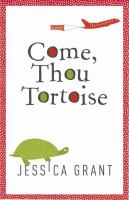
Come, Thou Tortoise by Jessica Grant

Come, Thou Tortoise is told in the unforgettable voice of Audrey Flowers, who leaves her tortoise with friends in Oregon when she flies home to Newfoundland after getting word that her father is in a coma. She grew up in St John's with her scientist father, Walter Flowers, and her sweet Uncle Thoby, who has one arm longer than the other. The family had great fun playing with language and puns.

"My dad did sometimes refer to us - the three of us - as the Bouquet. I think the Bouquet should hit the sack, he'd say. The bouquet is wilting. Or at least one Flower is. Speak for yourself, Wilter." Audrey may have a low IQ, but like her father and uncle, she is a master of words: "The Fairfont Hotel greets you with signage so cursive you curse your inability to read it." She meets the lawyer Toff, who is "wearing a purple scarf. Sorry, cravat. Some silk business tucked into his shirt. [..] My dad used to have an expression for a flamboyant dresser: Christmas on a stick. I'm sorry but a purple cravat is flamboyant."

At one point, Audrey cannot get into her house because the doorknob broke off. She goes to her neighbour for help, still holding the doorknob, and they call a locksmith. "On the table, the brass doorknob looks amazed to be reflecting the inside of someone's house. It lies on its side like it has fainted." (I was very sympathetic, since the doorknob to my front door broke off earlier this year. Unlike Audrey, I have another door that enabled access while I waited to repair the knob.)

Audrey grieves for her father, sorts through family secrets and frets about her tortoise in the most hilarious manner. Occasionally, the narrative switches to the voice of Winnifred the tortoise, who puts up with such indignities as being used as a bookmark while she waits for Audrey to return. Winnifred loves to sit on the dashboard when she travels in a car. (She is much smaller than Mrs. Cook, the tortoise in The Tower, the Zoo and the Tortoise by Julia Stuart.)

I would not say no to another book by Jessica Grant.

Monday, September 5, 2011

Miss Peregrine's Home for Peculiar Children by Ransom Riggs

Inspired by quirky vintage photographs, author Ransom Riggs has dreamed up a story about an unusual orphanage located off the coast of Wales. One of the orphans grew up to be Abe, Jacob's Jewish grandfather. At 15, Jacob had long given up believing in his grandfather's outlandish tales about growing up among orphaned children with peculiar talents... until Jacob saw his first monster. His adventures began then.

The book is sprinkled with over 40 reproductions of old photos. If you're in the mood for something completely different, check this out. It kept me amused and intrigued, although the gimmick wore a bit thin by the (cliffhanger) end. Grade 7 - adult.

Saturday, June 4, 2011

The Woefield Poultry Collective by Susan Juby

Susan Juby's Alice, I Think is one of the funniest novels I've ever read. The Woefield Poultry Collective is even better. Twenty-something Brooklynite Prudence inherits Woefield farm on Vancouver Island and is determined to make a success of the rocky, mortgaged-to-the-hilt piece of property that comes with one curmudgeonly hired man (Earl) and one depressed sheep (Bertie).

The story has four quirky narrators: Prudence, Earl, Seth and Sara. I love each one them. Earl's voice reminds me of the earthy way several of my uncles talk. On one of the few occasions when Earl is lost for words, he says "I didn't know whether to shit or brush my hair."

A traumatic incident caused Seth to drop out of school in Grade 11 and in the four years since he barely left his room; most of that time was spent blogging about heavy metal music and celebrities. Seth lived right across the road from Woefield until his mother kicked him out and he knocked on Prudence's door.

Sara is a bossy no-nonsense eleven-year-old with a passion for fancy chickens. Talking about Left Behind, Sara says "It doesn't have a very good plot, but it's easier to read than the Bible, which Mrs. Blaine also lent me. Mrs. Blaine told me that Left Behind was based on true events that will take place in the future." Sara's preoccupation with the rapture brings recent real-life headlines to mind.

Prudence is good-hearted, enthusiastic and works incredibly hard. I knew it was useless to resist her charms. Go Prudence! Go Susan Juby!

Monday, May 9, 2011

Please Ignore Vera Dietz by A.S. King

Vera Dietz is in her final year of high school while also working full-time as a pizza delivery technician. She tries not to draw attention to herself because she's already got enough to deal with. Besides working her butt off to get good grades AND save enough money for college, Vera is being harassed by the ghost of her ex-best friend, Charlie, who wants her to clear his name.

If they hadn't had a huge falling out, maybe Charlie would still be alive, but Vera is still really mad at him. Too bad she's also still in love with him.

What really happened on the night Charlie died remains a mystery through most of the book. The story is told from Vera's point of view, but sometimes we hear from her dad (who includes flowcharts), sometimes from the dead kid (Charlie), and sometimes from the pagoda (a town monument with a wry sense of humour). Vera is an endearing character who struggles to do the right thing. You'll be cheering for her, even when the pagoda grumbles.

Grade 9 - adult. Readalike: The Sky Is Everywhere by Jandy Nelson, for a similarly fresh voice.

Monday, February 21, 2011

The Tower, the Zoo and the Tortoise by Julia Stuart

Balthazar Jones is a Beefeater who works and lives in the Tower of London with his wife, Hebe, and their ancient tortoise, Mrs. Cook. Balthazar and Hebe's marriage has been falling apart since the death of their son, three years earlier. Aside from this serious element to the plot, The Tower, the Zoo and the Tortoise is best described as whimsical. It will appeal to readers looking for something light with a lively cast of characters (nearly caricatures) and zany action.

Hebe and her friend Valerie work at the London Underground Department of Lost Articles, tracking down owners of oddities like glass eyes and funeral urns. Valerie is being wooed by a tattooed ticket inspector named Alfred Catnip. Valerie usually manages to be wearing something odd when Alfred turns up at their service counter: a theatrical beard; a viking helmet complete with blonde braids; or a horse costume. There are several other romantic liaisons underway with characters who are even more bizarre. It's wacky, I tell you!

Because Balthazar owns a tortoise, he is the Beefeater chosen to be in charge of a new menagerie at the Tower of London. The assortment of animals have all been presented as gifts to the Queen from foreign governments: a zorilla, a glutton, a pair of Jesus Christ lizards, a tiny Etruscan shrew, and so on. More fun than a barrel of monkeys. (Speaking of which, the Geoffroy's  marmosets have a habit of exposing their private parts whenever they are under stress.)

It took me a while to get used to Julia Stuart's style, which is a jumbled heap of metaphor and simile, but I enjoyed it overall. I think it was the tragedy at the heart of the tale that salvaged this book for me.

Readalikes: Quirky, romantic fare like Chocolat by Joanne Harris; The Guernsey Literary and Potato Peel Pie Society by Mary Ann Shaffer; The Number 1 Ladies Detective Agency by Alexander McCall Smith and the film Amelie.

Tuesday, August 17, 2010

The Particular Sadness of Lemon Cake by Aimee Bender

The first time that Rose Edelstein began tasting the emotions of other people in the food they prepared, she was 11 years old. Her strange ability was an affliction more than a talent; when Rose was twelve, she learned the taste of her mother having an extramarital affair.

The Edelstein family encompassed another child with special talents: Rose's older brother, Joseph. Joseph was a math and science genius with a particular interest in particle physics. He was not at all interested in people. Rose suspected that he was disappearing entirely into the world of objects.

Rose's father had such a fear of hospitals that he would not even go inside when his children were born. The Edelsteins are a quirky bunch, but somehow that doesn't overpower their story. The novel is about coping and about accepting life's challenges. It is gracefully told - as sweetly tart and satisfying as a slice of lemon cake.

Wednesday, January 20, 2010

The Incident Report by Martha Baillie

Miriam Gordon, a 35-year-old library assistant at the Allan Gardens branch of Toronto Public Library, records interactions with patrons in brief incident reports. If you're in the mood for something different - amusing and perplexing and charming - give this a go. I loved it.