Showing posts with label science/nature. Show all posts

Monday, November 29, 2021

Best Audiobooks in November

These are the audiobooks that I enjoyed most during the month of November 2021, while quilting, baking, walking, and doing household chores:

The Day the World Stops Shopping: How Ending Consumerism Saves the Environment and Ourselves by J B MacKinnon
Audiobook [12 hr] read by Kaleo Griffith

Consumption is the greatest driver of environmental problems. Framed as a thought experiment, journalist and environmental activist James MacKinnon writes about powerful external forces urging us to consume and how we rely on a consumer-driven economy, which is destroying our world. I appreciate the optimism in this book, which looks at what a difference can be made by only a small shift in habits, as demonstrated at the start of Covid lockdowns. This book was a finalist for the GG award for nonfiction.

We have to stop shopping. We can‘t stop shopping.

Unreconciled: Family, Truth and Indigenous Resistance by Jesse Wente
Audiobook [7 hr] read by the author

CBC arts columnist Jesse Wente is of mixed Anishinaabe and white heritage. In this memoir he shows what anti-Indigenous racism in Canada feels like. From war-whoop taunting when he was a kid, to racial profiling by police, to anonymous death threats when he has spoken up about Indigenous issues on air. I remember Hal Niedzviecki's Appropriation Prize editorial in the May 2017 issue of Write magazine, an issue that showcased Indigenous authors. Wente was a weekly columnist for the CBC at that time and he recounts the heated conversations and strong emotions that were a fallout from that piece. He also writes poignantly about how his grandmother‘s experience at residential school has shaped the lives of her descendants. 

Storytelling is one of the key methods used by colonizers to explain and obscure their lawless treatment of the lands and peoples over which they claim dominion. But storytelling is also one of our best weapons in the fight to reclaim our rightful place.

I‘ve met people whose view of the world was so shaped by [Hollywood] misinformation that they believed all Indians were dead, that we‘d gone extinct. I‘ve met others who refused to believe I was Indigenous because I didn‘t have long hair.

Tokenism is a byproduct of dehumanization. It‘s hard to tokenize someone you see as fully human, someone whose ideas and work you respect.
In my experience, no matter how well disguised the tokenization, that realization always comes eventually, and it‘s never been fun when it arrives. At Toronto International Film Festival it took years, and it ultimately ruined the job of my dreams.

The Na‘vis‘ only chance at defending themselves and their way of life comes in the form of a white man who uses technology to remotely operate a lab-grown Na‘vi body. He is literally wearing Indigeneity as a costume. This revolting form of “going native” climaxes in the usual way, with the white saviour out-Na‘vi-ing the Na‘vi. He taps into their ancient spirituality in a way none of the Na‘vi seemingly can and uses the planet‘s energy to save the day. [regarding James Cameron's film Avatar]

Unsettling Canada: A National Wake-Up Call by Arthur Manuel and Chief Ronald Errickson
Audiobook [10 hr] read by Darrell Dennis

Arthur Manuel, son of influential Indigenous political leader George Manuel, combines memoir with an excellent overview of continuing Indigenous political and economic struggles over land rights. Sometimes while listening to this audiobook I would feel so frustrated about the way successive Canadian governments continue to ignore treaty agreements, Supreme Court judgements and our own constitution that I would either pace the floor or have to take a break entirely. Audiobook narrator Darrell Dennis is Secwepemc, as is author Arthur Manuel; I appreciate hearing the correct pronunciation of the many different Indigenous nations in British Columbia. 

Another thing I appreciate is the multifaceted knowledge I am acquiring by seeking out works by Indigenous authors. In Unsettling Canada, for example, Manuel has a completely different reaction to the film Avatar than film critic Jesse Wente (see previous entry); Manuel's experience with BC treaty negotiations is very different from Darrel McLeod's (in Peyakow); and Manuel's approach to self-government is different from Jody Wilson Raybauld's (see Indian in the Cabinet). 

The first obstacle in defining our new one-to-one relationship with Canada will be the very heavy debt from the seizure and economic exploitation of our lands for 150 years since Confederation. This debt is enormous. I suspect that one of the main reasons that the Canadian government refuses to acknowledge our Section 35 rights is that it would leave it open to paying a percentage of the astronomical wealth that has been taken out of our lands.

[On the 10 years spent drafting the UN Declaration on the Rights of Indigenous Peoples]: Even referring to us as Indigenous "peoples” was a battle with the [United Nations member] states‘ representatives, who wanted us referred to as Indigenous "populations." That term would have kept us outside of the UN‘s basic rights covenants, which offers protections to all of the world‘s “peoples.”

There is no downside to justice.

A Most Remarkable Creature: The Hidden Life and Epic Journey of the World's Smartest Birds of Prey by Jonathan Meiburg
Audiobook [10 hr] read by the author

Before listening to this audiobook, I knew nothing about caracaras, which are falcons found mostly in South America. They are remarkable creatures, as the title claims: highly intelligent, sociable and inquisitive. The author does a deep dive into everything about them and the entire book is riveting. A must for natural science nerds.

Peregrines have the fastest visual processing speed measured in any animal and their eyes are so sharp that they could read the headline of a newspaper from a mile away. A human with eyes in the same proportion to its skull as a peregrine would have eyes that measure three inches across and weigh four pounds each.

The trouble with the past is that it keeps changing. The [dinosaur extinction] asteroid‘s effects on the history of life were so sudden and pervasive that it‘s easy to forget we didn‘t even know about it until very recently.

Social wasps share a skill that exceeds the ability of nearly every mammal on earth: they‘re master builders. Most social wasps fashion their homes from a papier-mâché of chewed-up wood fibres mixed with their own saliva, and each species builds in their own style.

Immune: A Journey Into the Mysterious System that Keeps You Alive by Philipp Dettmer
Audiobook [10 hr] read by Steve Taylor

The human immune system is amazing and indispensable. It is also incredibly complex, so I was happy to have its multiple layers explained with humour and many analogies in this entertaining science book. The audiobook has frequent information summaries and is read by Steve Taylor, who also voices the Kurzgesagt science channel on YouTube. After listening, I went out and bought a print copy from Audreys bookstore so that I can refer back to this book in the future. The print copy has lavish colourful illustrations.

To most living things, you are not a person, but a landscape covered with forests, swamps and oceans, filled with rich resources and plenty of space to start a family and settle down.

The Apollo Murders by Chris Hadfield
Audiobook [15 hr] read by Ray Porter

Unlike the way I kept stopping to wonder about the science in Andy Weir‘s The Martian, I trusted all the space technology stuff in Hadfield‘s writing and just immersed myself in the setting, enjoying the psychological thrill of a suspenseful mystery set during the Cold War between the USA and the Soviets. I especially loved the woman cosmonaut and all the character dynamics. I was incidentally reminded of the cool facts in Mary Roach‘s Packing for Mars

Despite the tv ads, astronauts haven‘t drunk Tang in space since Gemini in the 1960s. One of the early astronauts had vomited Tang during space motion sickness and reported that it tasted even worse coming back up.

The Chosen and the Beautiful by Nghi Vo
Audiobook [9 hr] read by Natalie Naudus

Demonic deals, small acts of magic, queer characters and a Vietnamese Jordan Baker as story narrator (stolen from her homeland when she was a baby) are exactly the ingredients I didn‘t know I wanted in this delicious reinvention of The Great Gatsby. Nghi Vo obviously loves the original classic, paying homage while adding her own imaginative spin. Jazz age excess with social justice undercurrents.

—And her man? Is he behaving himself?
—Of course not, Aunt Justine. But you know the type: a new girl every time he looks about & finds his arm free.
—Well, that‘s a shame for Daisy then. She ought to keep him in better line.
I thought sometimes that my aunt forgot about how big men were, how much space & air they could take up.
[transcribed from the audio edition]

So Many Beginnings: A Little Women Remix by Bethany C Morrow
Audiobook [8 hr] read by Adenrele Ojo

Like the previous audiobook, this is a retelling of classic literature. I loved Alcott's Little Women when I was in Grade 5, but it‘s not the kind of book I enjoy now (because too much fussing about physical appearance and boyfriends). This remix, on the other hand, is a treat. The setting, a Civil War-era freedpeople colony in North Carolina, is as vivid as the formerly-enslaved characters. Also, it has subtle queer content. Nods to the original are nicely folded in, while portraying a little-known side of American history.

Jo spoke gently now, so that [Amy] wasn‘t confused into thinking she‘d done anything wrong. “No one was ever a Master, dearheart. They were only enslavers, and they aren‘t now, not anymore, and never again.” [transcribed from the audio edition]

Sunday, September 6, 2020

Noopiming by Leanne Betasamosake Simpson


Noopiming: The Cure for White Ladies by Leanne Betasamosake Simpson
House of Anansi, September 2020

A stunning experimental novel about the web of life.

Leanne Betasamosake Simpson is a Michi Saagiig Nishnaabeg member of Alderville First Nation. "Noopiming is Anishinaabemowin for 'in the bush' and the title is a response to English Canadian settler and author Susanna Moodie's 1852 memoir Roughing it in the Bush," (as stated on the back cover). 

And what a response! In Noopiming, the bush is the place of shelter, of home and healing, rather than a place of hardship. Even scraps of treed park areas in the city are a refuge for the urban Indigenous humans in this story. The nonhuman people--animals, trees, ancestors--also find their place in the city. Their perspectives are equally important in this wholistic tale.

        Esibanag moved back in and then learned all kinds of new shit like how to break zip-ties and open the green bins and the new, extra-expensive green bins and how to do public relations. They learned to tilt their heads at the cameras to look omg so cute. They learned to parade out their babies in a line, ride the subway and steal donuts. 

Anishinaabemowin words are used throughout the novel, especially for names. There are online sources, such as The Ojibwe People's Dictionary, that make it easy to look them up. (If you couldn't guess from the context in the previous excerpt, esibanag = racoons.)

This is set in today's Canada. It's the Anthropocene, the epoch of plastic. Blankets and lodges are made of tarps from Canadian Tire. Lodge supports are constructed from water bottles or wire from leftover NDP election signs. The chemical formula for polythene is carved onto a sacred cliff. 

        Things seem pretty fucked for the humans, to be honest. The white ones who think they are the only ones have really structured the fucked-up-ed-ness in a seemingly impenetrable way this time. A few good ones get their footing, and then without continual cheerleading, succumb to the shit talk. It is difficult to know where to intervene or how to start. There are embers, but the wood is always wet and the flames go out so damn easy.
        Everyone thinks the Ancestors have all the answers, but sometimes, most times, it takes more.

They/them pronouns are used for everyone, including Akiwenzii (Old Man) and Mindimooyenh (Old Woman). Ninaatig (Maple Tree) is nomadic, wandering far while pushing their shopping cart. Adik (Caribou) wears a small blue backpack that contains a voice recorder. The entire frame of reference is not exactly disorienting, but enough to make a reader sit up and pay attention. Betasamosake Simpson conveys oral storytelling tradition through repetition, and a generous use of white space on the page for silent pauses. Humour and poignancy are interlaced.

        On our way out, the mean post office lady yelled that Mindimooyenh could no longer just Scotch tape the correct amount of change to their letters and mail them, that they had to buy stamps like everyone else.
        As if Mindimooyenh will ever buy stamps like everyone else.

This wise and funny novel is like nothing else I've read. I am already looking forward to rereading it, to discovering more meaning in its layers.

Giller chances: HIGH

This post is part of a series. I'm on the Shadow Giller jury this year, so I'm reading as many qualifying Canadian titles as possible in order to come up with my own longlist prediction before the official one that will be announced on September 8, 2020. To see my other reviews that are a part of this project, click on the Shadow Giller tag. Also, please visit our Shadowing the Best of CanLit website to see what the rest of the Shadow Giller jury are up to. Thanks for visiting my blog.

Tuesday, August 4, 2020

The Wild Heavens by Sarah Louise Butler


The Wild Heavens by Sarah Louise Butler
Douglas & McIntyre, March 2020


Nature writing, in the form of a novel about the limits of human understanding about our place in this world.

Alternating chapters switch between Sandy Langley's account of her day spent following the tracks of a sasquatch in 2003, with longer flashbacks to the events of her lifetime living in a tiny cabin in the woods, where she was raised by her grandfather. It was an idyllic settler Canadian childhood, despite being marked by tragedy: being orphaned at seven. Luke, a boy her age, lived with his mother in a nearby cabin, but the nearest town was an hour's drive.

The multi-sensory evocation of the setting, a mountain valley in British Columbia, is my favourite thing about this book. I could smell the lake and trees, hear the birds, and feel the spongy moss.

        The air was damp and fragrant, the forest floor was soft under our feet and the rocky outcrops and huge fallen trees were blanketed in a brilliant green carpet of moss. We followed the trail uphill, looking for interesting things. We hooted to attract barred owls, but none answered. We thought we spotted one and tried to sneak up on it for a closer look, but it turned out to be just a dark fungus on a tree trunk.
        Luke knelt down, his face nearly on the ground, and called me over to breathe in the intensely sweet fragrance of the twinflower that was finally blooming. Our jeans were damp from the moss when we stood and continued upslope. The canopy thinned on the ascent, and soon we were scratched and sweaty, climbing deer trails through the old burn with juncos zipping around and squirrels calling out from the well-spaced trees.


As a young man, Sandy's grandfather had abandoned his priestly vocation after his first sighting of a sasquatch in 1920. He became obsessed with the creature and keeping its existence a secret. He ruefully tells her:

        "Of course, many have succeeded in reconciling their Catholicism with a modern approach to science, but I was the sort of young man who lacked the courage to tolerate any whiff of ambiguity in my own convictions."

Sandy has learned a scientific approach from her scholarly grandfather:

        Long before I was grown, I accept as self-evident the importance of knowing whether a particular chickadee chattering from the cedars was a Poecile atricapillus or a Poecile rufescent, because I had experienced for myself the deep satisfaction in that sudden spark of recognition, that acute and particular pleasure of unexpectedly spotting a familiar and beloved friend in a crowd.

This particular pleasure resonated with me, because I was a rural child with nature guidebooks ready to hand, happily absorbed in identifying plants and birds. 

Sarah Louise Butler's romantic outlook grated on me. Day-to-day hardships inherent in living in a remote place are glossed over in favour of the exaltation of living a primitive lifestyle, and of nature itself.

        Whenever Grandpa and I encountered something particularly striking -- a distant grizzly family foraging on the flats, a golden eagle soaring over a remote peak -- his face took on a rapturous expression, features lit from within as he beheld the fresh wonder. He would turn to me, make sure I was paying attention, and then, after, he would let me try to work out why that particular creature was right here, right now, steering me toward a recognition of the connections between everything.

Foreshadowing is neatly slipped into place, though sometimes heavy-handed. There are only a few examples of humour. Luke and Sandy, soon to be parents, are watching a salmon run:

        "There's just something so compelling about their life cycle," Luke said. "The circularity of it; how they spawn and then immediately die. It's kind of perfect, in a way."
        I looked at him, my hand resting on my pregnant belly, and shook my head incredulously. Really, the man had no sense of timing whatsoever.


I must be clear that the oversized humanoid creature is never referred to in the novel as a sasquatch (or a bigfoot, a yeti, or anything similar). The way it is presented as a mystical muse for Sandy and her grandfather is an aspect that didn't work for me. Otherwise, I enjoyed following the giant footprints while looking backwards upon an interesting life.

Giller chances: LOW - Existentialism within quintessentially settler Canadian wilderness writing; it harks back to an earlier era, oblivious of contemporary social and political realities. Nostalgia is fine, but not award-worthy.

This post is part of a series. I'm on the Shadow Giller jury this year, so I'm reading as many qualifying Canadian titles as possible in order to come up with my own longlist prediction before the official one that will be announced on September 8, 2020. To see my other reviews that are a part of this project, click on the Shadow Giller tag. Also, please visit our Shadowing the Best of CanLit website to see what the rest of the Shadow Giller jury are up to. Thanks for visiting my blog.

Sunday, May 1, 2016

At Hawthorn Time by Melissa Harrison

Melissa Harrison's novel At Hawthorn Time has captured my heart. These are some of the reasons:

  • Storytelling that circles back to the original scene via multiple points of view.
  • A broad cast of characters whose lives intersect mostly tangentially. 
  • Internal lives that feel real, recognizable. 
  • People who pay close attention to the natural world. 
  • Documentation of changes to a rural area over time: human activity versus nature.
  • References to myth (the Green Man, Puck) within a contemporary setting. 
  • Lyric language. The kind that makes me want to reread and underline and hug the book for being so beautiful.

"As the sun rose slowly over Jack's head a hawthorn in the hedge behind him felt the light on its new green leaves and thought with its green mind about blossom."

"The ash was hung here and there with lilac and green frills [...] and a slate-blue nuthatch decanted itself like a shot cork from a hole."

At Hawthorn Time is both nature writing and fiction. The closest readalikes I can think of are nonfiction: H Is for Hawk (Helen Macdonald) and The Old Ways: A Journey on Foot (Robert MacFarlane) - for engaging, poetic prose that places humans firmly within our natural world. A novel with similar elements of aging, myth, cyclic history, and of humans connecting with landscape is Etta and Otto and Russell and James (Emma Hooper).

I hope this is enough to convince you to read it. You will not regret it.

Tuesday, February 9, 2016

Thunder and Lightning by Lauren Redniss

When art and science get married, I am first in line with the confetti. That's why I want to shower Lauren Redniss' work with rose petals. Thunder and Lightning: Weather Past, Present, Future is full of fascinating information about weather, the font and unusual page layout are all part of the author's design and it's illustrated with hand-coloured photogravure and photopolymer prints. So gorgeous!

"I hoped to [...] capture a certain feeling - a sensation of strangeness, wonder, terror - that we experience in the presence of nature, most powerfully perhaps when encountering the forces of the elements: a howling wind, a thunderstorm, the beating sun."

Yes, Redniss captures that feeling very well. She also steps up to the challenge "to embrace the whole sky with the mind." (This is from a Latin inscription 'Totum animo comprendere caelum" on the wall at the National Weather Center on the University of Oklahoma's Norman campus.)

From Arctic explorations to desert ecology to classic Greek literature to meteorological warfare to interviews with folks at the Old Farmer's Almanac, Redniss covers a whole lot of ground. With such range, it should not have surprised me to encounter mention of the Humboldt current while I concurrently was listening to the audiobook about Alexander von Humboldt, The Invention of Nature (by Andrea Wulf). Redniss also writes about endurance swimmer Diana Nyad, whom I've recently encountered in other books: The Thing About Jellyfish (Ali Benjamin) and The Argonauts (Margo Nelson).

Thunder and Lightning is a book that can be revisited with much pleasure and enjoyed by curious minds age 12 and up.

Readalikes: Maps (Aleksandra Mizielinska & Daniel Mizielinski); Animalium (Jenny Broom & Katie Scott); The Where, The Why and the How: 75 Artists Illustrate Wondrous Mysteries of Science (Jenny Volvovski et al) and Unflattening (Nick Sousanis).

See also my review of Lauren Redniss' book about Marie Curie, Radioactive.

Thursday, December 31, 2015

The River by Helen Humphreys

Elegant. Poetic. Nature writing / fiction / memoir / meditation. Gorgeous book design: small, square format; translucent dust jacket; lavish full colour illustrations made up of contemporary and archival photos as well as historical images of flora and fauna. Helen Humphreys' The River is a gem.

Humphreys documents Depot Creek, the river near her home in Ontario, across years and across seasons.

"The test for how to tell if it's too cold for swimming is to plunge your hand into the river and if the bone in your wrist aches, then the water is too cold to enter."

"The British naturalist and writer Roger Deakin once said that watching a river is the same as watching a fire in the hearth. Both are moving and alive, and the feeling from watching them is a similar one." That feeling is beautifully evoked in The River.

Throughout the book, Humphreys incorporates fictional vignettes based on true stories, similar to those in her earlier nonfiction / novel / short story collection, The Frozen Thames. In The River, these all have environmental themes. They feature characters like a 19th century plume hunter, froggers, hungry boys shooting robins for their supper, and children catching fireflies for NASA in 1965. Two London women joining forces in their opposition to the barbaric fashion of feathered hats. Teenagers cooking at a frog festival where local population depletion necessitates frog leg imports from Indonesia.


"The blackbird sings after every sip of water."


The River makes my soul sing.

Monday, May 25, 2015

The Tusk That Did the Damage by Tania James

The Tusk That Did the Damage by Tania James has such a strong sense of place that I felt immediately transported to the rural setting in Kerala in southern India. The story centers around an elephant called the Gravedigger. He was orphaned by poachers as a calf and sold into labour. Later, he escaped and became a killer of men. Part of the narration is from the elephant's point of view, a stylistic feat that James pulls off nicely. She uses a close third person, close enough to glimpse inside the alien brain of another species.

"The flames of tiny lamplights trembled down the road to the temple. The Gravedigger could smell the hot oil, the chili-rubbed corn, the ice cream and peanuts, the plastic of inflatable toys, the petals of flowers, marigolds and rose water, all these shifting, rippling scents, and beneath them all, a heavy silt: the smell of people."

Images are from postcards I got in Sri Lanka in 1978. Copyright Ceylon Pictorials, Colombo.
The point of view shifts with different narrators, allowing a complex picture to emerge. The following is from the publisher's description on the dust jacket:

Transplanting rice (in Sri Lanka).
"Manu, the studious younger son of a rice farmer, loses his cousin to the Gravedigger's violence and is drawn, with his wayward brother, Jayan, into the sordid, alluring world of poaching. Emma is a young American working on a documentary with her college best friend, who witnesses the porous boundary between conservation and corruption and finds herself in her own moral gray area: a risky affair with the veterinarian who is the film's subject. As the novel hurtles toward its tragic climax, these three story lines fuse into a wrenching meditation on love and betrayal, duty and loyalty, and the vexed relationship between man and nature."

Even the minor characters seem very real, making it easy to feel swept up in their lives. The story is a gripping and immersive experience. I cooked rice and curry after I had finished, as a way to linger in the world of The Tusk That Did the Damage.

Readalikes (with links to my reviews): Fauna (Alissa York) for realistic fiction about humans and wilderness coexisting, while incorporating some animal viewpoints; and two layered, sensory novels by Ru Freeman that are set in Sri Lanka: On Sal Mal Lane and A Disobedient Girl.

Wednesday, May 20, 2015

H is for Hawk by Helen Macdonald

When her father dies, Helen Macdonald retreats from the world into her childhood passion for falconry. She gets a young goshawk and her grief is subsumed in the long hours spent training it. H is for Hawk is a masterpiece of nature writing and literary memoir. It's a book I want to hug. It also makes me want to feel the weight of a raptor on my fist, something I'd never imagined would interest me.

Some of the reasons I loved this book:

  • Macdonald, who doesn't like to kill, showed me something new: an appreciation for hunting, seen from a hawk's perspective.  
  • Macdonald's thoughtful re-examination of a book she had found infuriating when she was a child: T.H. White's The Goshawk
  • The specialized vocabulary of falconry, which Macdonald describes as one of the aspects that attracted her to this sport from the start. 
  • Macdonald's struggle through grief and mental illness into healing.
  • Beautiful, beautiful prose.

Not a falcon, but still.
Photo taken at Bojnice
Castle in Slovakia.
"Hunting with the hawk took me to the very edge of being a human. Then it took me past that place to somewhere I wasn't human at all. The hawk in flight, me running after her, the land and the air a pattern of deep and curving detail, sufficient to block out anything like the past or the future, so that the only thing that mattered were the next thirty seconds. [...] I looked. I saw more than I'd ever the seen. The world gathered about me. It made absolute sense. But the only things I knew were hawkish things, and the lines that drew me across the landscape were the lines that drew the hawk: hunger, desire, fascination, the need to find and fly and kill."

Macdonald writes that the "ability of hawks to cross borders that humans cannot is a thing far older than Celtic myth, older than Orpheus - for in ancient shamanic traditions right across Eurasia, hawks and falcons were seen as messengers between this world and the next."

There's a time when Macdonald was writing her father's eulogy and wanted to check a fact and so she reached for the phone to call him... "and for a moment the world went very black."

Siobhan, one of the other
wwoofers I worked with,
 whitewashing in Spain.
My own father had been dead for 10 years when I had a similar experience. After a disorienting couple of weeks spent uprooting brambles from a mountain slope while wwoofing* on a rustic farm in Spain, I was given an easy job: whitewashing a plaster wall. My father would do things like spend an afternoon while on a Hawaiian holiday helping a crew install tile on a roof simply because he had never done that before. I planned to write to him, describing the fat round brush and the paint mixed from a powder... and then came a sudden remembering that I would never write to him again. A sorrow that I thought was long finished. If only a falcon could have carried a message on my behalf.

Falconry is described as "a balancing act between wild and tame - not just in the hawk, but inside the heart and mind of the falconer." In time, Macdonald finds her equilibrium.

H is for Hawk is one of my favourite books so far this year.

Readalikes (with links to my reviews): The best I can do for comparison is to combine the meditative nature writing and memoir in Robert MacFarlane's The Old Ways with Cheryl Strayed's grief process in Wild and the intimacy of living with a wild bird in Stacey O'Brien's Wesley the Owl, (mouse carcasses and all).

*Wwoofing is a verb formed from WWOOF = World Wide Opportunities on Organic Farms, an organization that links volunteers with organic growers.

NOTE added May 24, 2015: Today I listened to Mary Oliver in conversation with Krista Tippett on the On Being podcast episode "Mary Oliver - Listening to the World" from February 5, 2015. I was struck by a similarity in one aspect of Macdonald's and Oliver's experiences. Both had found themselves too much captivated by the natural world and eventually had to learn to fully embrace the human world. It's a great interview, by the way.

Thursday, May 7, 2015

The Secret Life of Squirrels by Nancy Rose

Jessica Olin wrote a fun post about squirrels on her Letters to a Young Librarian blog, prompting me to share my own love for these little beasts with a photo taken at Abkhazi garden in Victoria, BC:
...and a link to my archives for a review of Squirrels of North America nature guide by Tamara Eder.
...and give a preview of my next review, which will be of Sita's Ramayana by Samhita Arni and Moyna Chitrakar, a tale with some scary fierce squirrels that join other animals and Rama in a battle against a demon king with ten heads.
Detail from Sita's Ramayana. Art by Moyna Chitrakar, Text by Samhita Arni.
...and to write about a wonderful children's picture book: The Secret Life of Squirrels by Nancy Rose.

Through the window at her home in Nova Scotia, Nancy Rose photographs squirrels exploring dioramas that she has created. I cannot tell you how adorable these images are. You must see for yourself at The Secret Life of Squirrels website.

The photos have been assembled together with text into a charming narrative about Mr. Peanuts, an atypical squirrel. Instead of gathering nuts and climbing trees, Mr. Peanuts cooks on a tiny grill, plays piano, and reads. "He especially likes to read aloud. (You may have heard him chattering in your backyard.)"

Mr. Peanuts invites his cousin to visit. His preparations include vacuuming, laundry and baking. When Cousin Squirrel arrives, they play games, go out for ice cream, and "scare each other with ghost stories, including 'The Old Haunted Tree' and 'The One-Eyed Owl.' You can't tell yourself a ghost story, thinks Mr. Peanuts. You need a friend."

The Secret Life of Squirrels is great for all ages. The simple story has a familiar scenario - preparing the house for a visitor, having fun with a friend - and it's easy for very young children to follow. The photographs are as cute as they are fascinating. Examining them for the details of how they were created is part of their attraction. Children who like crafting things will enjoy figuring out how they might make similar scenes. Lots of adults like miniature worlds too, and will appreciate the hours of patience necessary for Rose to get the perfect shot with live squirrel models.

Readalikes: Here Comes the Garbage Barge (Jonah Winter); Meerkat Mail (Emily Gravett); Town Mouse, Country Mouse (Jan Brett).

Sunday, February 1, 2015

Euphoria by Lily King

Three young anthropologists are studying tribes in 1930s New Guinea in Euphoria, a brilliant novel inspired by the life of Margaret Mead.

Nell and Fen have been incompatibly married for two years, working together in the field but with radically different approaches. Fen's jealousy over Nell's literary success and her ongoing correspondence with her female ex, Helen, simmers beneath the surface of their relationship.

Bankson, meanwhile, battles despair after a lonely period amidst the Kiona people.

   "Three days earlier, I'd gone to the river to drown myself.
    [...]
That beautiful image on the cover of
Euphoria is the bark of a
Eucalyptus deglupta. Photo above taken
at Wahiawa Botanic Garden in Oahu.
    They dragged me to shore, flipped me over, pounded me like a sago pancake, and pulled me back up to standing, all the while lecturing me in their language. They found the stones in my pocket. They grabbed them, the two men, their bodies nearly dry already for they wore nothing but rope around their waists while I sagged with the weight of all my clothes. They made a pile of the stones from my pockets on the beach and shifted language to a Kiona worse than mine, explaining that they knew I was Teket's man from Nengai. The stones are beautiful, they said, but dangerous. You can collect them, but leave them on land before you swim. And do not swim in clothes. This is also dangerous. And do not swim alone. Being alone you will only come to harm. They asked me if I knew the way back. They were stern and curt. Grown-ups who didn't have patience for an oversized child."

A few days after this incident, Nell, Fen and Bankson meet at a colonial government Christmas party. A spark is kindled between Nell and Bankson. Would it have been better if Bankson had remained alone?

A quote from Mead is used as an epigraph: "Quarrels over women are the keynote of the New Guinea primitive world."

I felt like I was right in the middle of it all, with the bugs in the tropical heat, mesmerized by the drama unfolding like a train wreck. Short chapters in three shifting perspectives create an engaging sense of discovery. Euphoria is heartbreaking and surprising in equal measure. I loved it.

Saturday, January 31, 2015

Wild Ones by Jon Mooallem

Wild Ones: A Sometimes Dismaying, Weirdly Reassuring Story About Looking at People Looking at Animals in America. Jon Mooallem's subtitle pretty much sums up his book's topic and its appeal. Elizabeth Kolbert's The Sixth Extinction covers similar ground, but oh, is it ever depressing. I was grateful for Mooallem's lighter approach. He is indeed "weirdly reassuring" as he investigates human responses to three species: polar bears, an endangered butterfly, and whooping cranes.

Mooallem wanders off onto fascinating tangents, like the origin of the toy teddy bear. The author has a young daughter and he noticed that she is surrounded by animal imagery on her things and in her picture books. What real animals will be left in the natural world when she grows up? He brought her along with him on his road trips while writing this book to give her the opportunity to see rare animals.

You can hear Mooallem read some of this work together with musical accompaniment online via the 99% Invisible podcast. That's how I learned about Wild Ones. I'm so glad that I did.

I listened to the Penguin unabridged audiobook [10 hr. 16 min.] narrated by Fred Sanders. It would be a great all-ages choice for a family road trip.


Monday, December 22, 2014

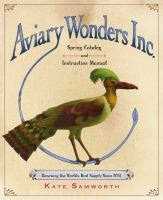
Aviary Wonders Inc. Spring Catalog and Instruction Manual: Renewing the World's Bird Supply Since 2031 by Kate Samworth

Funny and sad and horrifying. Kate Samworth's Aviary Wonders Inc. is one of the most confounding books that I've ever read. It's a beautifully illustrated picture book that's styled as a future catalog of robot birds made from mix-and-match parts. The re-engineered dodo from Jasper Fforde's Thursday Next series comes to mind.

"Whether you are looking for a companion, want to make something beautiful, or just want to listen to birdsong, we'll supply everything you need to build your own bird."

The brief book trailer below will give you a feel for Samworth's sly wit.


There are pages of beaks, bodies, wings and so on, which showcase the diversity of avian forms found in nature. Each page contains valid natural history information about birds. For example, that tails are used for brakes, balance, steering and display; that wing shape affects flying style; and "the Moa was large, flightless--and tasty! The last of the species was eaten in the fifteenth century."

The two-page spread about beaks divides them into four types: carnivores, for birds of prey; insectivores, for perchers, swimmers, and waders; herbivores, best for perchers; and piscivores, for waders and swimmers. "Choose beak according to diet."

A few of the beaks from Aviary Wonders by Kate Samworth (detail)
As seen in the detail above, while the beak shapes are accurate, the colours and patterns are outrageously lurid. They are so obviously unnatural that the overall effect is disturbing. 

Another creepy aspect is the breezy manner in which information about extinction is shared: "Passenger Pigeon. Imagine! These birds once travelled in flocks a mile wide and 300 miles long! The last died in 1914." So there's this uneasy mix of tragedy, hucksterism and humour. "100% Indian silk feathers don't fray with age like natural feathers" almost made me weep with the (unstated) reminder of species that have been made extinct because their feathers were used to decorate hats. 

Aviary Wonders is an important, thought-provoking book for readers of all ages.

Saturday, September 6, 2014

A Garden of Marvels by Ruth Kassinger

It took me nine weeks to read Ruth Kassinger's A Garden of Marvels: How We Discovered that Flowers Have Sex, Leaves Eat Air, and Other Secrets of Plants. Not because it isn't good, only because I kept being distracted by other books.*

I always have more than one on the go, and if I'm not totally hooked by something, I'll set it aside for when the right mood strikes. In the case of library books, this means that they sometimes go back to the library unread. A Garden of Marvels is about botany, a subject I love. It's also full of intriguing scientific information, like why orchids tend to remain in bloom for months. (It's so that their highly specific insect pollinators have time to find them.) Kassinger's style is personable and light, as exemplified in the following passages.

"Flowers dressed in green petals are generally not dressed for evolutionary success. They are less likely to catch the eye of a pollinator, and therefore less likely to produce offspring. (Wind-pollinated plants, like grasses and many trees, needn't invest in gay apparel.)"

"Insects favored flowers that provided not only a pollen dinner but a sweet postprandial drink. Over time, as plants whose flowers always kept a well-stocked bar prospered, mutations in nearby structures evolved into nectaries. Ever more attractive petals and scents evolved, too, to ensure that the location of the restaurant would be no mystery."

Anyway, the book was approaching the end of its maximum loan period and so I finished it yesterday morning. I don't know if the last third is so much better than the earlier part, or if I was just in the perfect mood, but I loved it.


Prompted by Kassinger's enthusiasm, I went off exploring. I searched YouTube for clips of bees tricked into pseudocopulation by orchids of the Ophrys genus. I looked for more information about Miscanthus giganteus, a type of grass that grows 12 feet in a season and is grown as a source of heating fuel for a greenhouse in Ontario. I investigated fruit cocktail trees (and, as a consequence, knew exactly what my friend Cathy was talking about when she said she was getting one). Kassinger notes that seeds from a 2010 prizewinning pumpkin sold for $1,200 each. Prices have risen. In 2013, they could be purchased online for $1,600 per seed. With all these tangents to follow, it's no wonder it took me a while to actually read the book!

If you enjoy popular science writing along the lines of Mary Roach, Amy Stewart, Diane Ackerman and Michael Pollan, A Garden of Marvels is for you.

The final lines in the book echo my own sentiments: "[Earth's] garden is more than a marvel. It's as close to a miracle as there is on Earth."

*During the same period that I was reading A Garden of Marvels, I started and finished:
5 adult novels
3 YA novels
3 nonfiction books plus 1 cookbook
8 graphic novels
1 short story collection
1 poetry collection
and listened to 8 audiobooks, including Middlemarch.
I also abandoned 4 books after an hour or two of reading.
Shelfari makes it easy to track these stats.

Friday, August 1, 2014

Albert Einstein and Antoine de Saint-Exupery in Picture Book Biographies

Biographies in picture book format are a weakness of mine. I think it's the combination of art and true facts, plus they are short. Because these books are usually only about 30 pages long, I know that I can spend a leisurely time appreciating them, and still get through the whole thing in one sitting. For me, they signal a mood of relaxed enjoyment.

I recently read two delightful examples back to back: On a Beam of Light: A Story of Albert Einstein by Jennifer Berne and Vladimir Radunsky and The Pilot and the little Prince: The Life of Antoine de Saint-Exupery by Peter Sis.

Radinsky's exuberant illustrations in On a Beam of Light radiate joyful energy. His black ink lines are expressively untidy and the rich gouache colours do not stay neatly inside the lines. The paper is light brown, speckled with fibers, giving it a homespun look.
Important lines of text are highlighted in red. (On a Beam of Light. Berne & Radunsky)

Berne has selected details about Einstein's life that will make the most impression on children. For example, when Einstein grew up, he chose specific clothes for thinking. He refused to ever wear socks. Einstein never spoke before age two, and hardly said a word before age three. When he did finally speak, he was full of questions.

"So many questions that some of his teachers told him he was a disruption to his class. They said he would never amount to anything unless he learned to behave like all the other students.
But Albert didn't want to be like the other students.
He wanted to discover the hidden mysteries in the world."

Readers can go on to discover more about Einstein through Berne's notes and resource list at the end.

Even though Peter Sis has a very different style from Radunsky, I was struck by the way they both showed their subjects as babies, floating in space:
Baby Einstein (On a Beam of Light. Berne & Radunsky)

Baby Saint-Exupery (The Pilot and the Little Prince. Sis)
In The Pilot and the Little Prince, Peter Sis uses medium to light colours, mostly golds and heavenly blues. He avoids black. His shading is made up of lots of minute lines and dots. There are whimsical details like the winged horse above. Continents on a map and mountains seen from a plane are shown with facial features. Pictorial elements on a page are frequently grouped in medallions with tidbits of additional text. It's like a treasure hunt to find everything on each page.

Young Saint-Exupery attempted to fly with his bicycle. (detail from The Pilot and the Little Prince. Sis)
There is a great deal more information in this book about Antoine de Saint-Exupery than in the one about Einstein. Older children, teens and adults will all find much to appreciate. Sis packs a lot into his pages! What makes the biggest impression is Saint-Exupery's lifelong love of flight, in spite of numerous crash landings. There are details about the history of aviation as well as Saint-Exupery's writing career and his service in World War II. And I learned a surprising lot about the earliest airmail service.

Peter Sis has written and illustrated many more wonderful books, including The Tree of Life (about Charles Darwin); Starry Messenger (about Galileo); and The Wall, his autobiography about growing up in Czechoslovakia. I've previously reviewed his retelling of a thirteenth-century Persian poem, The Conference of Birds.

Wednesday, July 30, 2014

Eyrie by Tim Winton

Set in the Western Australia port city of Fremantle, Tim Winton's Eyrie is a gritty and tender novel about betrayal's toll on an idealist's spirit. I was hooked from the start by the distinctive internal voice of Tom Keely, a former environmental spokesperson wrecking himself with booze and prescription drugs.

"Well, the upside was he hadn't died in the night. He was free and unencumbered. Which is to say alone and unemployed. And he was in urgent need of a healing breakfast. Soon as all his bits booted up. Just give it a mo."
[...]
"The lift was mercifully empty. He travelled unseen and uninterrupted to the ground floor. Let the lobby doors roll back. Took it full in the face. All that hideous light. Walked out like a halfwit into a bushfire. It was hot enough to kill an asbestos sparrow."

Tom has been holed up for a year in a dive-y tenth floor apartment. His self-centered anguish finally shifts when he meets two of his neighbours who live on the same floor. Tom knew Gemma when they were both kids living on the same block. She and her sister used to take refuge at Tom's house when their father got violent. Now, Gemma has a daughter in prison and she is caring for her 6-year-old grandson, Kai.

Gemma and Kai are facing deep trouble from some scary folk. The question is whether Tom can help himself, never mind anyone else.

It was smart of me to buy a gift copy of Eyrie for my friend Kathy, because this is a great book for discussion. Winton's storycrafting is impeccable and the ending is left open. There are all kinds of important issues like social justice, natural resources extraction, and class privilege. Kathy and I spent an hour on the phone talking about Eyrie last night. Winton will be at the Vancouver Writers Fest in October and we both look forward to hearing him there.

Readalikes: The Antagonist (Lynn Coady); The Painter (Peter Heller); and Carpentaria (Alexis Wright).

Friday, July 25, 2014

Fauna by Alissa York

Wildlife and lonely humans in Toronto encounter and change each other in Fauna by Alissa York.

Edal, a federal wildlife officer at Pearson Airport, is on stress leave and finds herself befriending a mouse. Guy, who inherited an auto junkyard from the uncle and aunt who raised him, is rehabilitating a red-tail hawk. Stephen, a soldier on medical leave after traumatic service in the Middle East, works for Guy and cares for an orphaned litter of raccoon kits. Lily, a homeless teen, sleeps in the Don Valley with her beloved Newfoundland dog. Kate, a veterinary technician, mourns the death of her lesbian lover. And then there's the Coyote Cop, a blogger who believes that all coyotes in the metropolitan area should be killed.

Close third-person point of view alternates between these people, along with occasional urban wildlife individuals: a squirrel, a raccoon, a coyote.

I spotted this guy in Vancouver.
Edal was named for one of the otters in Gavin Maxwell's Ring of Bright Water. When she was a child, her mother often read to her, but Ring of Bright Water was the only book she read to Edal in full.

"Her mother explained nothing, and she left nothing out. Countless words slipped Edal's grasp and swam away, but they swam beautifully, some darting, others wagging long and languid lines. Pinnacles and glacial corries. Filigree tracery and tidewrack rubbish-heap. Clairvoyance and manna and quarry. Purloined."

Fauna is a graceful meditation on the power of stories, and the way that connecting with other beings can improve our solitary existence.

Readalikes: Prodigal Summer (Barbara Kingsolver); Five Bells (Gail Jones).