Showing posts with label surrealism. Show all posts

Wednesday, September 9, 2020

The Baudelaire Fractal by Lisa Robertson


The Baudelaire Fractal
by Lisa Robertson
Coach House Books, January 2020

A feminist, philosophical novel about gender and creativity.

Poet Lisa Robertson's first novel is a tour-de-force that's hard to describe. It's semi-autobiographical and reads like a memoir, looking back on the travels of her stand-in, Hazel Brown, as a young Canadian in France, right through into present-day middle age. It also takes the form of an academic essay in the fields of cultural and gender studies. Sometimes I understand exactly what is meant, other times I feel on the edge of understanding, rereading passages to grasp their meaning. Robertson's prose is arresting, both for her tantalizing ideas and her vivid descriptions.

        This morning I'm at the round table under the linden tree, in a sweet green helmet of buzzing. Each of its pendulous flowers seems to be inhabited by a bee. They don't mind me -- they're rapturously sucking nectar. I'm at the core of a breezy chandelier of honey.

The central premise is that Hazel Brown wakes up one morning with the realization that she has become the author of the writings of Charles Baudelaire, slipping into them "as one slips into a jacket."

        I simply discovered within myself late one morning in middle age the authorship of all of Baudelaire's work. I can scarcely communicate the shock of the realization. 

The male perspective of Baudelaire and other creatives is troubling to Hazel. Women as individuals are erased and objectified. Baudelaire did this with his longtime companion, a black woman named Jeanne Duval.

        Baudelaire scorned Jeanne Duval and every female he dallied with, or at least did so on paper, Ted Hughes scorned Sylvia Plath, Ezra Pound scorned Djuna Barnes, George Baker scorned Elizabeth Smart, everybody scorned Jean Rhys. Proust did not scorn Albertine because Albertine was a man. The she-poets perished beneath the burden of beauty and scorn. This is what I observed.

Hazel's observations include the potentiality of fashion for its role in self-reinvention or the expression of personas.

        I found a tailored black mid-nineteenth-century gentleman's jacket at a flea market at Bastille. I suppose it would be called a frock coat, or perhaps a morning jacket. Its fitted sleeves were mounted quite high on the torso, its shoulders were softly rounded in an unfamiliar manner, and slipping it on I felt a freshened awareness of the articulations and expressions of my arms. I longed for a decorative walking stick. From a slightly accented waist its longish skirt flared a bit behind, encouraging a brisk, decorative enunciation of my step; this jacket added a grain of wit to its wearer's walk, like a mild sartorial drug.

Tangential musings develop subtle notions about the creative process and being a writer who is also a woman. Perhaps creation is more an aspect of becoming, rather than being. Meanwhile, I found it easy to identify with the concrete storyline, that of Hazel's travels and self-education through experience, through following her own desires, and learning to ignore the disregard of men.

I predicted The Baudelaire Fractal would be on the official Giller longlist, but it wasn't. It's not a book that will appeal to everyone, but for readers like me, it's intellectual dynamite.

-----------

This post is part of a series. I'm on the Shadow Giller jury this year, so I have been reading as many qualifying Canadian titles as possible. To see my other reviews that are a part of this project, click on the Shadow Giller tag. Also, please visit our Shadowing the Best of CanLit website to see what the rest of the Shadow Giller jury are up to. Thanks for visiting my blog.

Sunday, September 6, 2020

Noopiming by Leanne Betasamosake Simpson


Noopiming: The Cure for White Ladies by Leanne Betasamosake Simpson
House of Anansi, September 2020

A stunning experimental novel about the web of life.

Leanne Betasamosake Simpson is a Michi Saagiig Nishnaabeg member of Alderville First Nation. "Noopiming is Anishinaabemowin for 'in the bush' and the title is a response to English Canadian settler and author Susanna Moodie's 1852 memoir Roughing it in the Bush," (as stated on the back cover). 

And what a response! In Noopiming, the bush is the place of shelter, of home and healing, rather than a place of hardship. Even scraps of treed park areas in the city are a refuge for the urban Indigenous humans in this story. The nonhuman people--animals, trees, ancestors--also find their place in the city. Their perspectives are equally important in this wholistic tale.

        Esibanag moved back in and then learned all kinds of new shit like how to break zip-ties and open the green bins and the new, extra-expensive green bins and how to do public relations. They learned to tilt their heads at the cameras to look omg so cute. They learned to parade out their babies in a line, ride the subway and steal donuts. 

Anishinaabemowin words are used throughout the novel, especially for names. There are online sources, such as The Ojibwe People's Dictionary, that make it easy to look them up. (If you couldn't guess from the context in the previous excerpt, esibanag = racoons.)

This is set in today's Canada. It's the Anthropocene, the epoch of plastic. Blankets and lodges are made of tarps from Canadian Tire. Lodge supports are constructed from water bottles or wire from leftover NDP election signs. The chemical formula for polythene is carved onto a sacred cliff. 

        Things seem pretty fucked for the humans, to be honest. The white ones who think they are the only ones have really structured the fucked-up-ed-ness in a seemingly impenetrable way this time. A few good ones get their footing, and then without continual cheerleading, succumb to the shit talk. It is difficult to know where to intervene or how to start. There are embers, but the wood is always wet and the flames go out so damn easy.
        Everyone thinks the Ancestors have all the answers, but sometimes, most times, it takes more.

They/them pronouns are used for everyone, including Akiwenzii (Old Man) and Mindimooyenh (Old Woman). Ninaatig (Maple Tree) is nomadic, wandering far while pushing their shopping cart. Adik (Caribou) wears a small blue backpack that contains a voice recorder. The entire frame of reference is not exactly disorienting, but enough to make a reader sit up and pay attention. Betasamosake Simpson conveys oral storytelling tradition through repetition, and a generous use of white space on the page for silent pauses. Humour and poignancy are interlaced.

        On our way out, the mean post office lady yelled that Mindimooyenh could no longer just Scotch tape the correct amount of change to their letters and mail them, that they had to buy stamps like everyone else.
        As if Mindimooyenh will ever buy stamps like everyone else.

This wise and funny novel is like nothing else I've read. I am already looking forward to rereading it, to discovering more meaning in its layers.

Giller chances: HIGH

This post is part of a series. I'm on the Shadow Giller jury this year, so I'm reading as many qualifying Canadian titles as possible in order to come up with my own longlist prediction before the official one that will be announced on September 8, 2020. To see my other reviews that are a part of this project, click on the Shadow Giller tag. Also, please visit our Shadowing the Best of CanLit website to see what the rest of the Shadow Giller jury are up to. Thanks for visiting my blog.

Thursday, September 3, 2020

You Will Love What You Have Killed by Kevin Lambert


You Will Love What You Have Killed by Kevin Lambert
Translated from French by Donald Winkler

End-of-the-world surrealism in the voice of a child in Chicoutimi, Quebec.

Are you up for something totally weird? Something in a macabre vein? Faldistoire, the gay boy who narrates this tale, is already jaded by the time he's in Grade 2. 

        They teach us all sorts of stupid things at Rejean-Tremblay School. They boil down the meaning of life for us and make us swallow it in little pills to calm us at lunch or when the nurse comes to see us and meets us privately to deliver her messages: don't trust anyone you don't know, get vaccinated, this is how to brush your teeth, my-body's-no-body's-but-mine, beware of Halloween candies where old perverts have hidden long poisoned needles that will send you right to your grave, you have to inspect them and throw away anything suspicious.

Children in his neighbourhood are abused by adults, they die by accident and by homicide. Toads watch over their graves in the local cemetery. Transgender folk don't have it easy in Chicoutimi either.

        Thanks to our family connection, I find pictures of Paule before her operation in the photo albums of Angele, my grandfather Fernand's sister. He had been her golden boy before he was disowned by the whole family because of his transexual lunacies. When you eat at my great-aunt's and, a bit tipsy, she starts talking about her only son abducted by the demons of sodomy because his father was never there to discipline him and to alert him to sexuality's most twisted vices, I pretend to go to sleep on the couch and I listen to her song and dance as she curses a life that always gives all good things to the same people, Mother Nature who makes families of ten children without a single one that's fucked up, while my great-aunt is there all alone to shovel the shit of the entire world.

After he has completed Grade 6, Faldistoire's father chooses to send him to the private school in town.

        The Lycee charged money for the admissions test, each year's registration, the uniform that had to be changed every two years because we grew too fast, the shorts and T-shirts for physical education because of the new logo, every extracurricular activity and the materials required for it. The Lycee, a business masquerading as a school, with all the good intentions--bogus--of the teachers who, only once a year, on the day for parental visits, made as if they gave a damn.

The students' favourite teacher in high school is Madame Marjolaine:

        We were sure that she was the queen of sexuality, we imagined that she knew everything about blow jobs, anal penetration, cunts and cunnilingus, all those things we knew the names of but didn't know what they really were, and in time we would go and check out Google and watch a video that would give us our education, the real one.

Faldistoire is expected only to "survive as one raises one's head out of murky and toxic water." But doesn't everyone have a right to more than that? To thrive? In this novel, the ghosts are bent on revenge, on blowing up the status quo, on demolishing "beautiful things prized for no reason." It's a wild ride.

Giller chances: MEDIUM - It's unusual and strangely compelling, but probably too nihilistic for the Giller.

This post is part of a series. I'm on the Shadow Giller jury this year, so I'm reading as many qualifying Canadian titles as possible in order to come up with my own longlist prediction before the official one that will be announced on September 8, 2020. To see my other reviews that are a part of this project, click on the Shadow Giller tag. Also, please visit our Shadowing the Best of CanLit website to see what the rest of the Shadow Giller jury are up to. Thanks for visiting my blog.

Thursday, September 14, 2017

The Heavy Bear by Tim Bowling


"After making a press of dark roast, I slipped in the DVD and watched The Railrodder. Then I watched Buster Keaton Rides Again, the documentary shot simultaneously with the filming of The Railroader, which is even more haunting in its depiction of a dying legend and a vanishing nation. And I stepped straight out of linear time - just like Keaton as the projectionist in his classic 1924 film Sherlock Jr., who leaves his own body and enters the story he is showing on the screen - and arrived in the past where the light animates the dead and every shadow is a snarl of tape on the cutting-room floor."

Just like Keaton does, as the protagonist in the silent film Sherlock Jr., Bowling seems to step out of his life into a dream. The protagonist in Tim Bowling's latest book happens to be named Tim Bowling. He happens to be a writer living in Edmonton (where I also happen to live). He has a family and sometimes must make ends meet by taking teaching jobs... just like the real Tim Bowling. However, there are other elements that make it immediately clear that this is fiction. Bowling wakes up really early (or is he still dreaming?) on the morning that he is to begin teaching an English class. He cannot bear the thought of surmounting his introversion and standing in front of his students. What to do? What to do? His companions during his day-long existential crisis include the ghost of Buster Keaton and a large, but invisible, bear-poet.

"I had an imaginary bear who wept, a silent film ghost who remained true to silence, and my own sense of reality, which might either have been slipping away or speeding straight at me like an express train, depending on how you define reality. One fact was clear enough: the more I taught, the less I would write. And if I did not write, what would keep me out of a straitjacket? Yet what I wanted to write didn't pay me enough to support a family of five."

Bowling is someone best described as a writer's writer, and, with phrases like: "I pointed my heavy compass to campus," it's evident how much he enjoys playing with words.

"I checked my watch. It was almost one o'clock. I checked my pulse. It was still quick, but not alarmingly so. I checked my mood. It had sped through a few phases since the morning, and now had slid down toward where it started. Much had happened, but little had changed."

Tim's chance encounters on the streets of Edmonton lead him to an unlikely source of wealth and unwitting involvement in criminal activity. There's enough humour and narrative action to keep the storyline compelling even as it meanders through thoughtful interludes.

"I looked around at the cages and tanks. There were at least a dozen, and all were grimy. Some sort of a large lizard - perhaps a Komodo dragon - blinked up at me with its bulbous, Peter Lorre eyes. The sandpaper of its skin seemed to cast sparks against being. I could relate, too much so."

"For some strange reason, the depressing shop comforted me. Despite the filth and gloom of the place, the presence of other species, even these poor specimens, always lifted my spirits. I remembered my Whitman:

I think I could turn and live with animals: they are so placid and self-contain'd;
I stand and look at them long and long.
They do not sweat and whine about their condition;
They do not lie awake in the dark and weep for their sins;
They do not make me sick discussing their duty to God:
Not one is dissatisfied - not one is demented with the mania of owning things;
Not one kneels to another, nor to his kind that lived thousands of years ago;
Not one is respectable or unhappy over the whole earth.

It's a bizarre, twenty-first-century form of comfort, but you hear it from time to time: the earth and its life existed before us, and it will survive us. Even when you don't hear someone articulate the thought, you can feel it."

The Heavy Bear is an inventive, introspective and thoroughly rewarding novel.

Thank you to publisher Wolsak and Wynn for sending me a review copy.

Thursday, April 23, 2015

Kafka on the Shore by Haruki Murakami


I've realized that I've got a poor track record as far as blogging about the audiobooks I read and my goal is to do better. I listened to seven audiobooks in April, the most recent being Kafka on the Shore by Haruki Murakami [Naxos: 19 hrs].

The two main characters are 15-year-old Kafka (narrated by Oliver Le Sueur) and Nakata, a simple-minded old man who can talk to cats (narrated by Sean Barrett).

Miss Saeki, a former singer, is the enigmatic manager of a private library. Her name is pronounced in two different ways by the audiobook narrators. Barrett: Sah-eh-ki. Le Sueur: Psyche. I don't know which is closer to correct Japanese pronunciation, but I know which one I found more fitting. One of the other characters is Oshima, a transgender librarian, whom I wish had a greater role in the story.

There was a third audiobook narrator who performed the voice of a female teacher, but I couldn't find her name listed anywhere. I downloaded the e-audiobook from OverDrive and it had no publication credits at the beginning or at the end of the recording, which is something I've never encountered before. Searching for more information online, I learned that the translator is Philip Gabriel, who was awarded a PEN/Book of the Month Club Translation Prize for this work.

As I listened, I found myself checking off ingredients common to other books by Murakami that I've read:
  • multiple narratives that come together
  • parallel worlds
  • a central character who feels alienated
  • a ghostly, very beautiful girl
  • music is significant
  • libraries and books
  • lost cats
  • a menacing black dog
  • supernatural entities
  • sex while asleep or dreaming
  • brief episodes of gruesome violence
  • metaphysical musings
When I was about 11 hours into the story, I lost enthusiasm for a while. There's stuff about patricide and sleeping with both his mother and his sister and details about his cock and I needed a break. I switched to a different book for a while, then felt renewed interest in Murakami's use of symbolism and where he was going with this tale. 

I was glad that I finished it, because his work always makes me feel changed. Even so, I liked The Wind-up Bird Chronicles better.

Tuesday, March 24, 2015

Nobody Is Ever Missing by Catherine Lacey

A woman hitchhikes solo through New Zealand in Catherine Lacey's compelling novel Nobody Is Ever Missing. 

Elyria is missing. She left her husband and her job as a daytime television scriptwriter in New York without saying anything about her plans to anyone. In fact, she had little in the way of plans when she landed in New Zealand. She just needed to get away. Finding out why kept me turning pages, and so did Elyria's busy internal voice.

"He turned the music up, lit another cigarette, and opened a beer as we drove up a mountain, making hairpin turns at unadvisable speeds. My organs let me know how much they disapproved of where I was sitting--I couldn't remember why I had ever wanted to go anywhere at all."

Elyria saw many odd things on her road trip in New Zealand. I did too.
Many of the people who give Elyria a ride warn her about the dangers of hitchhiking. She, however, has more lofty things on her shattered mind.

"Let me say that whoever invented wanting, whoever came up with desire, whoever had the first one and let us all catch it like a hot-pink plague, I would like to tell that person that it wasn't fair of him or her to unleash such a thing upon the world without leaving us a warranty or at the very least an instruction manual about how to manage, how to live with, how to understand this thing that can happen in a person against her will, by which I mean desire and the need it gnaws in us and the shadow it leaves when it's gone."

New Zealand road ornament.
The world through Elyria's filter is mesmerizing and often surreal. I appreciated the grounding I felt during her moments of clarity.

"I walked into the library and the library smelled like every library I'd ever been in and Dewey decimals were on all the spines, same tiny font, tiny numbers, and I thought, for a moment, that there actually were things you could count on in this world until I realized that the most dependable things in the world are not of any significant use to any substantial problems."

There isn't a resolution for Elyria in the end--her problems are substantial--and yet I had seen enough shreds of resourcefulness to have hope for her. Nobody Is Ever Missing is a thought-provoking novel written in a fresh, wry style.

Readalikes with similar humour and themes: The Dept. of Speculation (Jenny Offill) for its exploration of marriage; The First Bad Man (Miranda July) for the mentally troubled main character; and Save Your Own (Elizabeth Brink) for a woman floundering to make sense of her life.

Friday, February 27, 2015

The Strange Library by Haruki Murakami

Murakami window display, December 2014 in Victoria, BC at the bookstore started by Alice Munro.
Strange Library UK ed. left, American right.
Book pocket is stamped 2 Dec 2014.
I'm comparing two editions of The Strange Library by Haruki Murakami. I received the UK (Harvill Secker) edition as a Christmas gift and I borrowed the North American (Knopf) edition from the public library. The text content is the same, translated by Ted Goosen, but the book designs are very different.

The tale begins when, on a whim, a boy on his way home from school asks at the public library for books about tax collection in the Ottoman empire. Then he is held captive in a labyrinth while forced to memorize them. A man in a sheepskin and a mute girl look after him. The story unfolds like a dream--or possibly a nightmare.
   "But, hey, this kind of thing's going on in libraries everywhere, you know. More or less, that is."
   This news staggered me. "In libraries everywhere?" I stammered.
   "If all they did was lend out knowledge for free, what would the payoff be for them?"
   "But that doesn't give them the right to saw off the tops of people's heads and eat their brains. Don't you think that's going a bit too far?"
Designer Chip Kidd (for Knopf) combines magnified, brightly-coloured Japanese paper miscellany, and photos, with text in oversized Typewriter font. The mute girl's dialogue is printed in blue ink.
Strange Library American edition. Look closely to see #BlueandBlack text on left. 
An effective series of illustrations begins with the close-up of a dog's eye, then incorporates a bird image that becomes increasing larger in the pupil of that eye. The moon is an important story element and I like the way Kidd includes it throughout. The overall effect is playfully moody in a fun-house-horror kind of way.
Strange Library American edition detail
Strange Library American edition on left, UK edition on right. Note difference in text size and layout.
Designer Suzanne Dean (for Harvill Secker) has opted for a standard serif font (maybe Dante? which, now that I think of it, would be appropriate for the name alone). The size of the text changes to emphasize words and sometimes is incorporated into illustrations. The lens of vintage eyeglasses magnifies a few letters on one page, for example. The mute girl's dialogue is in angled brackets, like a foreign language.
Strange Library UK edition detail
According to an article* I read online, Dean selected old images from the British Library. As with Kidd, some of the images are greatly enlarged. In both editions, experimentation with size contributes to an Alice in Wonderland-like feeling of disorientation.

The heavy use of black, plus pictures of insects, looming black dogs, and angled walls of books, give it a surreal, sinister atmosphere. Together with the marbled endpapers and an actual date due book pocket stuck to the front cover (brilliant!), the effect is of an arcane volume, unearthed from the stacks.
Both images are from UK edition. Effective use of large size font and manicules!
BTW, Keith Houston has an entire chapter on manicules in Shady Characters.
In their own way, each edition does a good job of emphasizing one of the central themes: coping with fear. I cannot choose which one I like better. I'm a huge fan of Chip Kidd, yet the UK edition may become my favourite simply because I will read it more often.
   "The kiss had shaken me up so much I couldn't think straight. At the same time, my anxiety had turned into an anxiety quite lacking in anxiousness. And any anxiety that is not especially anxious is, in the end, an anxiety hardly worth mentioning."
Strange Library UK edition detail.
If you are already a fan of Murakami's writing, you won't need any encouragement to pick up this lavishly illustrated little gem.

If you haven't yet dipped into his still waters to discover the hallucinations lurking beneath, then The Strange Library is a good test to see whether examples among his works that lean towards the bizarre--like The Wind-up Bird Chronicles--are for you. If you prefer more realism, Murakami's Colorless Tsukuru Tazaki and His Years of Pilgrimage might be more to your taste.

*A review by Buzz Poole in The Millions, comparing three different editions of The Strange Library.
See also an interview with Chip Kidd by Roland Kelts in The New Yorker about illustrating The Strange Library.

Friday, November 28, 2014

Sam & Dave Dig a Hole by Mac Barnett and Jon Klassen

When two creative rock stars join forces, great books happen. Author Mac Barnett and artist Jon Klassen previously collaborated on the delightful picture book Extra Yarn. Their latest creation is the playful and subversive Sam & Dave Dig a Hole. It's about two boys doing what kids like, accompanied by their dog who appears to know more than they do.

Readers know more too. Barnett plays the straight man here with the words.
   "When should we stop digging?" asked Sam.
   "We are on a mission," said Dave.
   "We won't stop digging until we find something spectacular."

Klassen's illustrations provide both the real story and the humorous contrast with the text. The earth shown in cross-section reveals that the boys decide to change directions every time they get close to treasure (increasingly massive gemstones, a bone).

Sharp readers will spot the differences when the boys return home empty-handed. The surreal ending makes Sam & Dave Dig a Hole satisfying for all ages.

Look for other wonderful picture books by these talented guys, including Chloe and the Lion (Mac Barnett & Adam Rex), House Held Up by Trees (Ted Kooser & Jon Klassen) and my all-time favourite, I Want My Hat Back (Jon Klassen).

Friday, September 26, 2014

Beautiful Darkness by Fabien Vehlmann and Kerascoet

The cover shows Aurora
next to the hand of a
human corpse.
A quirky combo of sweet and macabre, Beautiful Darkness is an astonishing full colour creation by French comics artists Fabien Vehlmann and Kerascoet. On the back cover of the Drawn & Quarterly English language translation, it is aptly labelled an "anti-fairy tale."

Take Thumbelina, Hansel and Gretel, Moomin, The Borrowers, Lord of the Flies and Gulliver's Travels, mix them together, and then twist the storytelling dial over to the darker end.

The action takes place in a forest, where a dead school girl sprawls, slowly decomposing. A loose community of Lilliputian beings scavenge for food and tools from the corpse and its accoutrements. They crawl in and out of its body cavities. They play amongst maggots as they hatch. ("Hee hee! That tickles!")

The community members are a varied assortment of doll-like creatures. They have big eyes and are portrayed in a cartoony style. In contrast, the corpse and one other (living) human are realistically illustrated, as are the insects and animals of the forest.

The lives of the miniature beings are precarious. They die in such a variety of black comedy misadventures that Andy Riley's The Book of Bunny Suicides comes to mind. Their challenge is to sort out the way their society will function... or malfunction. Who will lead them best: kind and selfless Aurora... or vain and ruthless Zelie?

Readalike pictorial works: Temperance (Cathy Malkasian); Pinnochio (Winshluss); Through the Woods (Emily Carroll); My First Kafka (Matthue Roth & Rohan Eason) and Ant Colony (Michael DeForge).

Sunday, July 6, 2014

Diving Belles by Lucy Wood

Lucy Wood's distinctive short stories reveal "the miraculous in the everyday." That quote is from Karen Russell's blurb on the cover of Diving Belles. Russell also calls Wood "a sorceress." Ali Shaw writes: "It is as if the Cornish moors and coasts have whispered secrets into Lucy Wood's ears and, in response, she has fashioned exquisite tales of mystery and humanity." Yes! What they said.

Some of the tales incorporate Cornish folklore, such as leaving a fish offering to appease hobgoblins called buccas. The landscape is nearly a character in its own right, while thrift and other coastal plants are ever present.

"Nothing moved across the moor except the rain, which appeared as suddenly and soundlessly as a face pressed against a window."

I savoured these stories slowly, opening my heart to their charms. Things are often not as they appear. "What you mistook for sadness is love."

A woman is sometimes a hare, as in 'Blue Moon.' In this tale, a kindly receptionist narrates her experiences in a nursing home for elderly folk with witchy abilities. "We kept finding them down at the harbour trying to sell the wind to fishermen in lengths of knotted rope. [...] Most days the phone wouldn't ring at all so I was roped into doing extra cleaning. There had been a spate of pentagrams appearing on the common room carpet, marked out in salt, and I had to hoover them up. It's a real pain because the grains bind themselves to the carpet fibres and won't shift unless you keep a pinch of salt on your tongue. By the end of it you're parched."

Each story carries fresh astonishments, so I have readalike suggestions for seven out out of the twelve individually, as well as for the collection in general.

'Diving Belles' (title story) - The Brides of Rollrock Island (Margo Lanagan)
'Countless Stones' - The Girl with Glass Feet (Ali Shaw)
'Of Mothers and Little People' - Some Kind of Fairy Tale (Graham Joyce)
'Lights in Other People's Houses' - The Ghosts of Kerfol (Deborah Noyes)
'The Giant's Boneyard' - Yellowcake (Margo Lanagan)
'Notes from the House Spirits' - the chorus of maids in Penelopiad (Margaret Atwood); and the sentient house in End of the World Blues (Jon Courtenay Grimwood).
'Blue Moon' - Tenth of December (George Saunders)

Additional readalikes for the collection as a whole: Jagannath (Karin Tidbeck); Vampires in the Lemon Grove (Karen Russell); and Pretty Monsters (Kelly Link).

Friday, May 16, 2014

The Unusual Life of Tristan Smith by Peter Carey

Still looking back on books that I read 10 years ago. These are my notes from July 2004 about The Unusual Life of Tristan Smith.

A most unusual and inventive narrative. I was reminded of Ella Minnow Pea (the fabricated country, the footnotes) and of A Prayer for Owen Meany (the freakish protagonist and the bizarre humour). The tiny country of Efica had a relationship to Voorstand that reminded me of the relationship between Canada and the U.S.A. Loved it. Great ending!

It was my first introduction to the multitalented Peter Carey and I've since enjoyed several more of this Australian author's works. The only one that I've previously reviewed on my blog, however, is Parrot and Olivier in America. 

Monday, September 2, 2013

Heads or Tails: Stories by Lilli Carre

Heads or Tails is a collection of whimsical stories by comics artist Lilli Carre. These surreal tales have few words and seem to come straight out of fever dreams. Under the hot streets of a city, people swim in pools of their own sweat. A woman splits into two selves. "There's a very small town where the people spend their days picking the moss off hollow logs." 

'My New Look' has only four panels and it is one of my favourites. A woman is convinced that her cups are insulting her, calling her a fatso and an old bag, so eventually she breaks them all. "I started drinking out of my hat." "Impractical, sure, but a much better life." The hat says, "Lookin' good, cowpoke."

In 'The Flip,' two women get more and more absurd as they prepare to flip a coin in a game of Heads or Tails. 
"If it's heads: the sound of my voice will make men, rabbits and lions stop in their tracks."
"If it's tails, you'll make me forget every embarrassing and nasty moment I've ever had."
"Heads: the world will fit in the palm of my hand." 
"Tails: I will live one day as a dandelion puff."
Etc. 
The coin goes up... but doesn't come down. Several stories and more than 50 pages later, Carre reprises the story. The coin falls... and we witness the winning wager. Okay, maybe this one is my favourite. 

It is hard to choose, because each bizarre story is perfectly brilliant. Just like the guy with a gemstone for a head (after he asked a witch for lasting beauty).

In Carre's stylized art, nonchalant heads without bodies lie around like Brancusi sculptures. Elaborate decorations gradually encroach on a king's space. A curly green cloud of vegetation emerges from between a woman's teeth after a meal. Check out Carre's website to see her astonishing work.

Readalikes: The Principles of Uncertainty (Maira Kalman); Tales from Outer Suburbia (Shaun Tan); Ojingogo (Matthew Forsythe); and, without pictures: Suddenly, A Knock on the Door (Etgar Keret).

Saturday, May 25, 2013

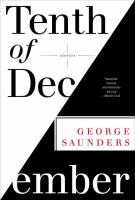
Tenth of December by George Saunders

George Saunders has already received so much praise for his masterful short stories that I hardly know what to add. His latest collection, Tenth of December, is a showcase for his energetic imagination. I love his life-affirming brand of surrealism. His stories are funny, dark and unsettling, but also tender, and very understanding of human foibles.

Saunders is also known for his stylistic innovation, so I'll give a few examples.

In The Semplica Girl Diaries, a father of three attempts to keep up with his more prosperous neighbours by acquiring an outrageous landscaping fad; live girls on display. It's written in the form of a daily journal.

"Note to self: Try to extend positive feelings with Scratch-Off win into all areas of life. Be bigger presence at work. Race up ladder (joyfully, w/smile on face), get raise. Get in best shape of life, start dressing nicer. Learn guitar?"

In Tenth of December, a man dying of cancer interrupts his suicide plans to rescue a child with a hyperactive imagination. The close third-person point of view shifts between the man and the boy. This is the child:

"He came out of the woods now to the prettiest vista he knew. The pond was a pure frozen white. It struck him as somewhat Switzerlandish. Someday he would know for sure. When the Swiss threw him a parade or whatnot."

In Victory Lap, a boy considers whether or not to disobey his parents' strict injunctions against interfering in someone else's business, when it appears that his neighbour is being kidnapped. Again, point of view alternates and we start in the mind of a teen girl, imagining she's descending a marble staircase, catching the eye of some adorable guy:

"Had he said, Let us go stand on the moon? If so, she would have to be like, {eyebrows up}. And if no wry acknowledgment was forthcoming, be like, Uh, I am not exactly dressed for standing on the moon, which, as I understand it, is super-cold?"

Several of the stories imagine a future with drugs tailored for every situation. Nostalgic theme parks are settings Saunders has used in his earlier collections, including Civilwarland in Bad Decline. Both feature in  My Chivalric Fiasco. where Ted, a historical interpreter, receives a hit of 'KnightLyfe' to help him get into his role.

"Martha: Ted. You okay?
To which I made Reply: Verily, I have not been Well, but Distracted & Remiss; but presently am Restored unto Myself, and hereby do make Copious Apology for my earlier Neglect with respect to Thee, dear Lady.
Martha: Easy there, Ted."

These stories are all fabulously entertaining. Enjoy.

Readalikes: Vampires in the Lemon Grove (Karen Russell); Pretty Monsters (Kelly Link); and Better Living Through Plastic Explosives (Zsuzsi Gartner).


Sunday, April 28, 2013

May We Shed These Human Bodies: Stories by Amber Sparks

It's hard to categorize the brief, surprising stories in Amber Sparks' collection. The title story, May We Shed These Human Bodies, is a creation fable, a lament in the first-person-plural voices of trees who have been turned into humans. Never-never is a melancholy retelling of Peter Pan told in multiple viewpoints. All the imaginary people are better at life is surrealist contemporary fiction:

   "Ruby can't stop driving, because if she stops she'll be somewhere. If she's somewhere, she'll be real. All the Ruby atoms in the vicinity will come to a screeching halt in the general shape of her. Then she'll have to deal with all of the issues real people deal with.
   No thank you.
   [...]
   Caleb, her imaginary best friend, calls on the space wires from Chicago to complain about the weather. The best part about Caleb is that he has a direct line into her head so she doesn't incur any long distance charges."

(In a strange coincidence, when I read All the imaginary people are better at life, I had just read a blog post from someone in Chicago who was complaining about the terrible weather they have been having.)

The stories are odd... in the best possible way. There's a great blurb from Ben Loory on the back of the book: "I always love a book that makes me fear for the writer's sanity." This may not always be true for me, but in the case of Amber Sparks, I agree with Loory.

Readalikes: Suddenly, a Knock on the Door (Etgar Keret); Vampires in the Lemon Grove (Karen Russell); Highly Inappropriate Tales for Young People (Douglas Coupland) and Anthropology (Dan Rhodes).

Friday, April 5, 2013

Suddenly, A Knock on the Door by Etgar Keret

Suddenly, A Knock on the Door is a collection of Etgar Keret's short, sharp and strange short stories. A trio of translators have made these poignant Israeli tales available to an English audience.

Most are only a few pages long and are about the average Joe, or Yosef, rather. Mundane life is knocked slightly askew with touches of the fantastic or surreal. There's always a little twist in the narrative, and I could never see it coming. They are like refreshing palate cleansers between reading other things.

You can see an excerpt from Keret's story Todd animated here. Very cool!

Readalikes: Anthropology (Dan Rhodes); The Elephant Vanishes (Haruki Murakami); and Kitchen (Banana Yoshimoto).

Saturday, March 23, 2013

Vampires in the Lemon Grove by Karen Russell


Karen Russell's latest collection of short stories, Vampires in the Lemon Grove, is astonishing in variety and inventiveness. As with her earlier collection, St Lucy's Home for Girls Raised by Wolves, and her novel Swamplandia!, Russell mixes surprising elements of the fantastical into realistic settings: vampires in contemporary Italy; fortunetelling seagulls who descend on an otherwise ordinary coastal town; girls who take on the role of silkworms in Edo-period Japan. In a brilliant send-up of sports fan culture, Team Krill champions the eternal underdog in the Food Chain Games in "Dougbert Shackleton's Rules for Antarctic Tailgating."

The title signals the strangeness to be encountered, the juxtaposition of night creatures with a garden bathed in sunshine. This story, set in Sorrento, is narrated by a nostalgic vampire: "there is no word sufficiently lovely for the first taste, the first feeling of my fangs in that lemon. It was bracingly sour, with a delicate hint of ocean salt. After an initial prickling -- a sort of chemical effervescence along my gums -- a soothing blankness travelled from the tip of each fang to my fevered brain."

Each story has a wildly different premise and its own unique voice. The young 19th-century narrator in "Proving Up" describes "evil turkeys that have heads like scratched mosquito bites." This one gets progressively creepier; Russell often explores greed, cruelty, obsession and other dark subjects. But it is her tongue-in-cheek humour that makes me love her writing so much.

The final story, "The Graveless Doll of Eric Mutis", is the most disturbing. A scarecrow who takes revenge on a group of teenage bullies in New Jersey reminded me of the tragedy of Matthew Shepard. (Coincidentally, I've got October Mourning next up on my reading list. It's Leslea Newman's verse novel in multiple voices about Shepard's death and its aftermath.)

Russell talks about her writing and reads from Vampires in the Lemon Grove on Radio Times, available online here.

Readalikes (novels as well as short stories): Please Ignore Vera Dietz (A.S. King); The Particular Sadness of Lemon Cake (Aimee Bender); Pretty Monsters (Kelly Link); Better Living Through Plastic Explosives (Zsuzsi Gartner) and anything by Margo Lanagan or Franz Kafka.


Saturday, January 12, 2013

Lewis Carroll's Alice's Adventures in Wonderland with artwork by Yayoi Kusama

Yayoi Kusama's art adds freshness to a beloved familiar tale in a new edition of Alice's Adventures in Wonderland. From the publisher: "Since childhood, Kusama has been afflicted with a condition that makes her see spots, which means she sees the world in a surreal, almost hallucinogenic way that sits very well with the Wonderland of Alice. She is fascinated by childhood and the way that adults have the ability, at their most creative, to see things the way children do, a central concern of the Alice books."

It's a Penguin Classic with the full text. The book design plays with font as well as colour. The result is delightfully whimsical and best demonstrated with examples of some of the pages. You really must handle it yourself to appreciate the high production quality in this beautiful, hardcover book. It would make a lovely gift.


Readalikes: Shakespeare's Hamlet: Staged on the Page by Nicki Greenberg. The Elements of Style by William Strunk, Jr. and E.B. White, illustrated by Maira Kalman. The Conference of the Birds by Peter Sis.

Sunday, October 14, 2012

A Case of Exploding Mangoes by Mohammed Hanif

Conspiracy theories surround the 1988 plane crash that killed the president of Pakistan, General Muhammad Zia-ul-Haq, as well as most of Zia's top commanders and an American ambassador. Mohammed Hanif has spun the mystery into an entertaining satire, A Case of Exploding Mangoes. It's narrated by a gay junior officer in the Pakistan army, Ali Shigri.

"There's poetry in committing a crime after you have served your sentence. I do not have much interest in poetry, but punishment before a crime does have a certain singsong quality to it."

"My punishment had started exactly two months and seventeen days before the crash, when I woke up at reveille and, without opening my eyes, reached out to pull back Obaid's blanket, a habit picked up from four years of sharing the same room with him. It was the only way to wake him up. My hand caressed an empty bed. I rubbed my eyes. the bed was freshly made, a starched white sheet tucked over a grey wool blanket, like a Hindu widow in mourning. Obaid was gone and the buggers would obviously suspect me."

Where has Shigri's lover, Obaid, gone? Who killed Shigri's father? Who will revenge his death? And what is to be done about a crow that heard the curse of an old woman and then flew across the Pakistani border illegally?

A dark and funny look at life under an unhinged dictator. Excellent!

Readalike: The Brief Wondrous Life of Oscar Wao (Junot Diaz).

Thursday, August 9, 2012

Strange Pilgrims by Gabriel Garcia Marquez

The day after I began making travel arrangements to add Geneva to my upcoming European trip, I started reading Gabriel Garcia Marquez's short story collection, Strange Pilgrims. The very first story, Bon Voyage, Mr. President, is set in Geneva. Don't you love it when that happens? (The serendipity, I mean. Receiving an invitation to visit a cousin in Geneva is also nice.)

I don't even remember who recommended this book, only that it was a man who said two of his most favourite stories are in Strange Pilgrims. I don't know which two, but I now have my own. "I Only Came to Use the Phone" is about a woman whose rental car breaks down on a remote road in Spain and ends up trapped in a mental hospital. The Trail of Your Blood in the Snow has a distraught Caribbean bridegroom unable to negotiate French bureaucracy while his bride lies in a Parisian hospital.

I read the edition translated by Edith Grossman and published in Canada by Knopf in 1993. The jacket summarizes thus: "These twelve extraordinary stories by South America's preeminent man of letters are set in contemporary Europe and recount the peculiar and amazing experiences that befall Latin Americans visiting or living abroad." Sublimely surreal.

Thursday, June 28, 2012

The Death-Ray by Daniel Clowes

If you were a lonely misfit teenager who suddenly discovered you could zap people right out of existence, would you use your power wisely? That is Andy's dilemma in the graphic novel The Death-Ray by Daniel Clowes. Andy's only friend during his teen years is Louie, a hotheaded misanthrope. Would things have turned out differently without Louie's bad influence?

Clowes (Ghost World; WilsonMr. Wonderful) writes about people that seem boring at first glance - average joes living nondescript lives - and then right away you get inside their heads and even the grumpy, bitter and jaded become sympathetic. Andy in The Death-Ray is just that sort of lonely middle-aged guy when we meet him in 2004. He has a chip on his shoulder about his two ex-wives: "Neither one of them was worth a damn. Just a couple of whores out to drain a man of his money and vigor. Too bad for them, I don't have much of either. Tough shit, ladies." Based on his boring present life, who would guess about Andy's exciting youthful misadventures?

The comics panels are in cheerful primary colours: bright yellow vomit; bright red blood. The Death-Ray is over-the-top and tongue in cheek. It's thought-provoking, tragic and absolutely brilliant.